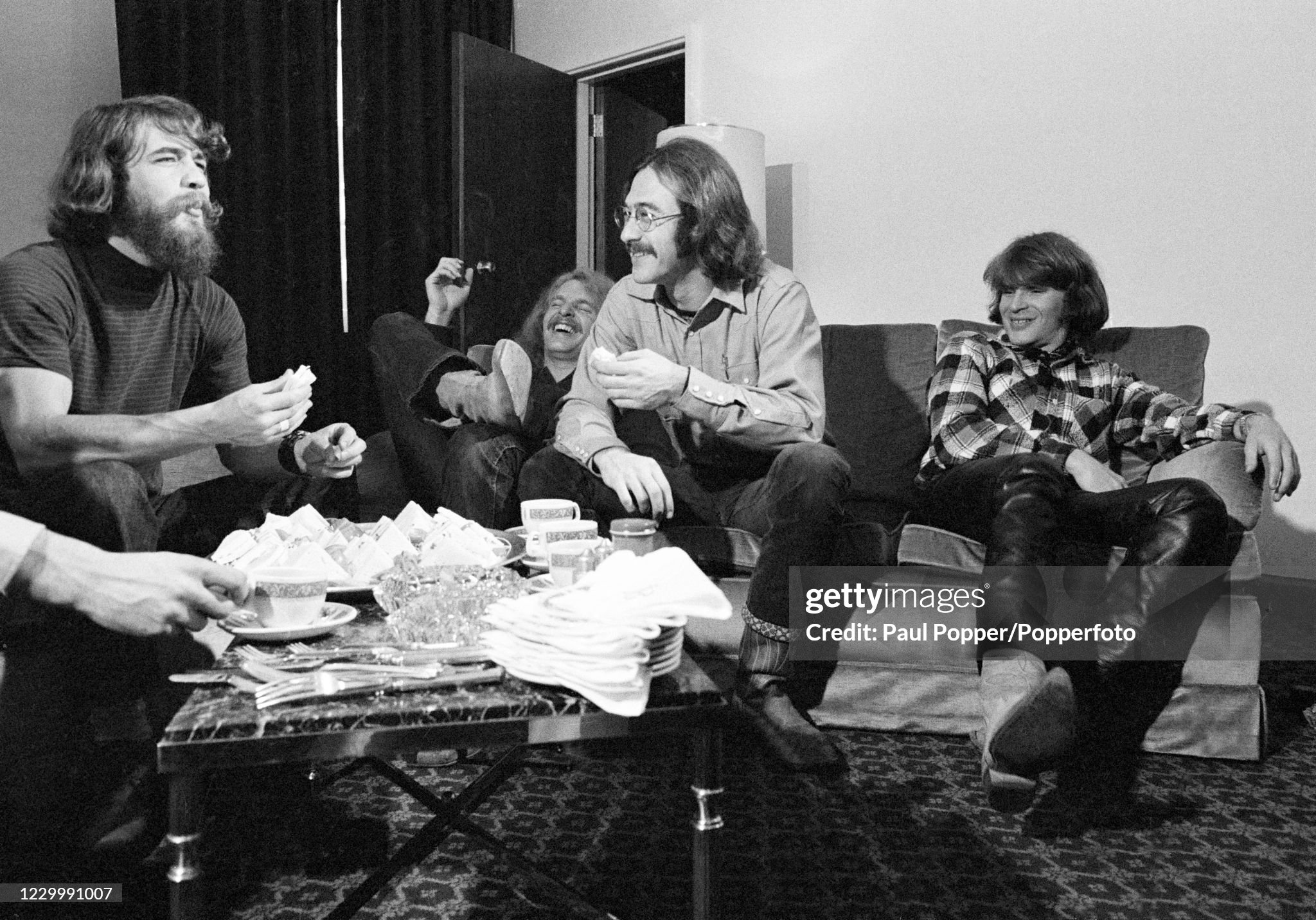
A furious song about class, power, and unfair sacrifice, “Fortunate Son” became even more dangerous when Creedence Clearwater Revival took it onstage in 1970.
Some songs were born for radio, polished just enough to slip into the bloodstream of the country. “Fortunate Son” was never one of them. From the first crack of the guitar, it sounded like a challenge. Released by Creedence Clearwater Revival in September 1969 and later included on the album Willy and the Poor Boys, the song rose to No. 3 on the Billboard Hot 100 as part of the celebrated “Down on the Corner” / “Fortunate Son” single. The album itself also reached No. 3 on the Billboard 200. Those are major chart facts, but they tell only part of the story. In 1970, when the band played the song live, it no longer felt merely like a hit record. It felt like a public reckoning set to a backbeat.
That is what makes the 1970 live performances of “Fortunate Son” so unforgettable. John Fogerty did not sing it like a man revisiting a recent success. He sang it as if the words were still hot in his throat. Onstage, the song got leaner, sharper, and more impatient. The studio version already moved with urgency, but the live 1970 approach stripped away any remaining distance between message and impact. It hit fast, stayed angry, and left no room for comfort. In an era when some bands stretched songs into long improvisations, CCR did something far more effective: they attacked the song and got out, leaving the crowd with the full force of its meaning.
The meaning, of course, was never hard to miss. “Fortunate Son” is one of the clearest protest songs ever written about privilege in America. It was not a complaint about ordinary young men sent into conflict. Quite the opposite. John Fogerty wrote it in fury at a system where wealth, family name, and political connection could protect some people while others carried the burden. He later pointed to the marriage of David Eisenhower, grandson of President Dwight D. Eisenhower, and Julie Nixon, daughter of President Richard Nixon, as part of the emotional spark behind the song. To Fogerty, it symbolized a world of inherited advantage, a class of people wrapped in patriotism but untouched by the cost paid elsewhere. That is why the opening line still lands like a slap: some people are born to wave the flag, while others are the ones expected to bleed, serve, or disappear into the machinery of history.
By 1970, that message had only grown heavier. America was exhausted, divided, and suspicious of every official promise. In that atmosphere, a live performance of “Fortunate Son” did not feel like commentary from a distance. It felt immediate. It sounded like the mood of the country compressed into two and a half minutes. The live arrangement from that period showed exactly why Creedence Clearwater Revival became such a formidable band. Doug Clifford drove the song with a hard, almost martial pulse. Stu Cook anchored the low end with a thick, insistent bass line. Tom Fogerty locked the rhythm into place, while John Fogerty hurled the vocal over the top like a warning siren. Nothing was wasted. Nothing was softened. The power came from discipline, not decoration.
There is also something deeply American about the way CCR played the song live in 1970. They were not a psychedelic mystery, and they were not interested in turning protest into abstraction. Their language was plain, their groove was rooted in rock, swamp rhythm, and old-fashioned urgency, and their attack was so direct that it almost felt documentary. You can hear why audiences responded so strongly. The song did not lecture. It exposed. It did not ask for sympathy. It demanded honesty.
That may be why “Fortunate Son” has never really aged into a museum piece. Many songs tied to a historical moment remain trapped there, important but remote. This one never did. Every time it returns, it sounds current again, because its subject is not limited to one war or one decade. It is about the old, bitter divide between those who make the rules and those who live under them. Heard live in 1970, that truth becomes even starker. The crowd energy, the speed, the edge in Fogerty’s voice, all of it reminds us that the song was not built for nostalgia. It was built for confrontation.
And yet nostalgia has a way of gathering around it anyway, not because the song is gentle, but because it captures a time when rock music could still be brutally plainspoken and wildly popular at the same moment. Creedence Clearwater Revival stood at a rare crossroads: critically respected, commercially huge, and completely unpretentious. They could fill the charts and still sound like they belonged to the factory floor, the roadside bar, the car radio, and the restless national conscience all at once. In live 1970 form, “Fortunate Son” reveals that balance perfectly. It is the sound of a hit record refusing to behave like one.
For listeners returning to it now, the live performance carries an extra weight. We hear not only the outrage of its own time, but the memory of a band at full strength, delivering a song that said exactly what it meant and never blinked. Some records entertain. Some records endure. And then there are songs like “Fortunate Son”, especially as CCR played it live in 1970, that seem to keep asking the same hard question across the decades: who pays the price, and who gets to walk away untouched?
