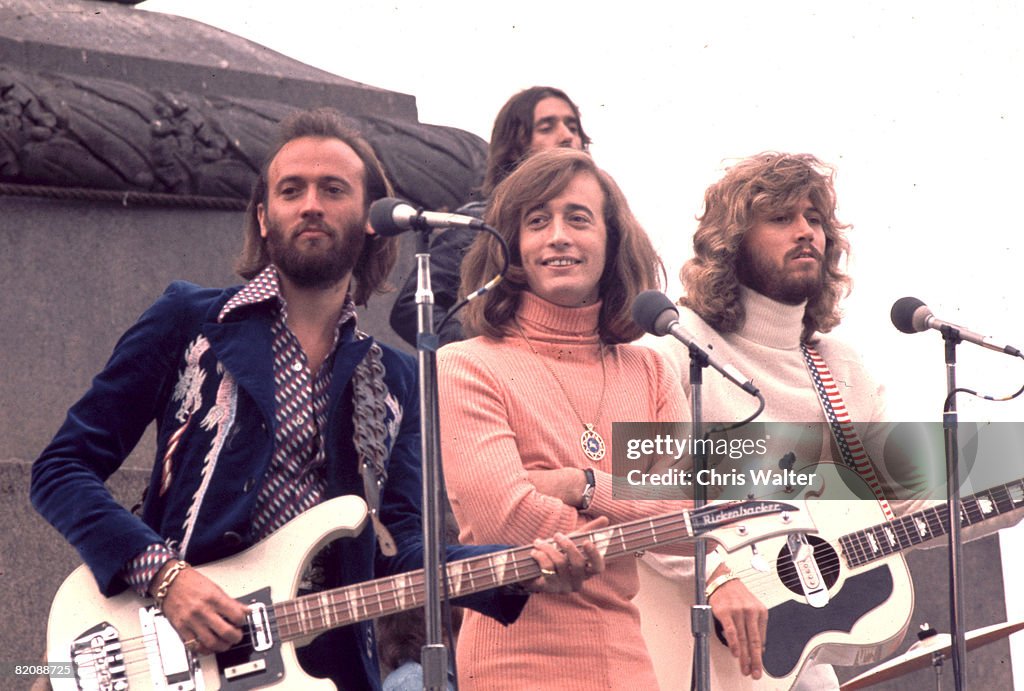
On Nothing Could Be Good, the Bee Gees turned down the glare of the disco years and let Barry Gibb’s voice move into a more intimate early-1980s shadow.
Nothing Could Be Good appears on the Bee Gees album Living Eyes, released in 1981, at a moment when Barry, Robin, and Maurice Gibb were navigating one of the strangest turns of their career. Only a few years earlier, their voices had seemed to define the sound of the late 1970s: sleek, high, rhythmic, and everywhere. By the time Living Eyes arrived, the cultural weather had changed. The group was no longer simply riding the crest of pop dominance. They were working inside the afterglow, where fame can become quieter, more complicated, and sometimes more revealing.
That is part of what makes Nothing Could Be Good so intriguing. It is not the album’s loudest statement, nor the song most often used to summarize the period. It sits deeper in the record, away from the immediate charge of a single such as He’s a Liar, and it asks for a different kind of listening. The song moves like a sensual ballad built on restraint rather than spectacle. Its atmosphere belongs to the early 1980s: polished, controlled, carefully lit by studio detail, but still carrying the melodic ache that had always separated the Gibbs from ordinary pop craftsmanship.
Living Eyes was produced by the Bee Gees with longtime collaborators Albhy Galuten and Karl Richardson, figures closely associated with the group’s late-1970s studio language. Yet this album does not simply repeat the formula that had made the brothers globally dominant. The surfaces are cleaner, the pulse is less fevered, and the emotional temperature often feels more inward. In that setting, Barry Gibb sounds as if he is experimenting with what remains after the grand public sound has been pulled back. His falsetto had become instantly recognizable, almost a signature bright enough to eclipse the man behind it. On Nothing Could Be Good, the interest lies in how that voice softens, bends, and searches for a more adult form of romantic tension.
The sensuality of the track is not aggressive. It is carried in the smoothness of the phrasing, in the way the vocal line seems to hover close to the listener rather than project outward toward an arena. Barry’s delivery suggests a singer less interested in dazzling than in persuading. There is still elegance in the upper register, but the emotional center feels more shaded. Instead of the ecstatic lift associated with the Bee Gees’ disco-era hits, the song leans toward a late-night language of hesitation, desire, and carefully measured vulnerability.
This matters because Nothing Could Be Good catches Barry Gibb in transition. The early 1980s would find him writing, producing, and shaping music in ways that extended far beyond the Bee Gees’ own albums. His voice, too, was entering a new phase. The high, silvery intensity was still part of his identity, but it was beginning to coexist with a smoother adult-pop sensibility, one better suited to slower tempos, luxurious arrangements, and romantic songs that depended on mood as much as hook. Listening to this track now, the change feels less like a break than a gradual turning of the wrist.
The Bee Gees were always more complex than the narrowest version of their public image allowed. Before the dance-floor era, they had already been masters of baroque pop, melancholy ballads, close harmony, and songs that made emotional uncertainty sound almost weightless. After the height of their disco success, they did not lose that gift; they had to find new rooms for it. Living Eyes can be heard as one of those rooms, a record where the brothers tried to step out from under an overwhelming cultural association and return to the subtler business of songcraft.
In Nothing Could Be Good, the arrangement does not crowd the vocal. It frames it. The song’s power comes from proportion: enough softness to feel intimate, enough polish to feel deliberate, enough melodic longing to remind listeners that the Bee Gees’ real engine was never only rhythm or style. It was the ability to make a phrase feel suspended between confidence and doubt. Barry’s voice here does not ask to be celebrated as a familiar trademark. It asks to be followed, quietly, through a change in light.
That is why this album cut deserves more attention than it often receives. It belongs to a period frequently discussed in terms of backlash, commercial pressure, or the difficult aftermath of enormous success. But inside that larger story are individual songs where the brothers were still refining their language. Nothing Could Be Good is one of those small, telling moments: a ballad that reveals how sensuality can be expressed through control, how a famous voice can become more interesting when it stops trying to prove itself, and how the Bee Gees, even in a complicated chapter, continued to leave traces of emotional precision in the corners of their records.
Heard today, the song feels like a private doorway into Living Eyes. It does not shout for historical importance. It simply lets the listener hear Barry Gibb adjusting his instrument to a new decade, trading some of the old brightness for a closer, warmer form of confession. The result is not just another romantic track from the Bee Gees catalog. It is a quiet signal from an artist and a group learning how to sound different without losing the melodic pulse that had always made them unmistakable.
