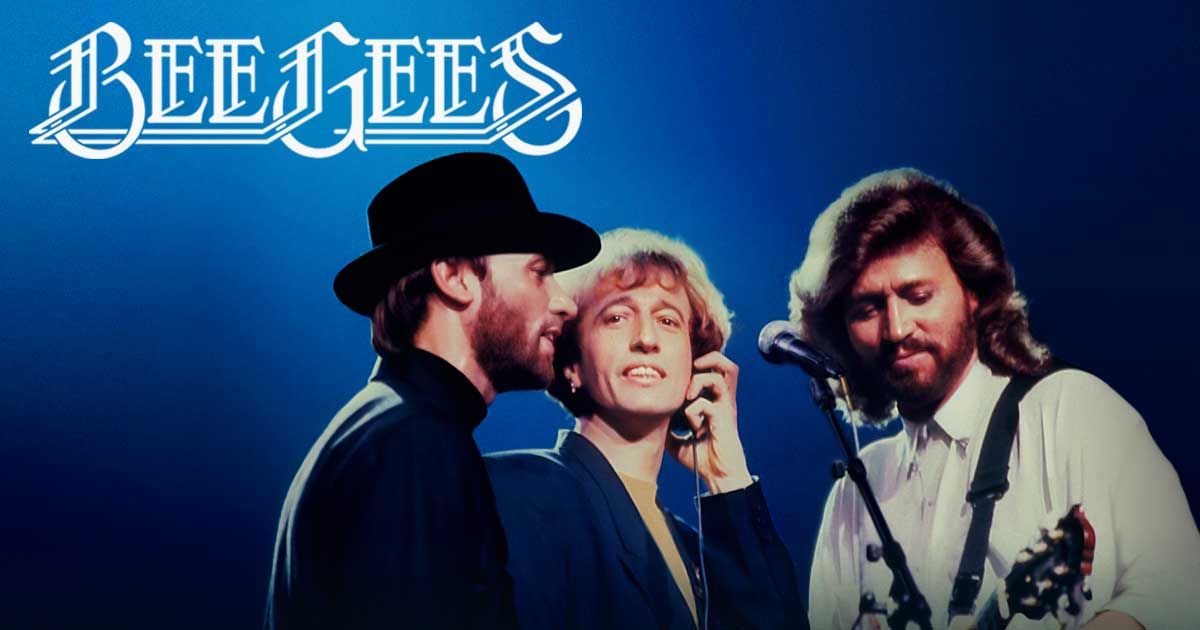
On When He’s Gone, the Bee Gees did not return by looking backward. In 1991, they carried their harmony instinct into a harder, shinier decade and made reinvention sound calm, deliberate, and real.
Released in 1991 as a single from High Civilization, “When He’s Gone” arrived at an important point in the long story of the Bee Gees. By then, Barry Gibb, Robin Gibb, and Maurice Gibb had already lived through several public versions of themselves: bright 1960s melodists, emotionally intricate 1970s balladeers, and then the most recognizable voices of disco-era pop. What made this period so interesting was that they were no longer simply living off that history. High Civilization was part of a new chapter, a comeback-era statement that asked a difficult question with unusual confidence: could the Bee Gees still sound unmistakably like the Bee Gees while stepping fully into the production language of the early 1990s?
“When He’s Gone” is one of the clearest answers they gave. The song holds onto what always made them distinct: close, intelligent harmony singing, emotional precision, and a gift for melodies that seem to gather force while remaining elegant. But wrapped around those familiar strengths is a production style that belongs very much to its time. The track leans into programmed rhythm, bright synthesizer textures, and the heavy electronic pulse that defined a great deal of early-1990s adult pop and dance crossover. The effect is not soft nostalgia dressed in modern clothes. It is more daring than that. The brothers sound as if they are testing their own musical identity against a tougher, more machine-driven frame.
That tension is what gives the recording its particular charge. The Bee Gees had always been masters of atmosphere, but here the atmosphere is less candlelight than chrome. The beat has a forward push, the surfaces are polished, and the arrangement leaves little doubt that the group understood where pop production had moved by 1991. Yet the heart of the performance remains deeply human. Their voices do not sit on top of the track like a relic from another era. They move through it, braid through it, and soften its edges without weakening its momentum. That balance matters. Many veteran acts of the period either resisted contemporary sound or surrendered too much to it. “When He’s Gone” feels more thoughtful than either of those choices.
It also helps to hear the song in the wider context of High Civilization. The album came after One in 1989, another project that had helped restore momentum and remind listeners that the brothers were still serious recording artists, not only a catalogue of past triumphs. High Civilization pushed even further into the production palette of the day. For some listeners, that made the album sound sleek almost to the point of severity. For others, it revealed how adaptable the Bee Gees really were. In that setting, “When He’s Gone” stands out not because it rejects the album’s glossy electronic design, but because it absorbs that design and still leaves room for vulnerability, phrasing, and musical intelligence.
There is something quietly impressive about the confidence of the performance. The song does not beg to be heard as a comeback. It does not wave at the past, and it does not over-explain its modernity. Instead, it simply assumes that the Bee Gees belong in the present tense. That may be one reason the track still feels so revealing. A lot of reunion or return-era records carry a trace of anxiety, as if the artist is asking permission to be relevant again. “When He’s Gone” does not ask. It enters with assurance, letting the brothers’ songwriting and vocal architecture do the real persuasive work.
And that vocal architecture remains the emotional center. The Bee Gees were never just recognizable because of falsetto or harmony in the abstract. Their strength was how they could make layered voices feel conversational, almost intimate, even inside large-scale pop arrangements. On this song, that gift survives the digital gloss. The harmonies do not merely decorate the chorus; they create the emotional weather of the record. Against the firmer electronic backdrop, every shift in tone feels more exposed. Warmth meets circuitry. Memory meets movement. Their voices make the production feel less cold, while the production keeps the song from drifting into self-imitation.
That is why “When He’s Gone” deserves attention beyond simple catalogue completion. It captures a mature group refusing the easiest narrative available to them. The easiest path would have been to remake an older sound and trust affection to do the rest. Instead, the Bee Gees allowed their songwriting to stand inside a new environment, with all the risk that implied. Not every listener wanted their harmonies surrounded by early-1990s electronic sheen, but that discomfort is part of what makes the record interesting. It is the sound of artists choosing motion over preservation.
Heard now, the single feels like a document of self-belief. Not loud self-belief, not theatrical self-belief, but the calmer kind that comes from musicians who know exactly what their signature is and are willing to place it in unfamiliar light. “When He’s Gone” may not be the first song named when casual listeners summarize the Bee Gees, yet it says something essential about their durability. In the High Civilization era, they were not trying to become who they used to be. They were trying to prove that their voices, their writing, and their instinct for emotional melody could survive contact with a different decade. On this song, they did more than survive. They sounded present, alert, and very much alive inside the future they had chosen to enter.
