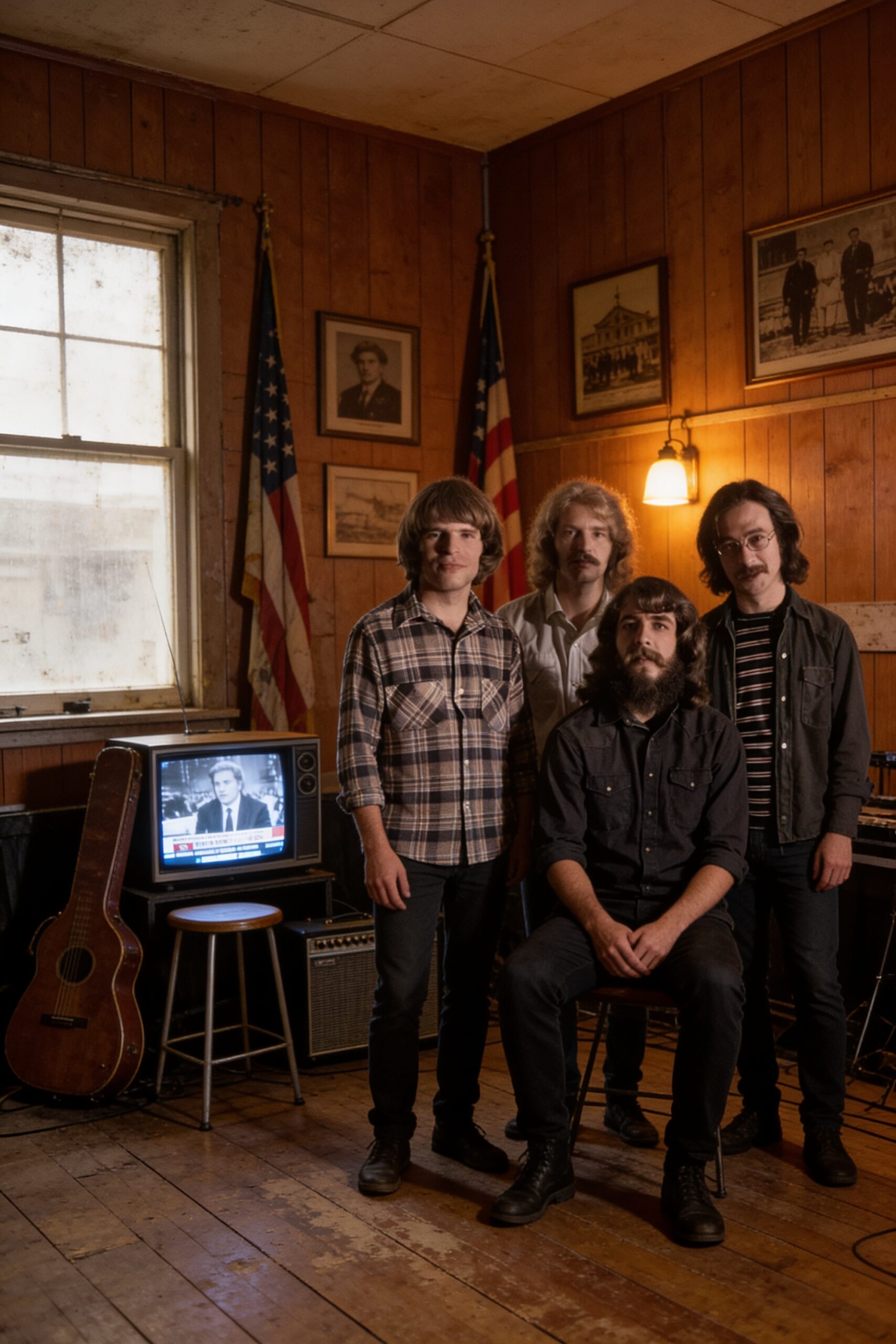
On Cosmo’s Factory, Creedence Clearwater Revival turned an Arthur Crudup blues lament into a hard-driving reminder that rock and roll never outran its roots.
When Creedence Clearwater Revival included My Baby Left Me on their 1970 album Cosmo’s Factory, they were not simply filling out a record with an old favorite. They were placing a signpost in the middle of one of rock’s most fertile albums, pointing back toward the blues and early rock and roll sources that had fed their sound from the beginning. Released by Fantasy Records in July 1970, Cosmo’s Factory arrived during the band’s remarkable peak, surrounded by songs such as Travelin’ Band, Run Through the Jungle, Who’ll Stop the Rain, Up Around the Bend, and Lookin’ Out My Back Door. In that company, the Crudup cover did not feel like an antique. It sounded like a machine already in motion.
The song’s roots reach back to Arthur “Big Boy” Crudup, the Mississippi-born blues singer and guitarist whose work became one of the foundations of early rock and roll. Crudup recorded My Baby Left Me in 1950, building it from the blunt language of abandonment and the rolling force of blues rhythm. His name would later be tied forever to That’s All Right, the song Elvis Presley cut at Sun Records in 1954, but My Baby Left Me also traveled through Presley’s world; Elvis recorded his version in 1956 for RCA. By the time Creedence took it on, the song had already moved from country blues into rockabilly and electric rock memory. CCR were hearing not only a blues number, but a lineage.
That is what gives their version its special charge. John Fogerty does not sing it as if he is trying to imitate Crudup, and the band does not treat the original like a museum piece. Instead, they bring it into the tight, urgent language of Creedence: lean guitar, driving rhythm, no wasted decoration, and a vocal that seems to snap against the beat. Tom Fogerty, Stu Cook, and Doug Clifford keep the track moving with the disciplined force that made CCR sound larger than four men in a room. The performance is fast, compact, and physical, but underneath the push is the same old wound: someone is gone, and the singer is left with motion because stillness would say too much.
Cosmo’s Factory was named after the band’s rehearsal space, a place drummer Doug Clifford jokingly associated with the relentless labor of practice. That nickname matters because the album feels built by work as much as inspiration. Creedence were often described in swampy Southern terms, yet they came out of Northern California, shaping a musical imagination from blues, country, R&B, rockabilly, and the radio echoes of an America they understood more through sound than geography. Their covers on Cosmo’s Factory were part of that self-portrait. Alongside their take on Before You Accuse Me, Ooby Dooby, and the extended reworking of I Heard It Through the Grapevine, My Baby Left Me showed how openly the band carried its sources into the present.
What makes the Creedence version so durable is the way it changes the emotional temperature without betraying the song. Crudup’s blues has a looseness, a conversational ache, the feeling of a man telling the truth because there is no other choice. Presley’s version helped push that feeling into the nervous brightness of 1950s rock and roll. Creedence made it heavier and more earthbound. Their My Baby Left Me is not a polished tribute; it is a working band’s response to an old form that still had fuel in it. The words are simple, almost painfully plain, but the arrangement refuses to sit quietly with sorrow. It runs. It kicks. It makes loss sound like something the body is trying to outrun.
That was one of CCR’s great gifts. They could take familiar American materials and make them feel immediate without smoothing away their rough edges. Fogerty’s voice, with its clenched bite and country-blues grit, had a way of sounding both old-fashioned and urgent. On My Baby Left Me, he does not overexplain the hurt. He delivers it as a fact, then lets the band carry the pressure. The result is not delicate, but it is emotionally precise. Sometimes a song about being left does not need to whisper. Sometimes it needs an engine.
The cover also asks listeners to remember the names behind rock’s common language. Arthur Crudup’s songs became part of the vocabulary that younger performers used to build new eras of popular music. His influence was enormous even when his public recognition lagged far behind the reach of his music. Creedence’s version, heard inside one of 1970’s defining rock albums, keeps that connection audible. It reminds us that the rush of rock and roll was never created from thin air. It came from older voices, older rhythms, older rooms, and artists whose songs kept moving long after the industry had moved around them.
So Creedence Clearwater Revival’s My Baby Left Me on Cosmo’s Factory is more than a sharp, hard-driving album cut. It is a crossroads in under three minutes: Crudup’s blues, Presley’s early rock, and CCR’s swamp-rock attack all meeting in one stripped-down performance. The song does not ask for reverence. It earns it by staying alive, by changing shape without losing its center. Decades later, the cover still feels like Creedence understood something essential: the past was not behind them. It was plugged in, turned up, and keeping time.
