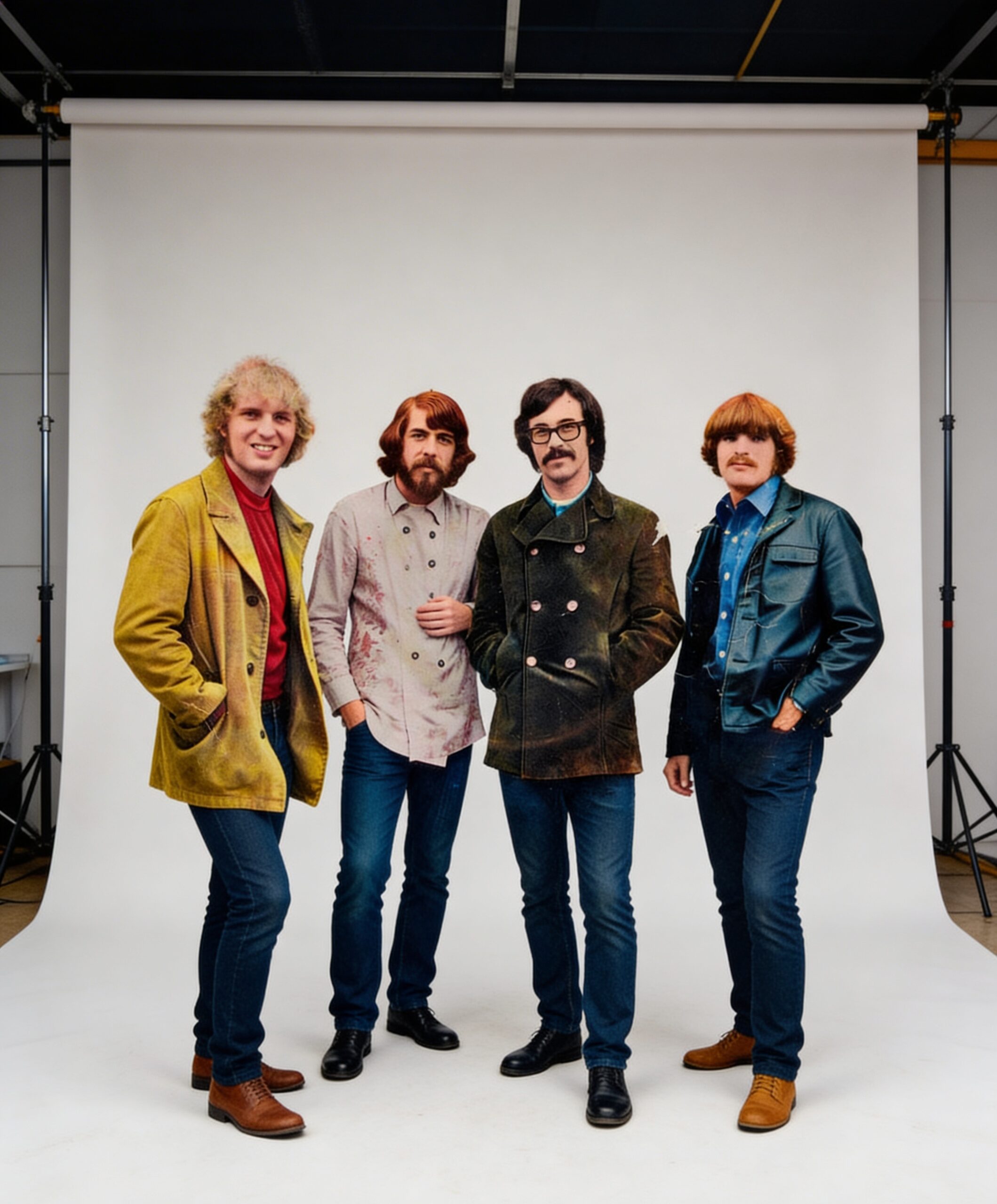
With a country lilt and a hard question, Creedence Clearwater Revival turned ordinary labor into an American reckoning.
On the 1969 album Willy and the Poor Boys, Creedence Clearwater Revival placed “Don’t Look Now (It Ain’t You or Me)” among songs that treated American life not as scenery but as evidence. Written by John Fogerty, the track is brief, direct, and deceptively easy on the ear. It does not arrive with the force of a speech. It moves like a country tune heard through a workday rhythm: plain, compact, and suspicious of ornament.
Willy and the Poor Boys, released in late 1969, was the band’s third album of an unusually productive year, following Bayou Country and Green River. Its most famous political flashpoint is “Fortunate Son”, but “Don’t Look Now (It Ain’t You or Me)” works by another pressure. Where “Fortunate Son” names privilege with clenched clarity, this song studies the quieter habit of letting someone else carry the load.
The arrangement is part of the argument. The song’s country-flavored gait does not soften the lyric so much as make it sound familiar. Creedence often found power in simple structures, and here the economy matters: a steady beat, dry guitar figures, a vocal that refuses theatrical outrage. Fogerty sings as if the facts do not need decoration. The music has the shape of a porch song or a road song, but the lyric keeps turning the view toward mines, fields, material labor, and the people whose effort becomes someone else’s comfort.
The title phrase is not only a punch line. It is a mirror. “Don’t Look Now (It Ain’t You or Me)” asks who will do the exhausting, necessary work, then answers with a shrug that feels too casual to be innocent. That is where the song gathers its force. It does not place the listener safely outside the problem. It suggests a society skilled at admiring labor in the abstract while arranging for distance from the laborer. The “you or me” lands because it includes ordinary people in the evasion, not just distant elites.
That restraint makes the song one of the album’s sharpest pieces of working-class commentary. Creedence were not writing from inside a polished folk-protest tradition here; they were using the vocabulary of American roots music to reveal an American contradiction. The country feel carries associations of rural life, usefulness, endurance, and common speech. But instead of turning those associations into comfort, the band lets them expose a moral gap: the gap between the work a country celebrates and the workers it prefers not to see.
In 1969, that kind of plainness had its own edge. American popular music was full of expanded forms, studio experiments, psychedelic color, and political urgency. Creedence could be just as urgent, but their method was often compression. They made songs that sounded older than the moment and yet spoke directly to it. On Willy and the Poor Boys, that quality becomes central. The album draws on blues, country, gospel echoes, folk material, and rock and roll directness, but it is not merely collecting styles. It is testing what those styles can still say about power, work, class, and responsibility.
“Don’t Look Now (It Ain’t You or Me)” remains striking because it does not flatter the listener. Many protest songs clarify an enemy; this one notices a habit. Its accusation is less dramatic and therefore harder to dismiss. The song hears how easily people benefit from systems they do not inspect, how quickly necessity becomes invisible when someone else performs it. Fogerty’s vocal stays close to the ground, and the band’s performance leaves no grand exit. The track ends without solving the question it raises, which is part of its honesty.
That is the enduring strength of the recording: not volume, not length, not a grand declaration, but a small song built around a large refusal to look away. Creedence Clearwater Revival made the American songbook feel rough, useful, and alive by trusting direct language and disciplined sound. In this track, the country flavor is not decoration; it is the road the truth travels on. The song still matters because it understands that a nation can sing about work while avoiding the hands that make its life possible.
