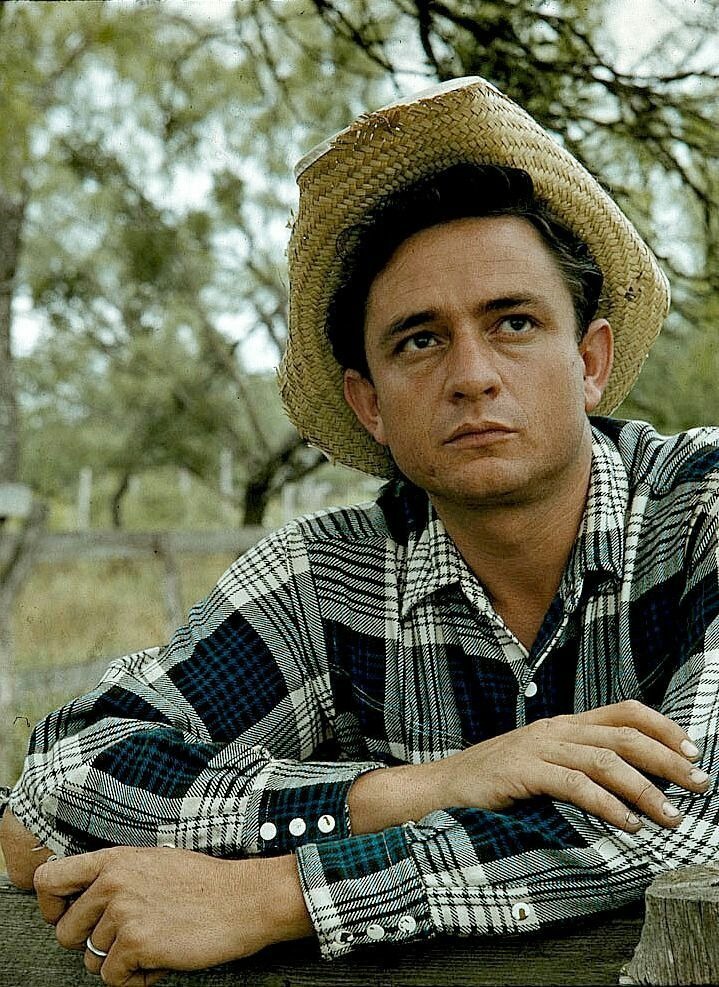
At Folsom State Prison, a familiar outlaw song became a live exchange between discipline, danger, and empathy.
On January 13, 1968, Johnny Cash recorded the live version of Folsom Prison Blues at Folsom State Prison in California that would open his album At Folsom Prison. The song was not new. Cash had first recorded it for Sun Records in 1955, and its train rhythm and hard-edged confession were already part of his identity. But the 1968 prison performance changed the frame. In that room, before an audience of incarcerated men, the song stopped feeling like a distant character sketch and became a charged conversation with the people closest to its setting.
The performance begins with the phrase that became nearly inseparable from Cash himself: ‘Hello, I’m Johnny Cash.’ It is plain, almost formal, and then the band moves immediately into the churning pulse of the song. There is no elaborate introduction, no attempt to decorate the moment. The clipped guitar figure, the snapping beat, and Cash’s low baritone create a kind of forward motion that feels both musical and physical, like steel wheels moving through a narrow corridor. The energy is not wild because the musicians lose control; it is powerful because they never do.
That restraint matters. Folsom Prison Blues is sung from the viewpoint of a man who hears a train beyond the walls and understands freedom through its sound. The lyric includes one of Cash’s most severe lines, a sentence of violence delivered without theatrical flourish. In the prison recording, the audience response around that moment has become part of the myth of the album; accounts of the record’s editing have noted that crowd sound on the released LP was shaped after the fact. Even with that caution, the performance still carries a real live tension: the singer, the song, and the institution surrounding the room press against one another.
Cash’s achievement is that he does not treat the setting as a costume. He had been interested in prison audiences for years before Folsom, performing for inmates and building part of his public image around songs of guilt, confinement, labor, and judgment. At Folsom, that image met an actual place with rules, guards, schedules, and men living inside consequences. The recording works because Cash keeps the line between empathy and performance visible. He is not claiming to be one of them. He is standing in front of them, singing a song that understands the emotional shape of being cut off from the world.
The band behind him makes the empathy unsentimental. Luther Perkins‘ guitar style, spare and percussive, leaves space around the vocal rather than crowding it. Marshall Grant‘s bass and W.S. Holland‘s drums keep the song moving with a steady economy. The arrangement does not ask for pity. It gives the narrator a pace, a pulse, and a wall to push against. Cash’s vocal phrasing is equally disciplined: he lets the words fall squarely, rarely stretching for drama, and that plainness makes the darkness of the lyric feel colder.
When the album was released by Columbia in 1968, it arrived at a point when Cash’s career needed renewed focus. The mid-1960s had tested him personally and commercially, and At Folsom Prison presented him not as a polished variety-show figure but as an artist returning to the elemental force of his own language. The record’s sound was raw by mainstream country standards: announcements, laughter, room noise, hard edges, and abrupt transitions remained part of the experience. It made the prison concert feel less like a novelty and more like a serious musical setting.
This is why the 1968 Folsom Prison Blues continues to feel immediate. Its force is not only in the famous setting or in the outlaw surface of the lyric. It is in the way Cash allows the song to become answerable to the room. A studio recording can place a character in the imagination; this live version places the character’s words in front of listeners who know confinement as fact. That does not make the song documentary, and it does not make the narrator admirable. It makes the performance morally sharper.
There is also a larger artistic lesson in the choice. Cash did not soften the song for the institution, and he did not exaggerate it into rebellion for applause. He trusted a simple arrangement, a severe lyric, and the difficult honesty of location. In doing so, he showed how a performance can gain depth when an artist accepts the pressure of context instead of escaping it. The prison concert energy comes from that pressure: the beat pushing forward, the voice staying level, the audience close enough to change the air.
The lasting power of Johnny Cash‘s 1968 live recording of Folsom Prison Blues is the sound of attention under constraint. It reminds us that courage in music is not always volume or defiance. Sometimes it is the steadiness to enter a difficult room, sing plainly, and let the truth of the setting do some of the singing.
