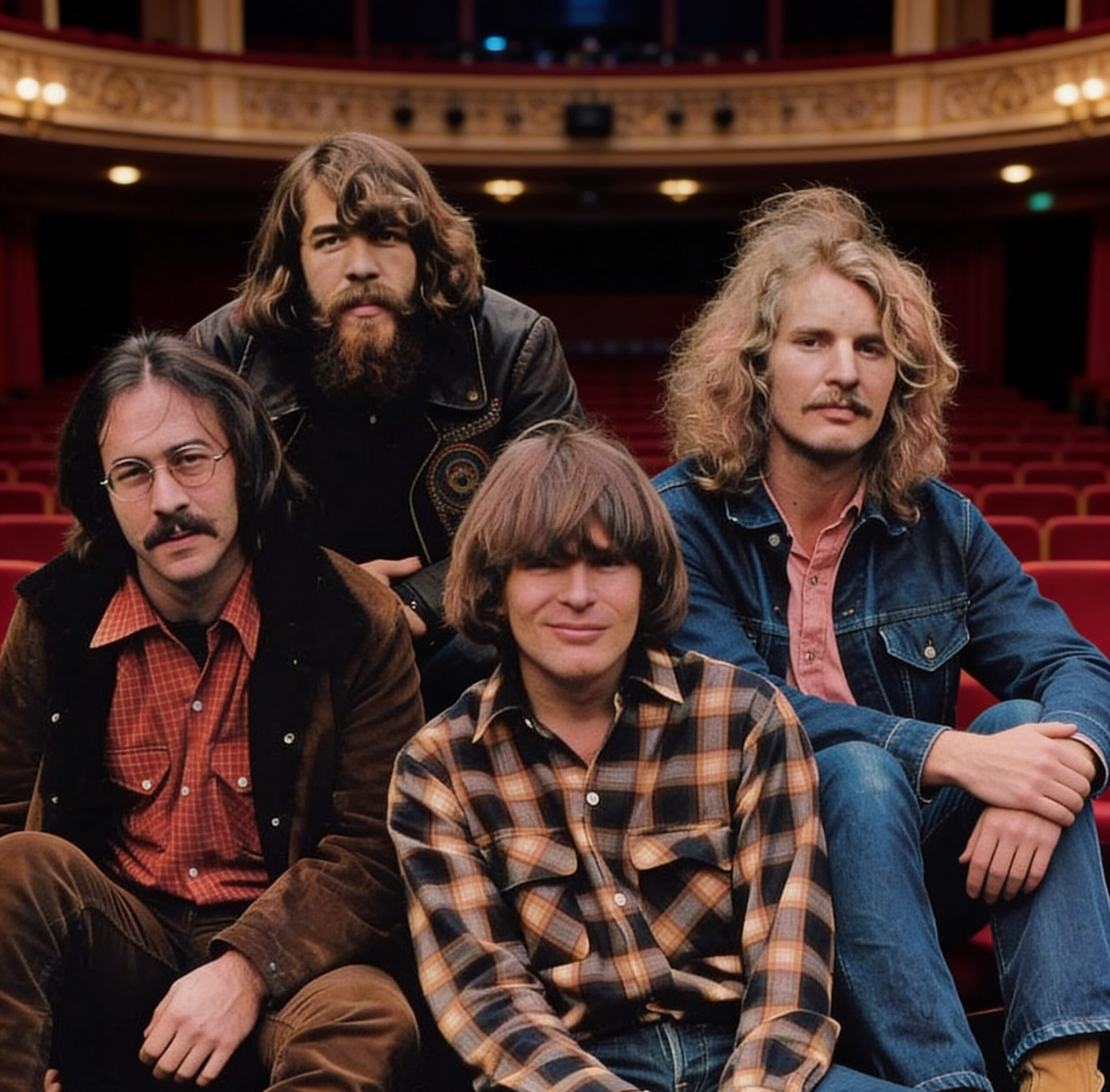
At the end of Pendulum, the band that mastered the direct road chose a stranger room.
Released in late 1970, Creedence Clearwater Revival’s Pendulum closes with Rude Awakening #2, a six-minute instrumental written by John Fogerty and placed where a record usually offers resolution. Instead, the album ends with a detour: not a chorus to remember, not a swamp-rock story, not a compact radio statement, but a studio-built passage that turns familiar Creedence materials toward abstraction. For a band often celebrated for directness, that closing choice still feels revealing.
By the time Pendulum arrived, Creedence Clearwater Revival had become strongly associated with economy. Their best-known recordings rarely wasted motion. The guitars struck cleanly, the rhythm section moved with purpose, and Fogerty’s voice usually carried the song like a weather report from some hard American road. Yet Pendulum broadened that frame. The album made space for keyboards and saxophones, leaned more openly into studio arrangement, and contained no cover songs. It was also the last Creedence album made with Tom Fogerty in the quartet, a fact that gives its exploratory edges an added historical weight without needing to turn them into prophecy.
Rude Awakening #2 begins close enough to recognizable territory that the listener may expect another muscular groove. The rhythm has shape. The parts seem to know where the floor is. There is still the sense of a band built on pocket and repetition, on the pleasure of finding a figure and making it move. But the track does not settle into the usual Creedence bargain, where tension is answered by a refrain or a guitar line is pulled back into the song’s center. Instead, the instrumental keeps widening the room around itself.
That widening is what makes the track so unusual in the group’s catalog. Without lyrics, Fogerty’s songwriting presence is felt less through narrative than through control of form, contrast, and release. The piece gradually drifts away from conventional rock architecture and into a more disorienting space of organ color, rhythmic fragments, and studio texture. It is not experimental in the grand theatrical sense; it does not announce itself as a manifesto. Its strangeness is more effective because it arrives from within a band whose identity had been built on forceful clarity.
The title helps frame the experience. Rude Awakening #2 suggests interruption, a jolt after assumption, a break in the surface of routine. As a closing track, it works almost like an alarm set inside the album. Earlier on Pendulum, songs such as Have You Ever Seen the Rain? and Hey Tonight use recognizable structures to carry feeling forward. The final instrumental refuses that kind of easy closure. It leaves the listener not with an answer, but with the sensation that the studio itself has become unstable ground.
That matters because Creedence’s power was often mistaken for simplicity. The band’s records could sound plainspoken, but plainspoken is not the same as simple. Their strongest work depends on strict decisions: what to leave out, when to repeat, how hard to lean on a rhythm, how little ornament a song truly needs. On Rude Awakening #2, the same discipline is pointed in a less familiar direction. The track does not abandon structure so much as test how far the band can stretch atmosphere before the familiar outline disappears.
Heard in the context of late 1970, the instrumental also belongs to a period when many rock artists were treating the studio less as a document of performance and more as an instrument in itself. Creedence were never primarily known as a studio-experiment band, and that is precisely why this ending stands out. The track does not make them into a different group. It catches them at the edge of their own method, using texture and uncertainty to disturb the confidence people expected from them.
There is a quiet courage in letting an album end that way. A band with Creedence’s momentum could have closed Pendulum with another sharpened hook, another declarative riff, another clean exit. Instead, they left behind a piece that still resists easy affection. It is not the first recording a casual listener reaches for, and it was never meant to compete with the band’s most enduring singles. Its value lies elsewhere: in showing that even a group famous for compression and drive could find meaning in looseness, shadow, and unresolved motion.
Today, Rude Awakening #2 sounds less like an oddity than a doorway. It reminds us that artistic identity is not only built by what an artist repeats, but by the moments when that repetition is interrupted. At the close of Pendulum, Creedence Clearwater Revival did not offer a neat goodbye or a familiar road home. They allowed the groove to fray, the room to tilt, and the record to end in the open space where certainty gives way to experiment.
