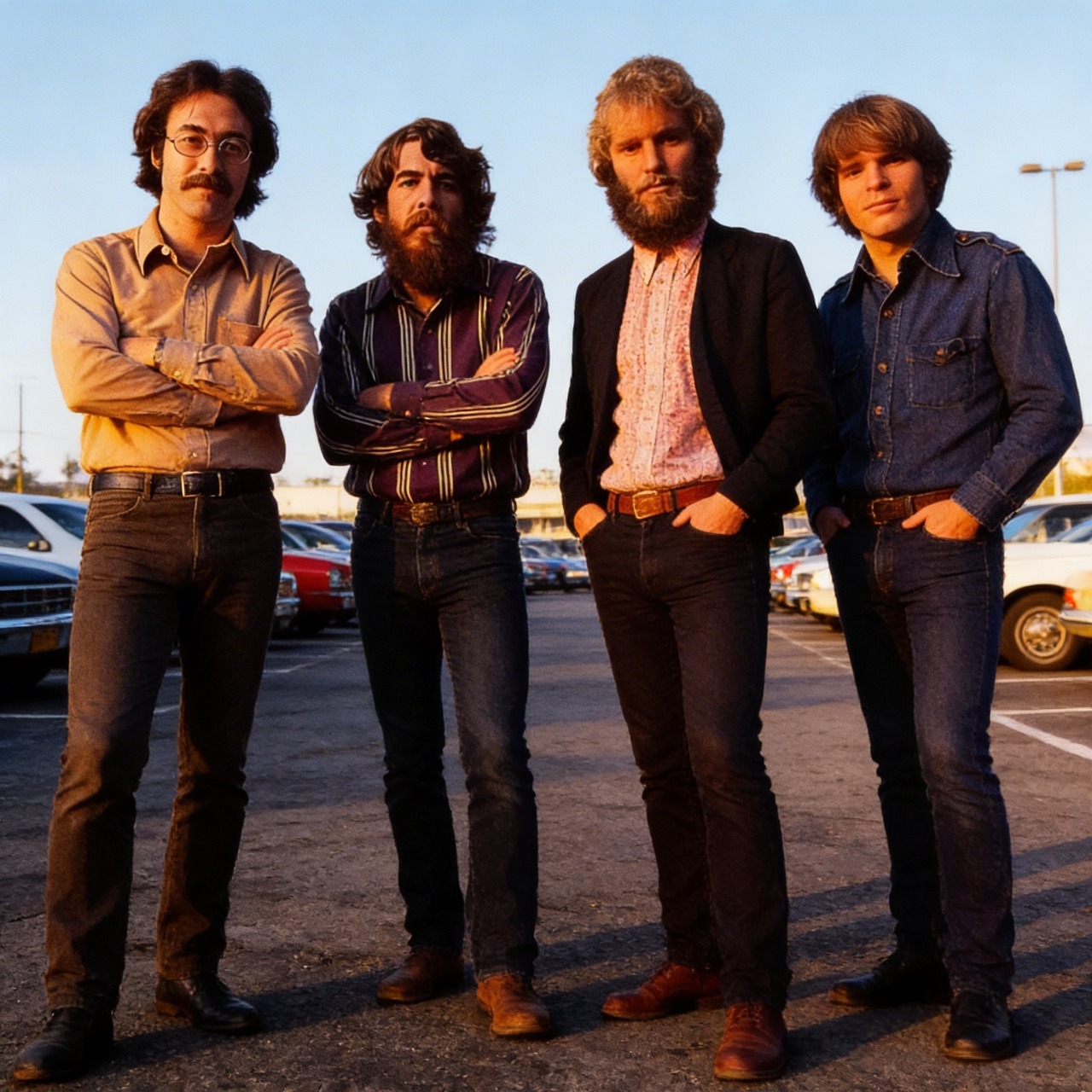
Before the swamp-rock myth had a name, John Fogerty found a hard little hometown story in “Porterville”.
In 1967, during his period of service in the U.S. Army Reserve, John Fogerty wrote “Porterville”, a compact, restless song that marked one of his clearest early breakthroughs as a writer. The recording arrived during the band’s transition out of the Golliwogs name and into Creedence Clearwater Revival, and it later appeared on the group’s 1968 debut album, Creedence Clearwater Revival. That timing matters. “Porterville” does not yet sound like the full public arrival of CCR, but it does sound like Fogerty discovering the kind of voice that would carry the band forward: plainspoken, sharp-edged, rural in imagination, and emotionally direct without asking for sympathy.
The song’s title points to Porterville, a real town in California’s Central Valley, but the place in the song works less like a travel destination than a pressure point. Fogerty was from the Bay Area, not from the Southern backwoods that listeners would later associate with CCR’s sound, and not from the fictionalized emotional terrain that fills this lyric. Yet that is precisely what makes the song important. He was beginning to understand how a named place could become a vessel for feeling. The narrator of “Porterville” carries resentment, family fracture, and the need to get away. The details are not a literal diary, but they are close enough to the bone to feel semi-autobiographical in spirit: a young writer turning private unease into a character who sounds as if he has already packed his bags.
What separates “Porterville” from much of Fogerty’s earlier work is its discipline. The song does not sprawl. It does not decorate its hurt. The arrangement moves with a lean insistence, built around a driving band performance rather than psychedelic haze or pop polish. The guitars have a rough, clipped presence; the rhythm section keeps the song on a narrow road; Fogerty’s voice cuts through with a tone that is more declarative than theatrical. He does not sing the narrator as a victim. He sings him as someone whose bitterness has hardened into motion.
That sense of forward pressure is crucial. “Porterville” is a leaving song, but it is not romantic about escape. Many rock songs of the late 1960s turned departure into liberation, a widening horizon, a bright refusal of old rules. Fogerty’s version is tighter and less idealized. The town behind the narrator is not simply boring; it is bound up with shame, judgment, and family absence. The future is not described in glowing detail. What matters is the refusal to remain fixed in the place that defined him. In that refusal, Fogerty found a language he would return to often: characters caught between memory and motion, pride and damage, home and the road.
The Army Reserve context gives the song another layer without needing to turn it into a military song. Fogerty’s service interrupted the normal fantasy of a young band’s rise. Instead of simply moving through clubs, rehearsals, and label decisions, he was also moving through the discipline and uncertainty of military obligation during the Vietnam era. It would be too much to claim that “Porterville” is directly about that experience. But writing it in that period helps explain the pressure in the song: the feeling of a young man measuring distance, identity, authority, and the cost of being told where one belongs.
By the time Creedence Clearwater Revival released their first album in 1968, the band still contained traces of its earlier identities. The debut record included covers, blues roots, and remnants of the group’s pre-CCR years. “Porterville” stands out because it points ahead. It is not yet the fully formed world of “Born on the Bayou”, “Green River”, or “Fortunate Son”, but the outline is there: a terse story, a strong place-name, a narrator with a grievance, and a band that sounds most powerful when it strips everything down to necessity.
Fogerty’s great early gift was not simply that he could imitate roots music. It was that he could use its directness to invent believable American voices. On “Porterville”, he was learning how to make a song feel older than its recording date without making it vague. The language is simple, but the emotional situation is not. The narrator’s anger may sound blunt at first, yet beneath it sits a more complicated wound: the knowledge that leaving home does not erase the home that made you.
That is why “Porterville” remains more than an early album cut in Fogerty’s story. It captures the moment before a signature became recognizable, when a songwriter was still close enough to uncertainty for the work to carry its raw outline. The song does not ask to be treated as prophecy. It is stronger than that. It shows an artist finding a way to turn displacement into form, to make a small town name ring like a personal reckoning, and to let restraint carry the weight that confession alone could not.
Listening back, the breakthrough is not in grandeur but in focus. John Fogerty did not need a long narrative to announce a new direction. In “Porterville”, he found a road, a voice, and a wound that could keep time. From that spare beginning, the roots of Creedence Clearwater Revival started to show.
