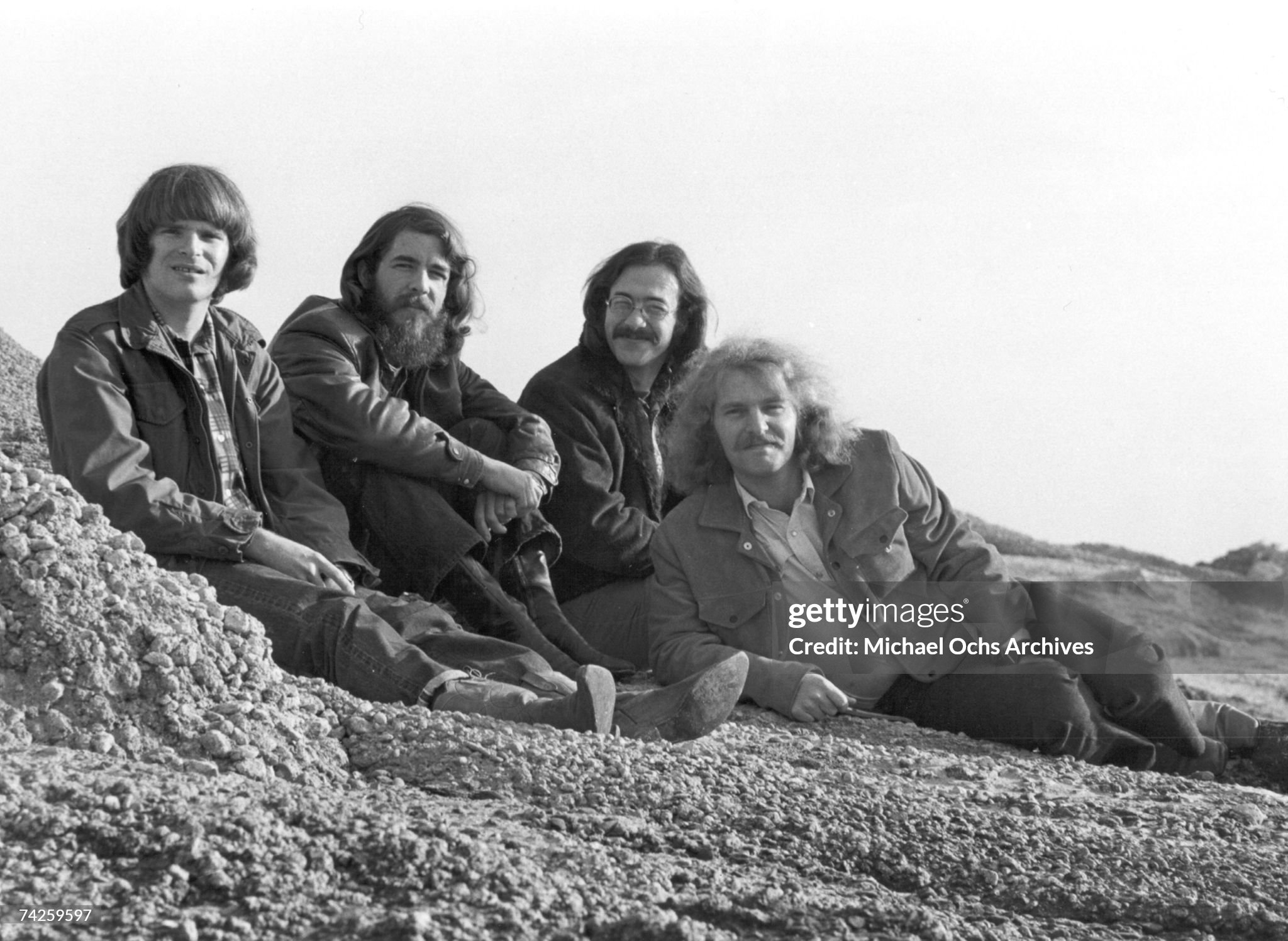
Released as the January 1970 flip side of Travelin’ Band, Who’ll Stop the Rain became something far greater than a B-side: a weary, beautiful reflection that rose to No. 2 and captured the comedown after a turbulent era.
Some songs arrive with a bang. Others arrive like a truth you were not ready to hear. Who’ll Stop the Rain by Creedence Clearwater Revival did both in its own unusual way. Issued in January 1970 as the flip side of the pounding, high-octane Travelin’ Band, it might easily have been treated as the quieter companion on a hit 45. Instead, the single became one of the group’s great chart milestones, climbing to No. 2 on the Billboard Hot 100. That matters, because it reminds us that listeners were not only drawn to noise and momentum. They were listening for something steadier, sadder, and more honest too.
That contrast is part of what still makes the record so striking. Travelin’ Band tears out of the speakers with bar-band urgency, all engine and sweat. Then comes Who’ll Stop the Rain, and the mood changes completely. The tempo relaxes. The guitars breathe. John Fogerty‘s voice does not plead so much as endure. It is the sound of a man standing in bad weather, looking far beyond the storm itself. Heard together, the two sides feel almost like a portrait of America at the turn of the decade: restless on one side, reflective on the other.
And for many listeners, that second side is the one that stayed. Part of the reason is its emotional timing. By early 1970, the optimism of the 1960s had already been tested by political turmoil, cultural exhaustion, and the heavy feeling that idealism had met the real world and come back bruised. Who’ll Stop the Rain seemed to catch that mood without shouting about it. It was not a protest anthem in the blunt sense, yet it carried the emotional residue of a protest era. It asked a question that felt larger than weather: when does the deluge end, and who, if anyone, can stop it?
Fogerty later connected the imagery of rain to Woodstock, the mud-soaked 1969 festival that has long stood as both the high-water mark and the hangover of a generation’s dream. That association makes the song even more powerful. It does not sound like the ecstatic myth of Woodstock that later culture often sold back to us. It sounds like the morning after. The crowds are tired. The field is wet. The banners are drooping. The promise is still there somewhere, but it has been touched by fatigue. That is why so many people hear this record as the comedown after Woodstock, not because it names the event directly, but because it captures the emotional weather left behind.
Musically, the song is deceptively simple, and that simplicity is one of its strengths. Creedence Clearwater Revival had a gift for making records that felt timeless without sounding ornate. There is folk in Who’ll Stop the Rain, but there is also country plainspokenness, a little heartland stoicism, and the unmistakable compact force that made CCR such a singular band. Nothing is wasted. There is no grand production trying to force significance onto the song. The meaning is in the performance itself: the clear melody, the resigned cadence, the sense that the singer has seen enough to know that easy answers are no answers at all.
Its release context matters too. When Who’ll Stop the Rain first appeared, it was not introduced as a separate prestige statement. It came riding shotgun on a 45 dominated, at least on paper, by Travelin’ Band. Yet radio and audiences often decide for themselves what carries the deeper pulse, and here they clearly did. The single’s run to No. 2 proved that this was no forgotten reverse side. It was a central CCR moment, one of those records that slips past format and billing because it meets listeners exactly where they are. Later in 1970, it would also appear on the landmark album Cosmo’s Factory, but its first impact came from that beautiful tension of being the “other side” and refusing to stay there.
Lyrically, the song works because it is open enough to invite personal meaning while still carrying unmistakable historical weight. The rain can be read as political disillusionment, media noise, social unrest, war-era anxiety, or simply the accumulated weariness of modern life. Yet the song never becomes abstract in a cold way. Its language is plain, almost old-fashioned, and that gives it durability. It speaks in images ordinary people understand. You do not need a manifesto to feel what it means. You hear the question, and somewhere in your own memory, you answer it.
There is also something deeply American about the way Who’ll Stop the Rain holds sorrow and resilience in the same breath. It does not collapse under its own melancholy. Instead, it keeps moving, quietly. That may be why the song has lasted so strongly across the decades. So many records from that era are tied to one flashpoint, one fad, one slogan. This one lingers because it is broader and more human. It belongs to 1970, certainly, but it also belongs to any season when the public mood turns heavy and people start looking for language equal to their disappointment.
In the long story of Creedence Clearwater Revival, this single remains one of the clearest examples of the band’s range and instinct. They could shake the walls, and they could also lower the temperature of a room with one thoughtful melody. That Who’ll Stop the Rain reached No. 2 as the flip side of Travelin’ Band is more than a chart fact. It is evidence that audiences recognized something profound in it from the beginning. Beneath the hit status, beneath the radio familiarity, there is still that unmistakable feeling: a song standing in the aftermath, asking a question history has never quite stopped asking.
