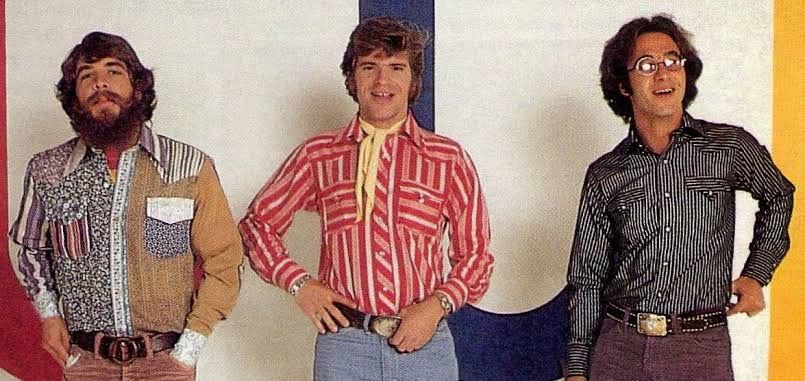
Before Creedence Clearwater Revival had its name, its myth, or its chart breakthrough, The Golliwogs were already inching toward the sound that would change everything. In “Walking on the Water”, John Fogerty was no longer chasing trends—he was quietly inventing the darker American voice that would soon define CCR.
If you want to hear the moment the old skin was starting to fall away, listen closely to The Golliwogs’ “Walking on the Water” from 1968. It was not a hit. It did not make a meaningful national chart impact in the way later Creedence Clearwater Revival records would. But history is not always announced by chart numbers. Sometimes it arrives in the form of a transitional single, a song made in the space between frustration and revelation. That is exactly what this record feels like now: the last doorway before the band stepped fully into the identity that made them immortal.
By the time “Walking on the Water” appeared, the group had already lived several musical lives. They had started as the Blue Velvets, then were renamed The Golliwogs by Fantasy Records during the years when American labels were eager to package bands in a more British-friendly style. It was never a name that truly fit them, and by the late 1960s it fit less than ever. The British Invasion had been a powerful influence, yes, but John Fogerty was beginning to hear something else in his own writing—something leaner, earthier, tougher, and more rooted in American rhythm, blues, country, and back-road unease.
That is why this song matters. “Walking on the Water” still carries traces of garage rock and late-1960s pop structure, but its mood is already different. There is shadow in it. There is space in it. There is that unmistakable Fogerty instinct for a song that sounds simple on the surface yet feels haunted underneath. Even the title has a mythic, almost biblical ring, but the record does not play like a hymn or a piece of flower-power uplift. It moves with tension. It suggests mystery more than comfort. And that instinct—to take American imagery and make it feel half-folklore, half-warning—would become one of the deepest signatures of Creedence.
Just as important is the timing. This was the period when John Fogerty was asserting himself more decisively as the band’s central creative force. His voice was becoming more commanding, his writing more direct, and his arrangement ideas more disciplined. The excesses were being stripped away. What remained was groove, atmosphere, and authority. In that sense, “Walking on the Water” is not merely an old pre-CCR curio; it is a blueprint in motion. You can hear a young band leaving behind costume and expectation, guided by a songwriter who had finally begun to trust what made him different.
There is also a fascinating historical detail that gives the song even more weight: “Walking on the Water” would soon be reborn as “Walk on the Water” on the 1968 self-titled debut album Creedence Clearwater Revival. That alone tells you how strongly the band believed in it. They did not discard the song when they changed names. They carried it forward. They refined it. They treated it as part of the bridge between the old band and the new one. In other words, this was not a dead end. It was a seed.
And what a revealing seed it was. The darker American voice people would later hear so vividly in “Born on the Bayou,” “Bad Moon Rising,” and “Run Through the Jungle” did not arrive out of nowhere. It was already forming here. Not fully, not in final shape, but unmistakably. Fogerty had started building a world of river towns, pressure, weather, work, restlessness, and moral fog—an America imagined through sound as much as story. “Walking on the Water” stands at the edge of that world, looking in.
For listeners returning to these recordings decades later, part of the song’s power lies in hindsight. We know what came next. Under the name Creedence Clearwater Revival, the band would break through later in 1968 with “Suzie Q”, which reached No. 11 on the Billboard Hot 100, and suddenly the national audience could hear what had been brewing. But before the breakthrough, before the swamp-rock legend hardened into history, there was this uncertain, searching, compelling final stretch. That is why The Golliwogs matter. They are not just a footnote before greatness. They are the sound of greatness learning how to speak.
There is something moving about hearing a band just before the world catches up. In “Walking on the Water”, the old name is still there, but the spirit of CCR is already pressing against the walls. You hear ambition, but also frustration. You hear craft, but also hunger. Most of all, you hear John Fogerty discovering that the truest path forward was not to sound more fashionable, but more local, more elemental, more American in the deepest musical sense. That choice changed everything.
So no, this was not a chart giant in 1968. It was something rarer: a threshold record. A song standing in the half-light, with one foot in a fading era and the other in a legend just beginning. And for anyone who wants to understand how Creedence Clearwater Revival really began, not as a marketing story but as a musical awakening, The Golliwogs’ “Walking on the Water” is one of the most revealing records you can hear.
