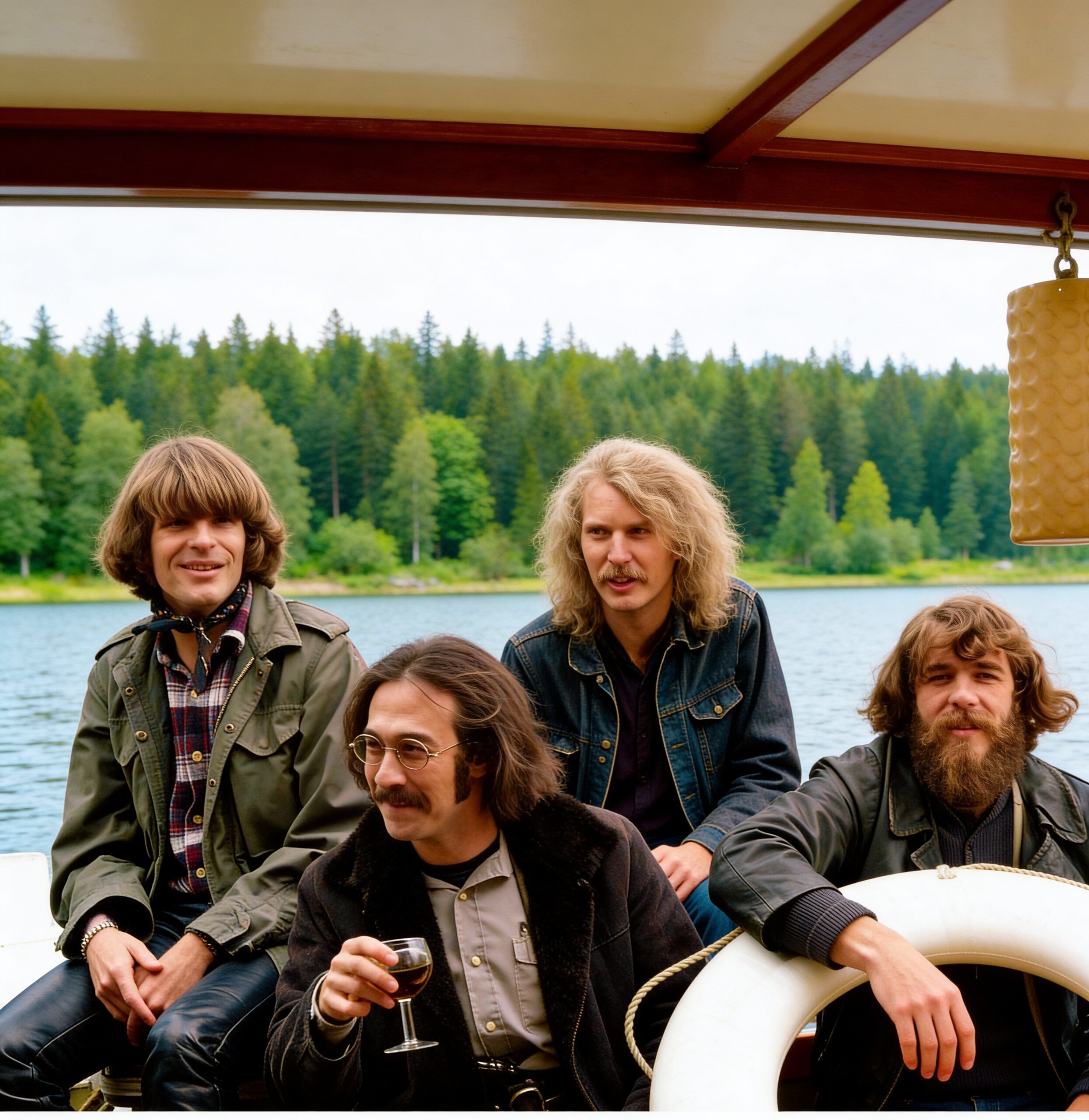
A bright, driving hit with a dark heart, Bad Moon Rising turned eerily prophetic when Creedence Clearwater Revival carried it into the mud, fatigue, and strange electricity of Woodstock 1969.
There are songs that entertain a moment, and there are songs that seem to lean forward and describe it before it has fully happened. Bad Moon Rising belongs to the second kind. Released in April 1969, months before Creedence Clearwater Revival stepped onto the stage at the Woodstock Music & Art Fair, the single became one of the band’s defining triumphs. It climbed to No. 2 on the Billboard Hot 100 in the United States and reached No. 1 in the United Kingdom, where it held that spot for three weeks. It was a compact, irresistible record, built on a rocking rhythm that sounded almost cheerful, yet its message was full of storm warnings, dread, and uneasy prophecy. By the time it echoed across Woodstock in August 1969, those lyrics felt less like pop poetry and more like a headline carried on the wind.
The song was issued ahead of Green River, the album that would arrive later that summer, and it showed just how sharp John Fogerty had become as a songwriter. Few writers of that era were better at hiding darkness inside something instantly singable. On the surface, Bad Moon Rising moves with the easy snap of classic American rock and roll. But listen closely and it is full of warnings: trouble on the way, earthquakes, lightning, ruin in the weather. Fogerty later explained that the song was inspired by a scene from the 1941 film The Devil and Daniel Webster, in which a storm brings destruction. That image stayed with him, and he translated it into a lyric that felt both old-fashioned and timeless, like a folk warning dressed in electric guitar.
That contrast is the secret of the song’s staying power. It smiles while it trembles. It sounds radio-friendly, but it carries genuine foreboding. This was one of the great achievements of Creedence Clearwater Revival: they could make music that felt rooted in the soil of America while also catching the unease of a changing age. In 1969, that mattered. The country was full of noise, argument, hope, and exhaustion. Bad Moon Rising did not preach. It simply looked up at the sky and told the truth as it saw it.
That is what makes the Woodstock performance so fascinating. Creedence Clearwater Revival were not a struggling act fighting to be discovered there. By August 1969, they were already one of the hottest bands in America. Yet their appearance at Woodstock became one of the festival’s most unusual missing chapters. The band took the stage in the early hours of August 17, after long delays and a difficult set by the Grateful Dead. John Fogerty later spoke of a weary audience and a strange, drained atmosphere. He felt the crowd had largely gone quiet or fallen asleep, and he was dissatisfied enough with the performance that the band’s set was left out of the original Woodstock film and soundtrack. For years, that absence gave the performance an almost ghostly status in rock history.
And yet that very setting gives Bad Moon Rising an added power. Woodstock had already become a place of mud, rain, confusion, and endurance. The idealism was real, but so were the physical hardships. In that environment, a song about ominous skies and trouble on the way landed differently. On the studio recording, the warning comes in a brisk, polished form. On stage at Woodstock, it feels rougher, more lived in, as if the song had wandered out of the radio and into the weather. What had sounded catchy in April felt strangely literal by August.
There is also something moving about the tension between the public myth of Woodstock and the private frustration behind this set. We often remember great festivals as endless moments of revelation, but musicians remember the delays, the poor sound, the fatigue, the uncertainty. Creedence Clearwater Revival brought discipline and force to a festival usually remembered for looseness and sprawl. Their music was tighter, leaner, more direct than many of the groups around them. So when Bad Moon Rising appeared in that set, it carried an edge that matched the band’s identity. This was not psychedelic drift. This was a warning bell with a backbeat.
The song’s meaning has only deepened with time. It is not really about one storm, one disaster, or one historical crisis. It is about that human feeling that something is shifting in the air before anyone can fully explain it. That is why the song remains so effective. The melody invites you in; the lyric leaves you unsettled. Many listeners have smiled at the famous misheard line that turned There’s a bad moon on the rise into There’s a bathroom on the right, a mondegreen that followed the song for decades. Even that little bit of humor says something about its reach. The record entered everyday life so completely that people played with it, remembered it, passed it on.
Still, at Woodstock, the song was no joke. It became part of one of the festival’s most overlooked truths: some of its most historically important music happened not in the bright mythology of the movie screen, but in the hours when the field was tired, the mud was deep, and the performers had to push through sheer atmosphere. In that sense, Creedence Clearwater Revival’s Bad Moon Rising was a perfect Woodstock song precisely because it did not flatter the moment. It recognized the shadows inside the dream.
That is why the performance still lingers in memory. Not because it was the most celebrated set of the weekend, and not because it was polished into legend at the time, but because it captured something true. A hit single from Green River, already proven on the charts, suddenly sounded like a weather report for an era. And when John Fogerty sang those words into the Woodstock night, Bad Moon Rising became more than one of 1969’s great records. It became a warning carried by one of America’s finest bands, in one of popular music’s most mythic places, at exactly the hour when myth gave way to reality.
