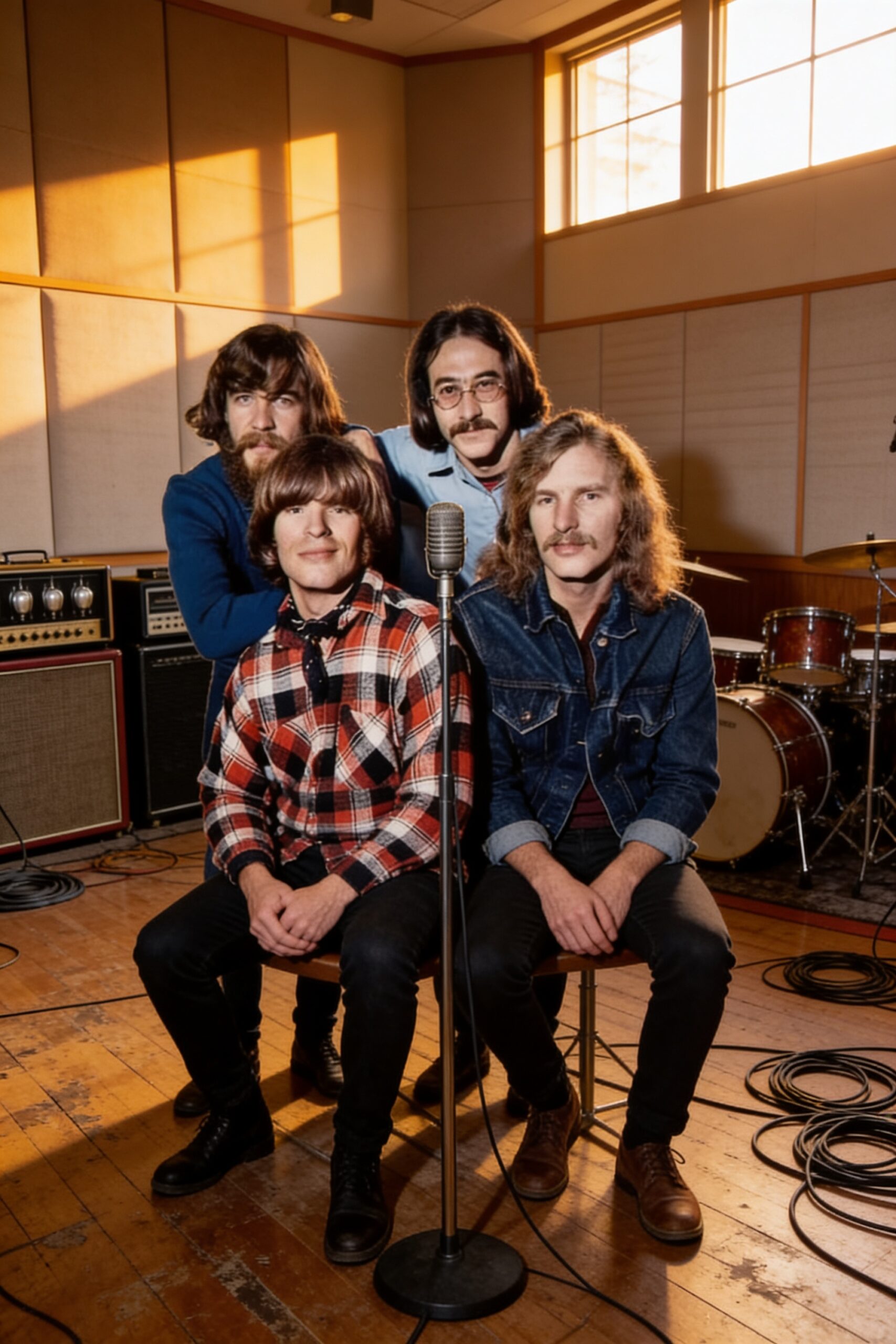
At the close of Pendulum’s first side, Creedence Clearwater Revival turned down the fire and let John Fogerty’s Hammond organ give “(Wish I Could) Hideaway” its uneasy, inward glow.
When Creedence Clearwater Revival released Pendulum in December 1970, the band was standing at the far edge of one of rock’s most concentrated winning streaks. In barely a few years, they had moved from Bay Area outsiders to one of the most dependable names on American radio, with a sound that seemed built from river mud, garage-band discipline, and the sharp focus of John Fogerty’s writing. Yet “(Wish I Could) Hideaway”, placed as the closing track on side one of the LP, tells a quieter story. It follows “Have You Ever Seen the Rain?” on the album sequence and ends the first half not with a burst of certainty, but with a retreat into shadow, carried in large part by Fogerty’s Hammond organ lines.
That placement matters. On vinyl, the end of an album side is not simply another track position; it is a pause built into the physical act of listening. A side-one closer has the power to leave a room suspended while the record waits to be turned over. “(Wish I Could) Hideaway” uses that space beautifully. It does not demand attention the way a single does. It settles in, almost stubbornly, as if the song has chosen not to compete with the louder parts of the Creedence myth. Instead, it becomes one of those deep cuts that rewards the listener who stays past the familiar landmarks.
Pendulum itself was a transitional record. It was the group’s sixth studio album, released by Fantasy Records, and it would become the last Creedence album to feature Tom Fogerty as a member of the band. It was also their first album made up entirely of John Fogerty originals, without the cover songs that had helped connect earlier records to rock and roll, blues, and country roots. The familiar CCR engine was still there: Stu Cook’s bass, Doug Clifford’s drums, Tom’s rhythm guitar, and John’s unmistakable vocal bite. But the record widened the palette. Keyboards, horns, and more layered studio textures gave parts of Pendulum a different emotional temperature from the lean, road-tested punch of albums like Green River or Cosmo’s Factory.
Within that broader sound, “(Wish I Could) Hideaway” feels less like an experiment for its own sake and more like an honest shift in weather. The title alone suggests withdrawal, but the performance never turns limp or defeated. Fogerty sings with the same controlled pressure that had powered so many Creedence songs, only here the pressure seems to move inward. The voice is not leading a charge down a back road; it is looking for cover. The band plays with restraint, letting the mood collect around the arrangement rather than pushing it into a simple rocker’s release.
The Hammond organ is central to that feeling. In Creedence Clearwater Revival’s most familiar image, the electric guitar often carries the story: clipped, direct, and unsentimental. But on this track, Fogerty’s organ work adds a different kind of gravity. The lines do not feel ornamental. They do not simply color the edges of the recording. They sit inside the song like a second thought that will not go away, thickening the atmosphere and giving the melody a weary, searching dimension. The instrument’s rounded tone softens none of the tension; if anything, it makes the unease more human.
That is why “(Wish I Could) Hideaway” remains such a compelling album cut. It shows Creedence at a point where their sound was still instantly recognizable, yet no longer confined to the sharp silhouettes of swamp rock and radio concision. The song does not abandon the band’s identity. It deepens it. Underneath the sturdy rhythm and plainspoken delivery is a feeling that success, motion, and noise may not be enough to quiet whatever is pressing from within. Heard after the public-facing ache of “Have You Ever Seen the Rain?”, the track becomes even more revealing. One song asks a question that millions would come to recognize; the next seems to step away from the crowd and close the door behind it.
For listeners who know Creedence mostly through the hits, “(Wish I Could) Hideaway” can feel like finding a side room in a house they thought they knew. It is not the loudest moment on Pendulum, nor the most celebrated. But it captures something valuable about the album’s mood: the sense of a great American band expanding its language while carrying the weight of its own momentum. John Fogerty’s Hammond organ lines give that weight a sound, not grand or theatrical, but close to the skin.
Decades later, the track still works because it refuses to explain itself too neatly. It closes side one with a question of escape, yet the band never fully disappears into softness. The groove remains. The voice holds. The organ breathes around the edges. In that balance, Creedence Clearwater Revival left behind more than a deep cut. They left a small, shaded doorway into the private side of a band often remembered for its public force.
