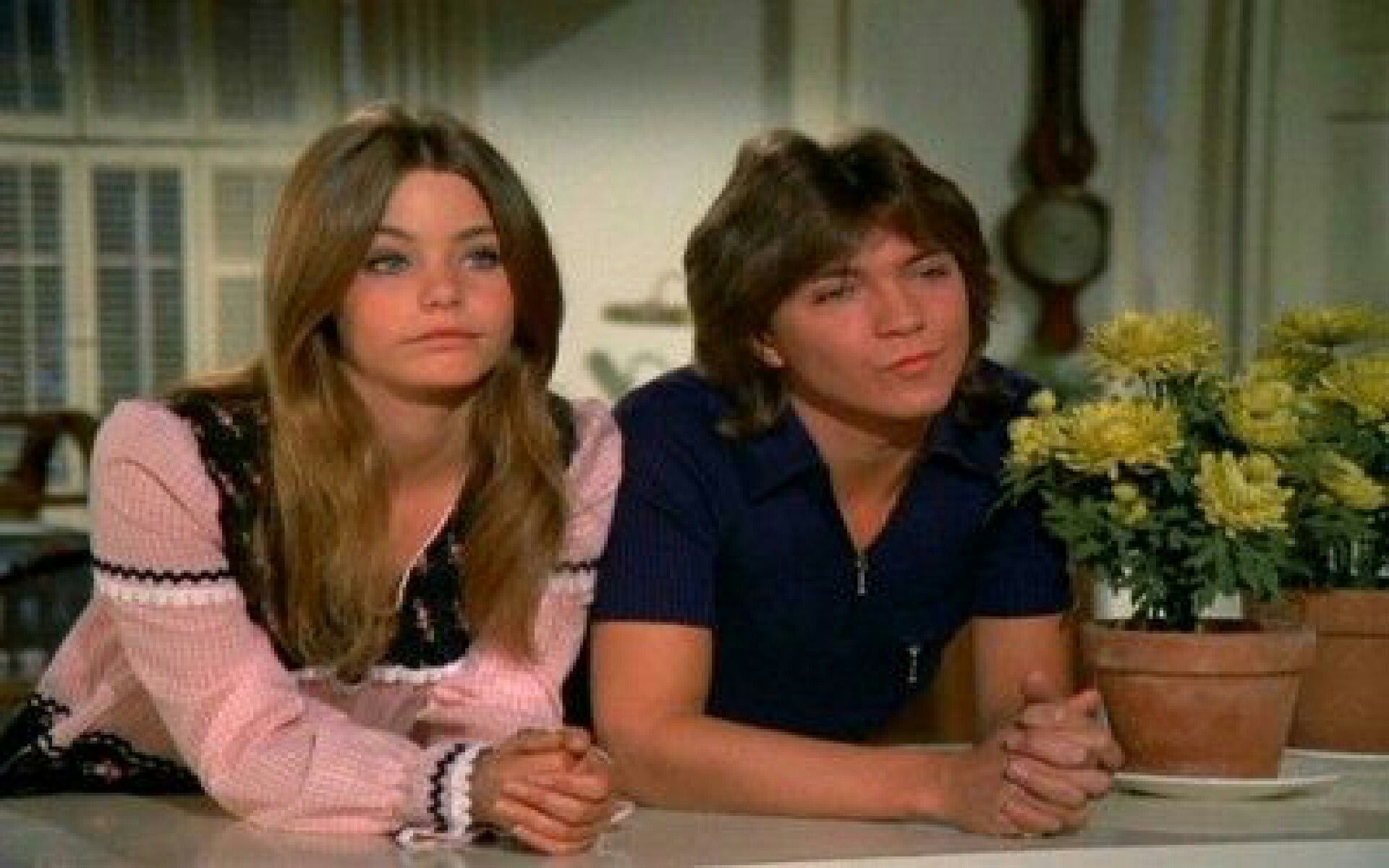
The Partridge Family turned Please Please Me into something bright, polished, and wistful, proving that an early cry of longing could still glow in the gentler pop world of the 1970s.
Among the more intriguing corners of The Partridge Family catalog, Please Please Me carries a special kind of resonance because its story begins long before the television family bus rolled onto American screens. The song was written by John Lennon and Paul McCartney and first made famous by The Beatles in 1963, at the very dawn of Beatlemania. That original recording became a breakthrough moment: it reached No. 1 on major U.K. charts such as NME and Melody Maker, while on the chart later recognized as the official U.K. standard, Record Retailer, it peaked at No. 2. In the United States, the Beatles’ version rose to No. 3 on the Billboard Hot 100 in 1964. Those numbers matter, because any later version of Please Please Me inevitably stands in the shadow of a song that helped change pop music itself.
When The Partridge Family approached the song, the atmosphere was entirely different. This was not Liverpool in the early 1960s, with hungry young musicians trying to force their way into the world. This was polished American pop, shaped for television, radio, and living rooms. The group’s records were steered largely by producer Wes Farrell, with lead vocals from David Cassidy and support from elite studio musicians. That production background is important, because it explains why the Partridge Family reading of Please Please Me feels less urgent, less raw, and more warmly packaged than the Beatles original. It does not try to outshout history. Instead, it softens the edges and lets the melody sparkle in a brighter, more accessible way.
Unlike signature Partridge Family hits such as I Think I Love You, which reached No. 1 on the Billboard Hot 100, or Doesn’t Somebody Want to Be Wanted, which climbed to No. 6, Please Please Me is not generally remembered as one of the group’s major chart-driving singles. It occupies a different space in their legacy: not the giant hit everyone immediately names, but the kind of recording that reveals taste, craft, and the group’s connection to an earlier pop language. For listeners who return to these records with time and memory behind them, that can be just as rewarding.
The song’s emotional center has always been deceptively simple. On the surface, Please Please Me is a direct plea for affection and reciprocity. But like so many early Lennon-McCartney songs, its power lies in how much yearning is packed into plain words. John Lennon himself spoke about the double meaning in the title: “please” as a request, but also “please” in the sense of satisfying someone. That gives the lyric a little extra charge, though never enough to disturb its pop innocence. It is a song about wanting love returned, about feeling that one’s patience has been stretched thin, and about reaching the point where tenderness and frustration meet in the same breath.
That emotional tension is where the Beatles’ version lives most vividly. Their recording began life as a slower song, more in the mold of Roy Orbison, before producer George Martin encouraged a faster, more energetic treatment. The result was electric: eager harmonica, quick pulse, young voices pushing forward as if the whole future depended on the next two minutes. The Partridge Family, by contrast, recast the material through a softer commercial lens. In their hands, the desperation becomes lighter, the ache becomes gentler, and the song starts to feel less like a breakthrough cry and more like a polished echo of an earlier age.
And yet that is precisely what makes the Partridge Family version so charming. It reminds us how durable a truly strong pop composition can be. Strip away the original historical explosion, place the tune in a more carefully arranged early-1970s setting, and it still works. The hook still lands. The lyric still carries emotional motion. The title still sounds like a young heart trying not to ask too much, while asking for everything at once. That is the mark of classic songwriting.
There is also something touching about hearing The Partridge Family engage with material so closely tied to the first great wave of modern pop excitement. The group often gets remembered only for its sunshine image, its television charm, and the immediate sweetness of songs like I’ll Meet You Halfway or Breaking Up Is Hard to Do. But recordings like Please Please Me show another side of their appeal. They were part of a pop continuum. They stood downstream from the British Invasion, borrowing from it, polishing it, and translating it for another moment in popular culture.
That may be why the song still holds a certain glow for listeners who spend time with it. It is not the definitive Please Please Me; history settled that long ago. But it is a revealing reinterpretation, one that lets us hear how a song born in youthful urgency could be reshaped into something smoother, sweeter, and no less melodic. In the Partridge world, everything seems a little sunnier on the surface. Even so, beneath that bright finish, the old longing remains. Someone is still asking to be heard. Someone is still asking to be loved back. And across the years, that feeling never really goes out of style.
