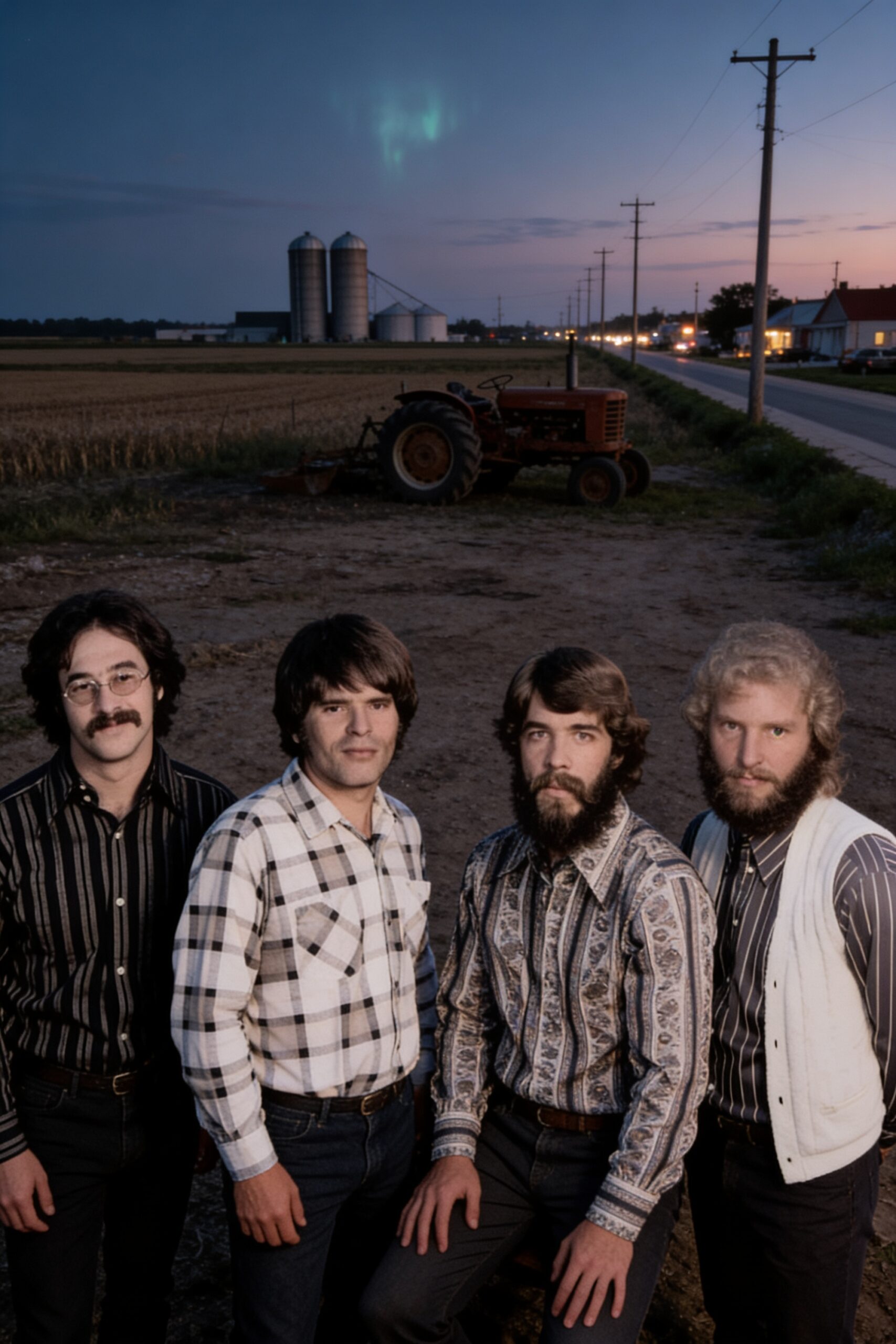
On Pendulum, Creedence Clearwater Revival let the swamp-rock engine idle long enough for a soul ballad to reveal the doubt inside the groove.
“It’s Just a Thought” sits deep inside Creedence Clearwater Revival’s 1970 album Pendulum, a record often remembered first for “Have You Ever Seen the Rain?” and “Hey Tonight”, but one that carries a stranger, more exploratory atmosphere than the band’s biggest radio memories suggest. Released on Fantasy Records at the end of a remarkably productive run, Pendulum was the group’s sixth studio album and the last Creedence album made by the original quartet: John Fogerty, Tom Fogerty, Stu Cook, and Doug Clifford. Within that setting, “It’s Just a Thought” feels less like a spotlight single than a side-room confession, a song where John Fogerty’s voice and organ playing pull Creedence toward soul ballad territory without abandoning the band’s plainspoken gravity.
That matters because Creedence Clearwater Revival were never a band associated with ornament for its own sake. Their most familiar sound was lean and physical: guitars that cut straight through the air, drums that did not wander, bass lines that moved with working-band certainty, and Fogerty’s voice carrying the bite of someone who had learned not to waste syllables. They could make a song sound as if it had always existed on a jukebox somewhere between a roadhouse and a riverbank. But Pendulum complicates that picture. The album brings in keyboards, saxophones, and broader textures, showing a band stretching its vocabulary while still trying to sound like itself.
“It’s Just a Thought” is one of the record’s most revealing examples of that expansion. The organ does not enter as decoration; it changes the emotional temperature of the room. Instead of the hard forward motion that defines so many Creedence classics, the track allows a more suspended feeling to gather. The rhythm still has shape, but the song breathes in longer lines. The organ gives the recording a church-adjacent warmth and a soul-music ache, not in a flashy way, but as a cushion for uncertainty. It lets the lyric feel less like a declaration and more like a private worry voiced just loud enough to be heard.
John Fogerty wrote the songs on Pendulum, and by 1970 his position inside Creedence had become both the band’s creative engine and one of its pressures. It is easy, with hindsight, to read too much autobiography into every line, and the wiser approach is to listen to what the performance itself offers. On “It’s Just a Thought,” Fogerty does not sound like a man making a grand speech. He sounds measured, watchful, almost wary of saying too much. That restraint is part of the song’s power. The title itself carries a shrug, as if the singer is trying to minimize the feeling before it can become too dangerous. But the music will not let it disappear. The organ keeps returning the thought to the surface.
The song’s soul-ballad quality also shows how much range Creedence had beneath the reputation. They were often described through images of bayous, back roads, protest songs, and hard-charging American rock and roll, yet “It’s Just a Thought” points toward another current in their music: the influence of rhythm and blues, gospel feeling, and economical soul phrasing. Fogerty had always understood the emotional force of simplicity. Here, instead of driving that simplicity through a guitar riff, he lets it unfold through tone and space. The result is not soft in the sense of fragile; it is vulnerable in the sense of unguarded.
Placed on Pendulum, the track gains additional resonance. The album arrived after a stunning sequence of Creedence releases in 1969 and 1970, when the band seemed almost unstoppable to the outside world. Yet the music on Pendulum often feels restless, as if success had opened doors and tightened walls at the same time. The brisk confidence of “Hey Tonight” and the uneasy weather of “Have You Ever Seen the Rain?” frame a record that is not simply repeating a winning formula. “It’s Just a Thought” belongs to that uneasy middle ground, where experiment and weariness, soulfulness and discipline, sit close together.
Because it was not one of the band’s famous hits, “It’s Just a Thought” has the special life of a deep cut. It waits for listeners who move past the greatest-hits doorway and settle into the album as an album. For those who know Creedence mainly through the big choruses and road-tested guitar figures, the song can feel like discovering a quieter room in a familiar house. The walls are the same, the voice is unmistakable, but the atmosphere has changed. The confidence has dimmed into contemplation. The beat no longer insists on motion; it allows a pause.
That pause is what keeps the song alive. “It’s Just a Thought” does not need to compete with Creedence Clearwater Revival’s most celebrated recordings. Its value lies elsewhere: in the way it catches the band in transition, in the way John Fogerty’s organ opens a different emotional register, and in the way a supposedly modest album track can reveal a side of a famous group that radio memory often smooths away. It is Creedence not as myth, not as shorthand, but as musicians standing in a late-1970 studio moment, trying another shade of truth before the next chapter closed in.
Heard now, the song feels like a small hinge on a larger door. It reminds us that albums are not only built from hits, and bands are not only defined by their loudest signatures. Sometimes the deeper truth is tucked after the familiar rush, waiting in a slower tempo, in a held note, in the warm rise of an organ, in a singer who calls it only a thought while the music tells us it has been living there for a long time.
