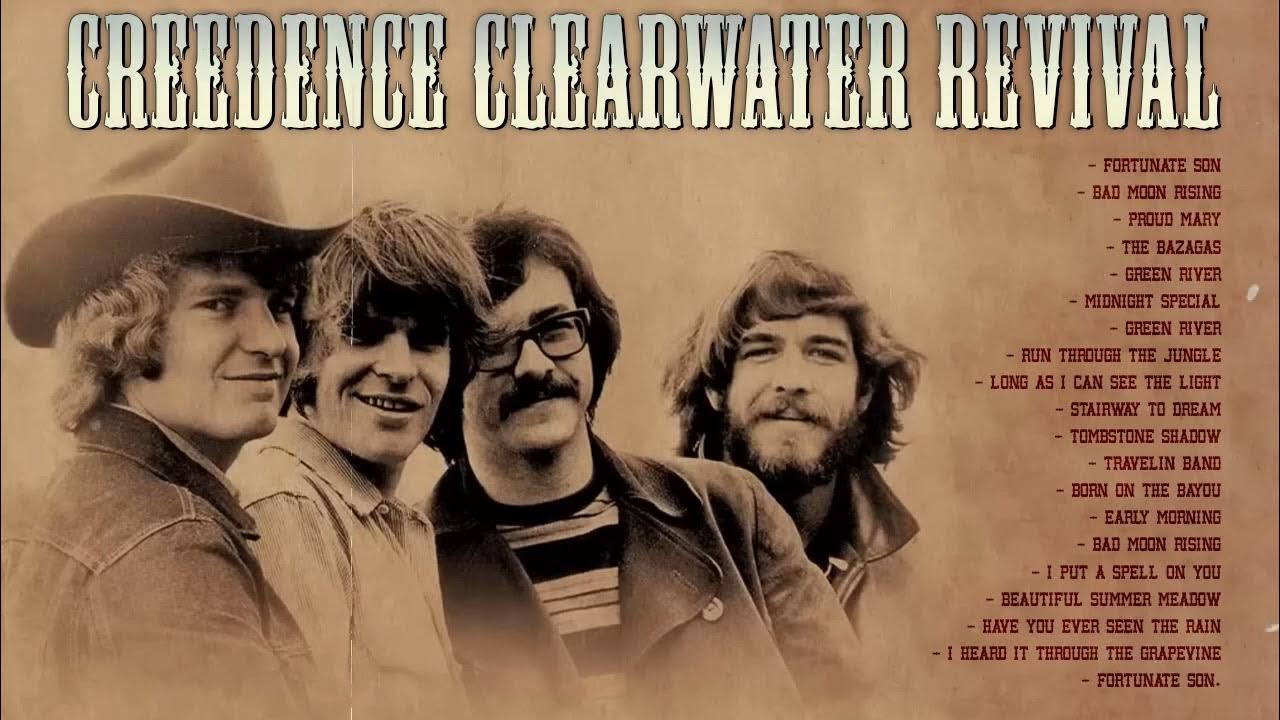
The remastered Oakland performance of Fortunate Son catches Creedence Clearwater Revival at the exact point where a hit song became a public reckoning, loud, lean, and impossible to ignore.
This version of Fortunate Son is not just another pass through a classic. The subject here is the remastered live recording from the Oakland Coliseum, Oakland, California, January 31, 1970, and that detail matters. Heard in this form, Creedence Clearwater Revival do not sound like a band carefully preserving a recent success. They sound like four men driving the song straight into the nerves of the moment. The performance came only a few months after the song’s 1969 release, when its anger was still fresh, the political wound behind it still open, and the band’s rise still moving at a breathtaking speed.
On its original release, Fortunate Son appeared on a single paired with Down on the Corner in September 1969. That single climbed to No. 3 on the Billboard Hot 100, while the album Willy and the Poor Boys, released later that year, also reached No. 3 on the Billboard 200. But chart numbers only tell part of the story. Even then, it was clear that Fortunate Son was not built to live and die by chart positions alone. It carried a sharper edge than most radio hits of its time, and it spoke with a bluntness that listeners recognized immediately.
John Fogerty wrote the song as a furious answer to class privilege in America during the Vietnam era. He has often explained that the spark came from watching how wealth, family name, and political connection could lift some young men above sacrifice while others were expected to carry the burden. Fogerty has also pointed to the public attention surrounding David Eisenhower and Julie Nixon as part of what stirred his thinking. What made the song powerful, however, was that it never turned into a lecture. It was compact, direct, and unsparing. Fortunate Son was not an attack on ordinary soldiers. It was an attack on the hypocrisy that wrapped privilege in patriotic language.
That is exactly why this Oakland Coliseum performance still lands with such force. In the studio, the song is a fast and brilliant detonation. Live, it becomes even more physical. The remastered sound gives extra definition to the snap of Doug Clifford’s drums, the weight of Stu Cook’s bass, the tight push of Tom Fogerty’s rhythm guitar, and above all the cutting urgency in John Fogerty’s voice. There is no softness in the delivery. No attempt to smooth the song into a crowd-pleaser. The band attacks it with the same economy that made Creedence Clearwater Revival so formidable: no wasted motion, no unnecessary ornament, no self-indulgence.
By January 1970, CCR were one of the biggest bands in America, yet they still played with the hard discipline of a group that knew exactly what its songs were meant to do. That is one of the great pleasures of this recording. So many live versions of famous songs become bigger, longer, and looser. This one becomes tighter in spirit, even as it breathes with the crackle of a real stage. You can hear the pressure of the room. You can hear a band performing not from nostalgia, not from distance, but from the living center of its own era.
The Oakland recording also reminds us that Fortunate Son was never merely topical in the narrow sense. Yes, it belongs unmistakably to its time, and yes, it has become one of the defining songs associated with the Vietnam era. But its endurance comes from something deeper than historical placement. The song still speaks whenever ordinary people feel the rules are not being applied equally, whenever public duty sounds different depending on who is being asked to pay the cost. That is why the song keeps returning in American life. Not as a museum piece, but as a warning siren.
This performance is also valuable because it reveals what made Creedence Clearwater Revival such a powerful live act. They were never a band built on spectacle. They did not need elaborate staging or grand theatrical gestures. Their authority came from rhythm, attack, and conviction. The Oakland tapes, later heard officially through releases tied to The Concert and subsequent remastering, preserve that truth beautifully. The remaster does not make the performance modern; it simply lets the listener stand a little closer to what was already there.
And what is there is extraordinary. Fortunate Son arrives like a challenge, burns fast, and leaves a mark. In the studio, it is one of the great American singles. In Oakland, on January 31, 1970, it becomes something even more vivid: a document of a band at full command, and of a song whose meaning had not faded into history because history had not yet let go of it. That is why this version matters. It is not a footnote to the original. It is the sound of the original message being tested in open air, before an audience, with no place to hide.
More than half a century later, the remastered live cut still feels startlingly immediate. It reminds us that some songs do not grow old by becoming softer. They endure because the truth inside them keeps finding new ears. Creedence Clearwater Revival gave Fortunate Son its first life in 1969. In Oakland, early in 1970, they gave it another one, rougher, louder, and in some ways even more unforgettable.
