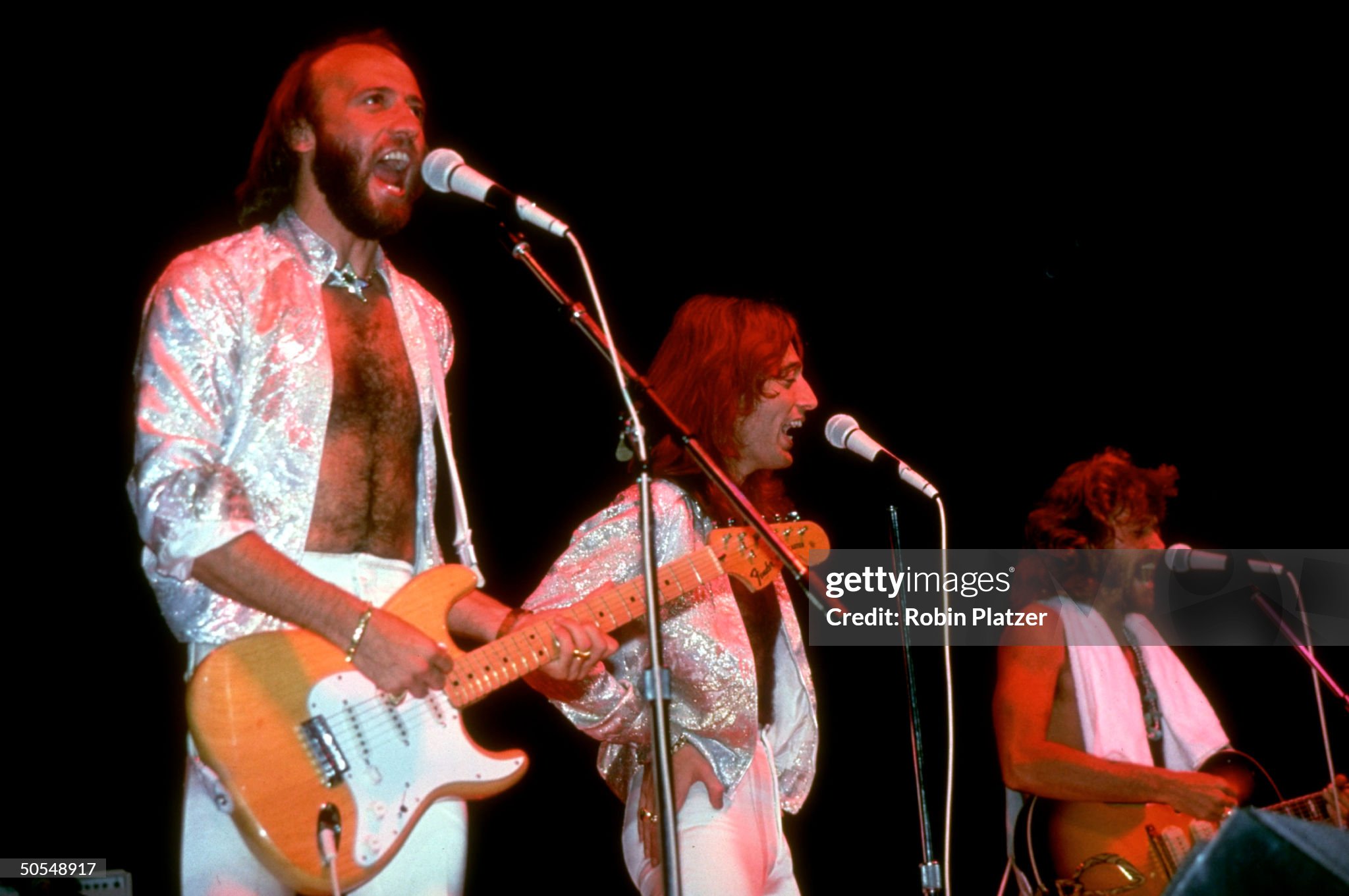
On “Black Diamond”, the Bee Gees can be heard at a quiet threshold: still richly melodic, but newly altered by the absence of lead guitarist Vince Melouney.
“Black Diamond” belongs to the strange, ambitious world of Odessa, the double album released by the Bee Gees in 1969, and it carries a piece of recording history that changes the way the track feels in the ear. It is noted as the first track the group recorded after the departure of their lead guitarist, Vince Melouney, a musician whose presence had helped give the Bee Gees’ late-1960s records some of their sharper, more guitar-driven edges. That detail may sound small at first, the kind of personnel note that sits quietly in the margin of an album history. But with Odessa, margins matter. The record is full of thresholds, half-lit rooms, grand gestures, fraying bonds, and beautiful uncertainties.
By the time the Bee Gees reached Odessa, they were no longer simply the young harmony group who had arrived in Britain with an uncanny gift for melody. Barry Gibb, Robin Gibb, and Maurice Gibb had already moved through the ornate pop of Bee Gees’ 1st, the dramatic mood pieces of Horizontal, and the polished craft of Idea. Their songs could be intimate and theatrical at once, as if a confession had wandered into a drawing room with heavy curtains and an orchestra waiting just out of sight. Odessa, produced in the Robert Stigwood era and released as a sprawling double LP, pushed that impulse further. It was not merely a collection of songs; it felt like a world, uneven in the most fascinating way, full of maritime images, chamber-pop colors, country touches, mock-anthems, and brooding ballads.
Within that world, “Black Diamond” sounds less like a standard pop recording than a room being rearranged after someone has left it. Melouney’s departure did not remove the Bee Gees’ ability to make forceful records, nor did it turn them suddenly into something unrecognizable. But it did alter the balance. A lead guitarist in a band is not only a source of solos or riffs; he can be an anchor, a counterweight, a human line moving against the voices. Without that familiar presence, the Gibbs’ singing and arranging instincts seem to move into a different kind of space. The song’s emotional center is not built around attack. It is built around atmosphere, vocal pressure, and a sense of suspended drama.
That is why the recording context matters. “Black Diamond” becomes more than an album track from 1969. It becomes a document of transition. The Bee Gees were narrowing and expanding at the same time: losing one instrumental voice while deepening their reliance on the studio as a place of color, tension, and architecture. Their music had always depended on voices that could blend almost too closely, voices that seemed to know one another before the words arrived. On Odessa, that closeness becomes grander and more uneasy. The harmonies are still beautiful, but beauty here is not simple comfort. It often feels formal, contained, even slightly remote, as if the songs are dressed for a ceremony no one can quite explain.
Vince Melouney had joined the Bee Gees during their major 1960s rise and played on key recordings from the period when the group’s baroque pop instincts were still intertwined with the vocabulary of a working band. His guitar work helped underline the fact that the Bee Gees were not only writers of elegant melodies, but also a group moving through the same late-1960s landscape as many of their peers: pop was becoming more layered, albums were becoming statements, and bands were testing how much atmosphere a three-minute song could hold. His exit, coming before this track, places “Black Diamond” at a fascinating point: the Bee Gees were still a band, with drummer Colin Petersen still part of the recorded sound, but they were also becoming something more elusive, more arranged, more dependent on the internal weather of the Gibb brothers’ voices.
The title itself, “Black Diamond”, carries the kind of contradiction the Bee Gees often understood instinctively. A diamond suggests value, hardness, shine; blackness suggests mystery, concealment, perhaps distance. The song does not need a large external story to feel dramatic. Its drama comes from its position on the album and in the group’s evolution. Heard alongside the sweep of the title track, the fragile theatricality of “Lamplight”, and the direct emotional pull of “First of May”, it becomes part of an album that seems to be searching for a language big enough to hold private instability and public ambition at once.
In hindsight, Odessa is often remembered as one of the Bee Gees’ most unusual works: ornate, divided, absorbing, and difficult to reduce to a single mood. It arrived during a period of strain within the group, and soon after, the Bee Gees’ story would take another turn as Robin briefly stepped away for a solo path. But it is important not to turn every note on the album into a prediction. What makes “Black Diamond” compelling is subtler than that. It captures the sound of artists continuing to work after a change in the room. No announcement is required. No dramatic explanation is necessary. The recording itself carries the shift.
To listen to “Black Diamond” with this context in mind is to hear the Bee Gees not as a fixed image from memory, but as a living group in motion. The voices are familiar, yet the ground beneath them has moved slightly. The arrangement does not shout about what is missing; it absorbs the absence and turns it into texture. That is the quiet power of the track. It reminds us that a band’s history is not only written in hit singles and famous performances, but also in the first song after a door closes, when everyone left in the room has to decide what the music will become next.
