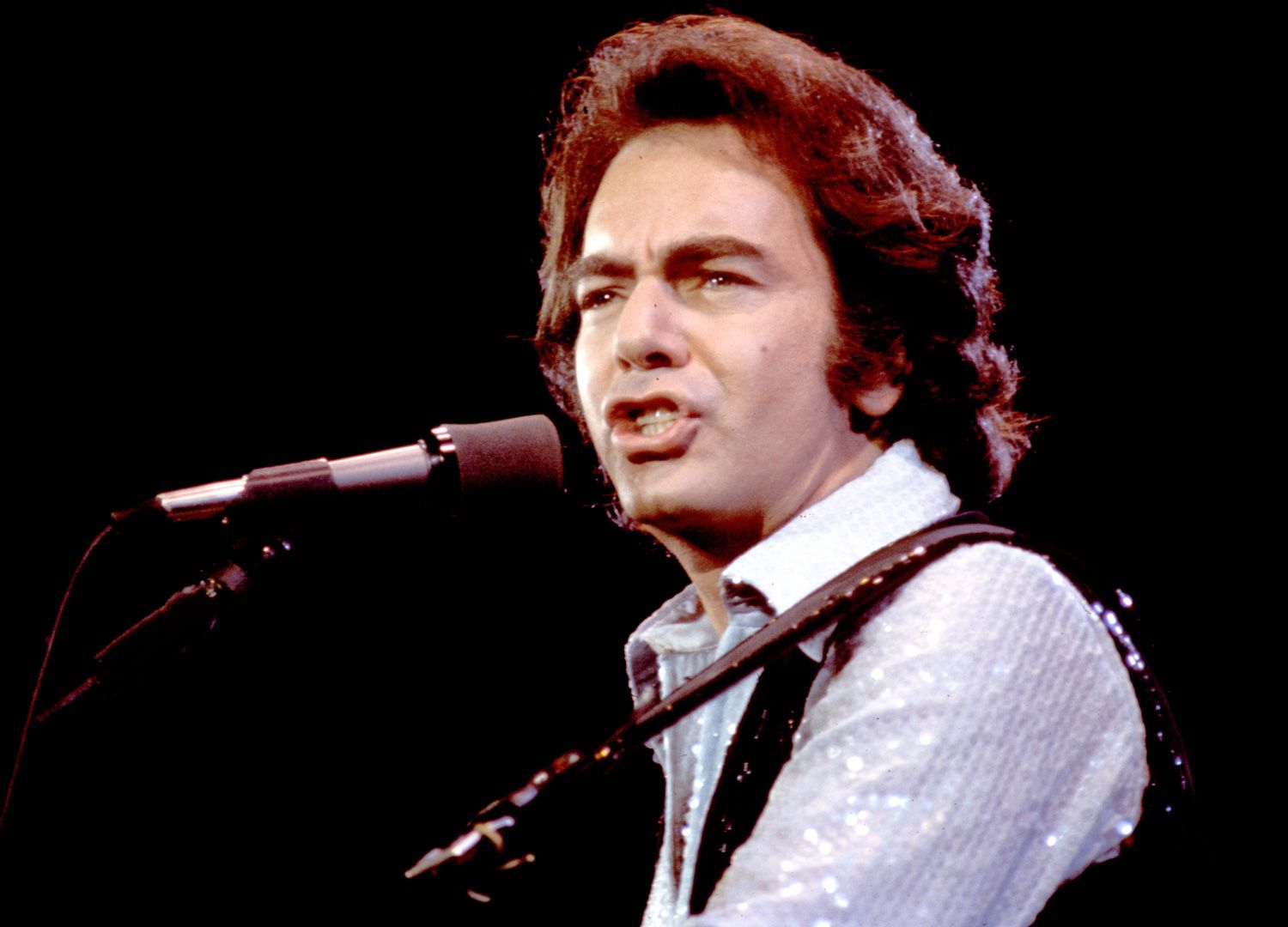
Before his name became tied to communal choruses and polished stage warmth, Neil Diamond cut an early album track that sounded nervous, moral, and unmistakably of 1968.
Neil Diamond’s “The Pot Smoker’s Song” sits on Velvet Gloves and Spit, his 1968 album from the crucial early stretch after his first burst of success as a songwriter and recording artist. That context matters. This is not the later Diamond of arena-wide recognition, nor the seasoned performer whose songs would be embraced as shared memory. It is the younger Neil Diamond still shaping his public identity, still moving between Brill Building craft, folk-rock urgency, theatrical pop, and a growing taste for social and personal drama.
He had already shown he could write with force and economy. Songs like “Solitary Man” and “Cherry, Cherry” had established him as more than a background craftsman. But Velvet Gloves and Spit finds him searching for a wider emotional and musical vocabulary. The album title itself feels almost like a warning label: softness and abrasion, polish and grit, a singer trying to decide how much tenderness and how much bite belonged in his sound. Within that mixture, “The Pot Smoker’s Song” remains one of the most strikingly period-specific tracks in his early catalog.
Heard now, the song can feel startling because it does not behave like the Neil Diamond many listeners expect. It is not built simply to charm. It does not settle into the easy release of a chorus designed for a crowd. Instead, it carries the anxious tone of a late-1960s moral warning, shaped by a moment when marijuana had become more than a substance in public conversation. It was a symbol in the argument between generations, a shorthand for rebellion, fear, freedom, youth culture, and social change. Diamond’s song enters that argument not with cool detachment, but with a cautionary intensity that makes the track feel closer to a small dramatic scene than a standard pop album cut.
Part of what makes “The Pot Smoker’s Song” unusual is its use of testimonial-style spoken passages, which interrupt the expectation of a conventional pop performance. The effect is deliberately unsettling. These voices make the track feel documentary-like, as if the song is trying to pull the outside world into the studio and place it beside Diamond’s melodic instincts. Whether a modern listener hears the message as blunt, dated, earnest, or uneasy, the construction reveals something important about his early ambition. He was not only writing love songs or character sketches; he was testing whether a pop record could carry a social warning and still sit inside the shape of an album.
That attempt is what makes the track valuable as an early-era artifact. It does not need to be smoothed into the later Neil Diamond story to matter. In fact, its rough edges are the point. The language of the song belongs to its time, and so does its fear. The late ’60s were full of records that tried to speak directly to changing youth culture, sometimes with grace, sometimes with awkwardness, often with a mixture of both. “The Pot Smoker’s Song” belongs to that complicated tradition. It reflects a mainstream artist looking at a cultural shift and responding through the tools he had: melody, dramatic framing, and a strong instinct for emotional immediacy.
There is also a revealing contrast between this track and some of the more familiar Diamond songs that followed. Within a year, “Sweet Caroline” would help move him toward a broader kind of pop permanence, one built around lift, warmth, and instant recognition. Later recordings would make his voice feel larger than the room, almost ceremonial. But here, on Velvet Gloves and Spit, he sounds closer to the ground. The song is not grand in the later sense. It is tense, pointed, and somewhat uncomfortable, as if the singer-songwriter is still deciding how much responsibility a pop song should carry.
That discomfort is worth listening to. It reminds us that early albums are often not neat previews of future fame. They are workrooms. They contain experiments, misfires, risks, and flashes of personality that later success can make easy to overlook. “The Pot Smoker’s Song” may not be the first track casual listeners name when they think of Neil Diamond, but it opens a window onto a restless young artist in 1968, willing to step outside romance and rhythm to wrestle with the anxieties of his moment.
In that sense, the song is less interesting as a simple warning and more interesting as evidence of artistic pressure. It shows Diamond before his image had fully hardened, before the audience knew exactly what to expect from him. The voice is familiar, but the surroundings are stranger. The melody carries discipline, but the subject pulls the track into the uneasy public air of its year. What remains is an album cut that feels preserved in tension: part pop craft, part social document, part early experiment from a songwriter still discovering how wide his stage could become.
Listening to “The Pot Smoker’s Song” today means hearing not only a particular Neil Diamond track, but a particular cultural temperature. It is a reminder that the path to beloved songs is rarely smooth. Sometimes an artist’s catalog contains a piece that is awkward, revealing, and deeply rooted in its time—and for that very reason, it tells us more than polish ever could.
