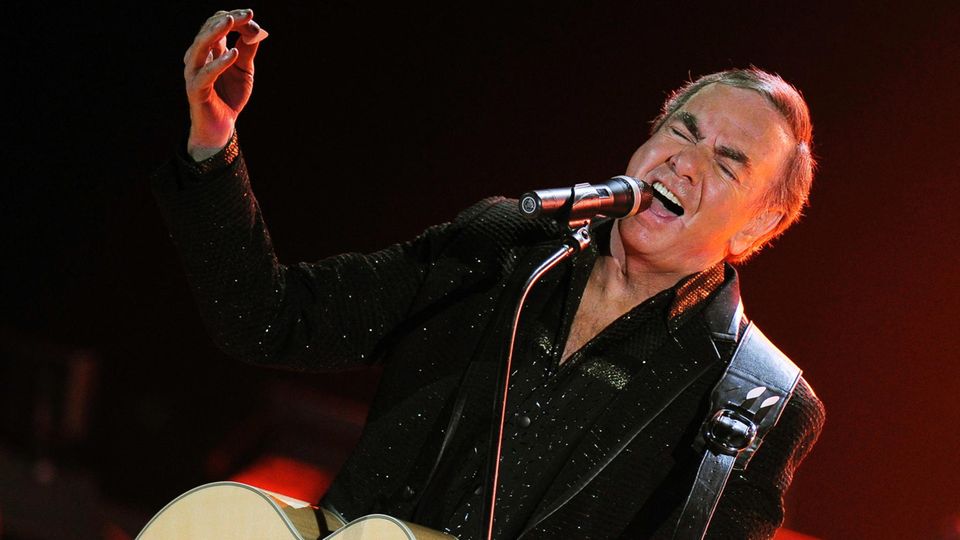
In Neil Diamond’s Skybird, the Jonathan Livingston Seagull soundtrack turns flight into a language of longing, discipline, and release.
Neil Diamond‘s Skybird appeared in 1973 on the Jonathan Livingston Seagull soundtrack, the music he wrote and performed for Hall Bartlett’s film adaptation of Richard Bach‘s bestselling novella. The setting is essential: this was not simply another Neil Diamond song looking for radio space or a comfortable place inside his catalog. It was one vocal piece within a larger soundtrack-score, written for a film about a gull who refuses the limits assigned to ordinary flight.
By 1973, Diamond already knew how to command a crowd and how to place a melody where memory could hold it. The previous years had made him one of popular music’s most recognizable voices, a writer who could move from Brill Building craft to grander, more searching statements. Jonathan Livingston Seagull gave him a different canvas. Instead of writing about romance, city streets, or the charged loneliness of performance, he was asked to create music for an allegory: movement, practice, exile, vision, return. The soundtrack became a place where his gift for direct melody met a story that wanted to look upward.
Skybird works because it understands that upwardness can be both physical and spiritual. The song carries the bright contour of a pop piece, but it also behaves like a score cue with words. Its melody seems made to rise, not in a showy burst, but through a steady sense of lift. Around Diamond’s voice, the arrangement suggests open air and forward motion, drawing the ear toward an imagined horizon. It is not a heavy song, yet it is not weightless. There is striving inside it, the feeling of someone measuring the distance between what is familiar and what might still be possible.
The film itself has always occupied a complicated place in 1970s popular culture. Richard Bach‘s book had become a phenomenon, a slim philosophical tale embraced by readers who heard in Jonathan’s flight a promise of self-discovery. Hall Bartlett’s screen version tried to translate that inward fable into images of gulls, ocean, and sky. For many listeners, however, Diamond’s soundtrack became the most enduring doorway into the material. The album did not merely decorate the picture; it gave the story a singing center. It also earned major recognition, including a Grammy Award for its original score, confirming that Diamond’s musical reach extended beyond the conventional pop album.
That recognition matters, but it is not the deepest reason Skybird continues to draw people back. The song feels like a small, luminous part of a larger suite, surrounded by themes of flight, solitude, and becoming. In the context of the soundtrack, it does not stand alone as a neat three-minute statement. It gathers meaning from the material around it: the broad gestures of Be, the reflective atmosphere of the film, the sense that every ascent has a cost. Diamond’s vocal presence keeps the idea from becoming abstract. He sings not like a distant narrator explaining a lesson, but like someone standing close to the edge of a question.
There is a special tension in hearing a major pop singer step into a project built around a philosophical symbol. The risk is obvious: a song about flight can easily become too polished, too certain, too eager to inspire. Skybird avoids that by keeping its emotional weight in motion. It does not sound like an answer so much as an invitation. The word itself feels almost childlike, but the surrounding music gives it breadth. The bird is not only a creature in the sky; it becomes a shape for ambition, freedom, discipline, and the ache of leaving the lower air behind.
Placed in Diamond’s early 1970s work, the track reveals a side of him that sometimes gets overshadowed by the bigger stage moments. He could be dramatic, yes, but he was also drawn to plain-spoken spiritual hunger, to melodies that made large feelings feel surprisingly close. On Skybird, his voice does not need to force the vision. It lets the arrangement open around it, allowing the song to feel less like a declaration and more like a gradual clearing. The result is a piece that belongs to its movie and yet can travel outside it, carrying the mood of the soundtrack even when heard far from the images it was written to serve.
What remains most affecting is the way Neil Diamond uses the language of a film score to make aspiration feel personal. Skybird is not simply about escape; it is about the discipline required to rise, and about the loneliness that can accompany any journey away from the expected path. More than half a century later, the song still seems to hover between soundtrack and prayer, between pop craft and cinematic symbol. Its beauty lies in that suspension. It asks listeners to look up, but also to listen inward, where the desire for flight often begins long before anyone else can see the wings.
