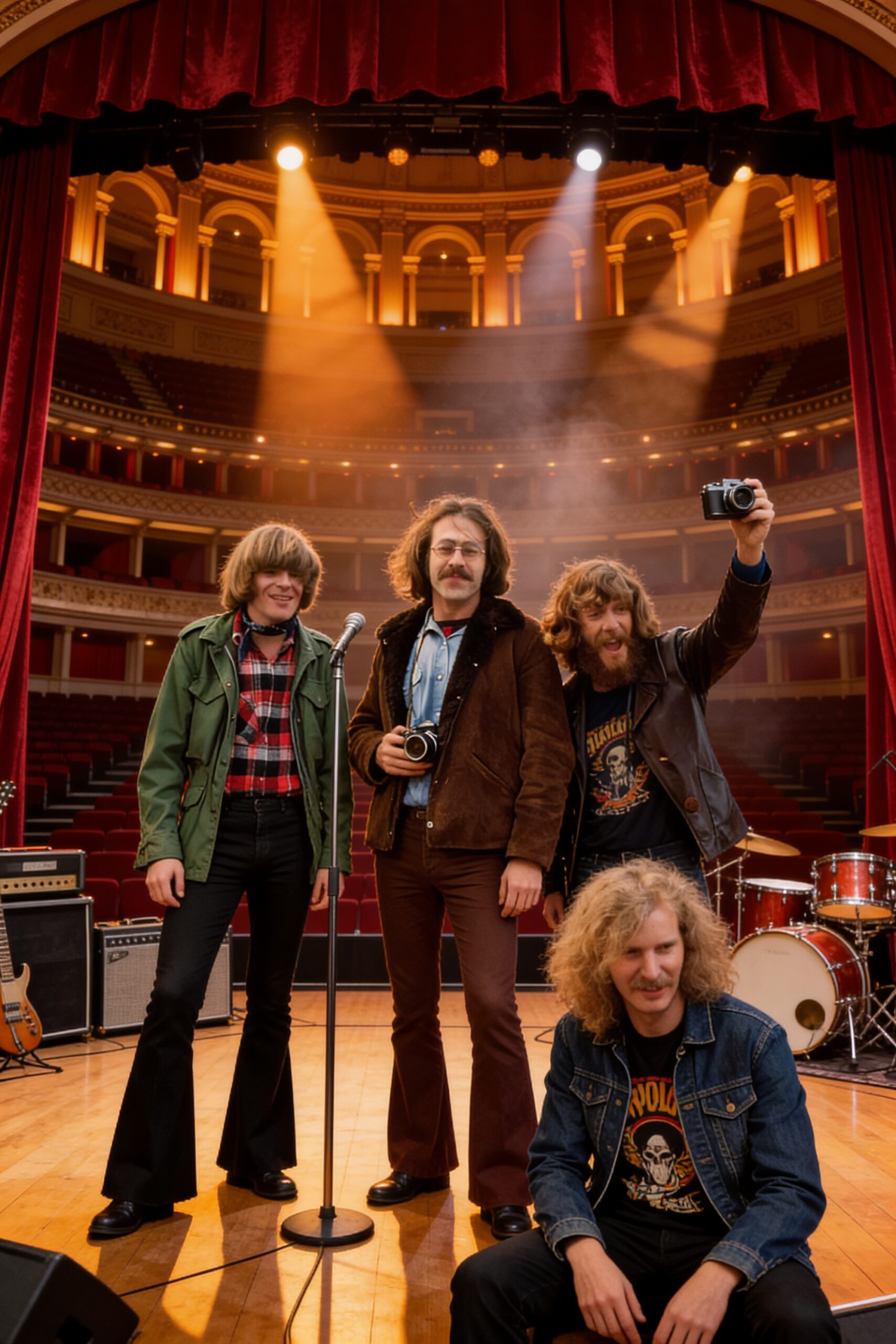
On “Side o’ the Road”, Creedence Clearwater Revival briefly stepped away from the story song and let John Fogerty’s guitar speak in its own clipped, restless language.
Released on Creedence Clearwater Revival’s 1969 album Willy and the Poor Boys, “Side o’ the Road” occupies a curious and rewarding corner of the band’s catalog. It is not one of the big radio landmarks. It does not arrive with the plainspoken force of “Fortunate Son”, the front-porch brightness of “Down on the Corner”, or the communal folk memory of “The Midnight Special”. Instead, it slips into the album as a compact instrumental, a rare moment when the famous CCR voice falls silent and John Fogerty’s lead guitar takes over the storytelling.
That alone makes the track worth pausing over. CCR was a band built on directness: a hard snare, a disciplined bass line, rhythm guitar with no wasted motion, and Fogerty’s voice cutting through like a man trying to be heard above weather, engines, and bad news. Their best-known records often feel almost inevitable because the songs waste so little time getting to the point. But “Side o’ the Road” reveals another kind of directness. Without lyrics, Fogerty does not suddenly become showy or ornamental. He stays lean. He phrases like a singer. He bends notes with the same nasal urgency that marked his vocals, and the guitar seems to carry the accent of the whole band.
Willy and the Poor Boys arrived during an astonishing year for CCR. In 1969 alone, the group released three studio albums: Bayou Country, Green River, and Willy and the Poor Boys. By the time this record appeared, the band had refined a sound that felt both old and immediate. They drew from rock and roll, country, blues, R&B, and American folk traditions, but they did not present those influences as museum pieces. They tightened them, electrified them, and sent them out with a garage-band pulse. Within that setting, “Side o’ the Road” feels like a small roadside stop between larger statements, yet the stop has its own view.
The instrumental works because it understands scale. Fogerty was never the kind of lead guitarist who needed a long runway to make his point. His playing often came in short, bright bursts: a riff that framed the song, a solo that tightened the emotion rather than decorating it, a tone that had more tooth than polish. On “Side o’ the Road”, the lead line carries the track forward with a slightly wiry confidence. It feels rural without being quaint, blues-based without leaning on imitation, and rock-driven without turning into a display piece. The band behind him remains characteristically firm, giving the guitar just enough room while keeping the groove close to the ground.
That restraint is part of the pleasure. Many rock instrumentals of the era treated the absence of a vocal as an invitation to stretch out. CCR did the opposite. “Side o’ the Road” is short, disciplined, and almost stubbornly economical. It behaves less like a jam than like a song whose words have been deliberately withheld. You can almost hear where a vocal might have entered, but the guitar fills that space with clipped phrases and answering motions. The result is not emptiness; it is concentration. Fogerty’s guitar becomes the character, the narrator, and the weather in the same breath.
He had a distinctive way of making lead guitar sound practical. There is little sense of a musician trying to escape the song in search of virtuosity. Instead, the notes seem to belong to the road, the barroom, the rehearsal space, the AM radio speaker. This is why “Side o’ the Road” remains interesting beyond its novelty as a rare CCR instrumental. It shows that Fogerty’s musical identity was not only in his singing or songwriting, but also in the pressure and shape of his guitar lines. His lead playing could carry the same rough intelligence as his lyrics: plain at first glance, sharper the longer you listen.
Placed on Willy and the Poor Boys, the track also helps broaden the album’s emotional landscape. The record is often remembered for its public-facing songs: working-class theater, antiwar anger, old folk material recharged with rock muscle. “Side o’ the Road” offers a different kind of Americana, one without a slogan or a character sketch. It suggests movement rather than destination. It feels like dust on an amplifier, a band locked into a groove, a guitarist saying just enough and then getting out before the feeling becomes too polished.
For listeners who come to CCR mainly through the hits, this instrumental can feel like finding a side door into the band’s workshop. There is no famous chorus to lean on, no lyric to quote, no grand statement announcing itself. What remains is touch, tone, timing, and the chemistry of four players who understood how to make simplicity feel charged. In that sense, “Side o’ the Road” is not a footnote so much as a close-up. It lets the ear settle on the grain of Fogerty’s guitar and the way CCR could turn a few sturdy musical ideas into something with motion and character.
More than five decades later, the track still has the appeal of a modest discovery. It reminds us that the spaces between a band’s famous songs often hold clues to how that band truly worked. John Fogerty did not need many notes to leave a mark, and Creedence Clearwater Revival did not need many minutes to create a complete atmosphere. On “Side o’ the Road”, the voice is absent, but the accent is unmistakable: dry, sharp, restless, and unmistakably CCR.
