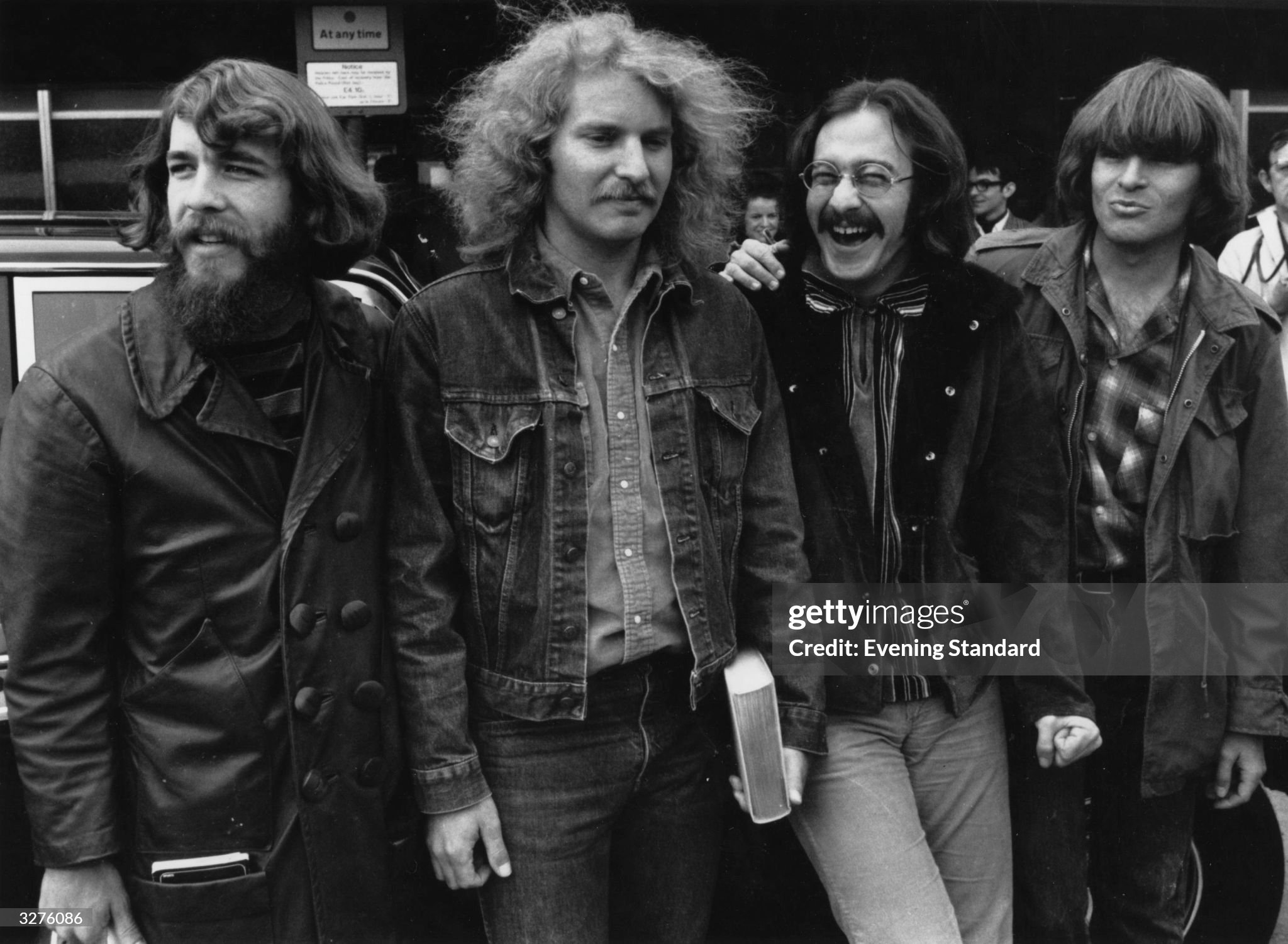
At Woodstock, Keep On Chooglin’ was not just another long jam. It was Creedence Clearwater Revival bringing midnight grit, swamp rhythm, and stubborn American drive to a festival that almost let the moment slip away.
There is something haunting about Creedence Clearwater Revival’s Keep On Chooglin’ – Live At The Woodstock Music & Art Fair / 1969. Not because the band sounds uncertain. Quite the opposite. They sound fierce, tight, and fully in command. The haunting part is that this performance, one of the rawest and most revealing documents of CCR at their peak, spent years living in the shadows of Woodstock mythology. While other artists became inseparable from the festival’s public memory, Creedence Clearwater Revival remained one of its great missing names. That absence had less to do with the music than with circumstance, timing, and one artist’s disappointment in how the night unfolded.
CCR took the Woodstock stage after midnight, in the early hours of August 17, 1969, following a delayed and difficult schedule. By then, much of the audience was exhausted, muddy, and half-spent from the long day and the festival’s notorious logistical problems. John Fogerty later spoke unhappily about the set, feeling the crowd had been drained and that the performance did not capture the impact the band could normally deliver. Because of that dissatisfaction, Creedence Clearwater Revival did not appear in the original Woodstock film or the first soundtrack album. For years, that decision helped create a strange historical distortion: one of America’s biggest bands at the time had played the most famous festival of the era, yet many casual listeners barely knew it.
That is why this version matters so much. It restores a missing chapter. And when you hear Keep On Chooglin’ in this setting, you understand immediately that the omission was never about a lack of power. If anything, the performance reveals what CCR did better than almost anyone in 1969: they could turn a groove into something elemental, repetitive in the best sense, like wheels on rails or a river current that refuses to stop.
In terms of chart history, Keep On Chooglin’ was not a hit single in the usual sense, so it did not carve out its own run on the Billboard Hot 100. But its parent album, Bayou Country, released in 1969, climbed to No. 7 on the Billboard 200 and helped establish Creedence Clearwater Revival as a major force. That same breakthrough period also gave the band Proud Mary, which reached No. 2 in the United States. By the time of Woodstock, CCR were no fringe act wandering onto a lucky stage. They were already one of the most important American bands in the country, riding a run of records that felt lean, urgent, and unmistakably their own.
On the studio version from Bayou Country, Keep On Chooglin’ already sounded less like a neatly packaged song and more like a mission statement. It was built on repetition, pulse, harmonica, and drive. The word chooglin’ itself felt like something between an engine sound and a way of life. It suggested movement, persistence, the refusal to polish away the dirt under the music’s fingernails. John Fogerty did not write it as a delicate confession or a poetic diary entry. He wrote it as a groove you could live inside. That was part of CCR’s genius: they could make simplicity feel enormous.
At Woodstock, that quality opens up even further. The band stretches the song until it becomes a full-bodied live ritual. Doug Clifford and Stu Cook lock the rhythm down with patient force. Tom Fogerty gives the performance shape and thickness from the side, keeping the track grounded while John Fogerty pushes it forward with his rough, needling voice and cutting guitar. There is no unnecessary decoration. No grandstanding for its own sake. What you hear is a working band doing what it did best: building pressure, holding it, then letting it roll on and on until the music feels almost physical.
That is the deeper meaning of Keep On Chooglin’, especially in this live 1969 Woodstock context. It is a song about momentum, but not cheerful momentum. It carries strain inside it. It knows the road is long. It knows fatigue is real. And still it moves. Heard at Woodstock, after midnight, in front of a worn-out field, the song becomes almost stubborn in its spirit. It is not asking for idealism. It is insisting on endurance. That gives the performance a weight that many prettier festival moments do not have.
There is also a revealing contrast here between CCR and the broader image many people hold of Woodstock. Much of the festival’s legend is wrapped in dreamy language: peace, clouds, sunrise, generation-defining communion. Creedence Clearwater Revival brought something earthier. Their music was not made of incense smoke and abstraction. It was made of Southern imagery, hard grooves, short lines, and an old American restlessness. In that sense, Keep On Chooglin’ may be one of the most honest performances of the whole event. It sounds less like a poster and more like real life.
Decades later, when the set finally became more widely available in official form, listeners could hear the truth for themselves. The performance was not a footnote. It was a lost center of gravity. And Keep On Chooglin’, perhaps more than any other song in the set, explains why. It captures Creedence Clearwater Revival at the intersection of reputation and reality: a band at peak strength, playing one of the most famous festivals in history, yet somehow remaining outside its most familiar narrative. That tension is part of what makes this recording so moving now. It sounds like recovered history. It sounds like a midnight document pulled out of the mud and finally heard clearly.
For those who have loved CCR for years, this version does not merely confirm what the band could do. It deepens the picture. And for those coming to it fresh, it offers a different kind of Woodstock memory: not flowered romance, but propulsion, grit, and a groove that keeps going long after the lights should have gone out.
