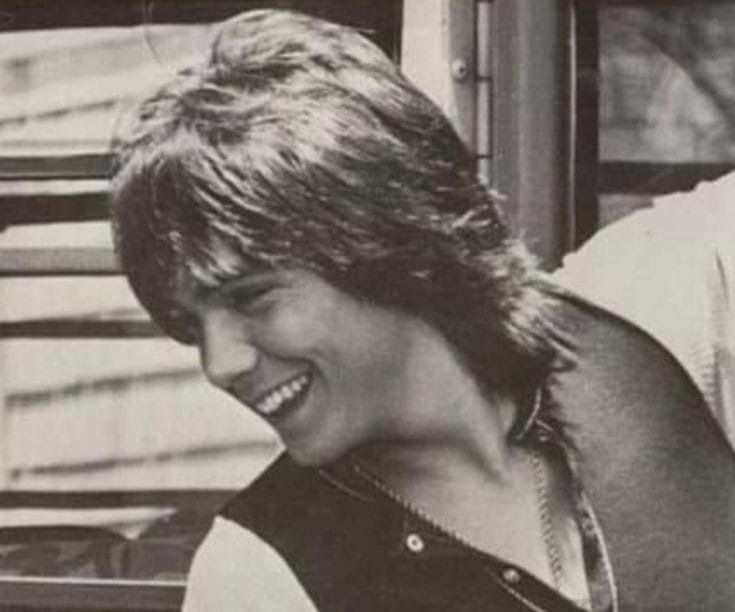
On “Soul Kiss,” David Cassidy lets the old teen-idol frame fall back, revealing an adult-pop mood built on atmosphere, restraint, and reassessment.
David Cassidy recorded “Soul Kiss” for his 1992 album Didn’t You Used to Be…, a title that already seemed to carry a question he had been hearing for years. The song, co-written by Cassidy with Sue Shifrin, belongs to a chapter of his catalog that deserves to be heard with more patience than nostalgia usually allows. It is not the bright, instantly familiar television-pop image that followed him from The Partridge Family, nor is it simply an adult performer trying to outrun the past. It is quieter than that, more atmospheric, and in some ways more revealing.
By the time Didn’t You Used to Be… arrived in 1992, Cassidy’s public story had already been written and rewritten by other people. To many listeners, his name still carried the rush of early-1970s fame: the screaming crowds, the magazine covers, the soft-focus bedroom walls, the enormous success of “I Think I Love You” with The Partridge Family, and his own solo presence as a singer who became famous before he could fully define what fame would mean for him. That kind of recognition can become a gilded cage. It preserves a face, a sound, a moment — but it can make later work feel like an afterthought before anyone has truly listened.
“Soul Kiss” pushes gently against that habit. It does not arrive like a declaration or a comeback slogan. Its strength is in mood, in the way the song seems to occupy a dimmer room than the one Cassidy had once been placed in by pop culture. The track’s atmosphere suggests adult-pop sophistication rather than teenage spectacle. There is space around the vocal. The feeling is less about performance as possession and more about closeness as something uncertain, something that has to be approached carefully. In that setting, Cassidy’s voice is not trying to recreate the boyish brightness people remembered. It sounds like a singer accepting a narrower beam of light and making it work in his favor.
The co-writing credit with Sue Shifrin matters because it places the song inside a more personal and collaborative adult songwriting world. Shifrin had her own professional identity as a songwriter, and her presence in the credit gives “Soul Kiss” a sense of craft beyond celebrity. The song does not need to be treated as a diary entry to feel intimate. Its intimacy comes through shape and restraint: a title that hints at sensuality, a delivery that does not overplay it, and a musical mood that seems to understand that desire in adulthood is rarely as simple as the pop songs of youth promised it would be.
That is part of what makes the album title Didn’t You Used to Be… so pointed. It sounds like the beginning of a sentence people never quite finish politely. Didn’t you used to be that boy on television? Didn’t you used to be on lunchboxes, posters, and radio countdowns? Didn’t you used to belong to a different era? Instead of answering with bitterness, “Soul Kiss” seems to answer with texture. It says, in effect, listen here, not there. Listen to the pacing. Listen to the breath held back. Listen to the man inside the song rather than the photograph attached to his name.
Career reassessment often happens long after the work itself appears. At the time, records like this could be difficult for the public to place. The early 1990s were crowded with changing pop identities: adult contemporary polish, rock reinventions, dance textures, and the rising force of alternative music all competing for space. For an artist like David Cassidy, whose earliest success was so strongly tied to youth culture, the challenge was not merely to release new music. It was to persuade people that new music from him could be heard without the old reflex of comparison.
In that sense, “Soul Kiss” becomes more than a deep cut from a 1992 album. It becomes a small but telling piece of evidence in the larger argument for Cassidy as a working adult artist — someone still searching for atmosphere, phrasing, collaboration, and emotional scale after the most visible part of his fame had settled into memory. The song does not erase the past, and it does not need to. What it does is complicate the easy version. It lets the listener hear a voice that had been recognized too quickly, too loudly, and too narrowly, stepping into a mood where recognition is not the point.
Heard now, “Soul Kiss” carries the quiet charge of an artist asking for a different kind of attention. Not applause for what he once represented, not dismissal because of it, but a listening space wide enough for the later chapters. The old image may always enter the room first, but on this track, it does not get the final word.
