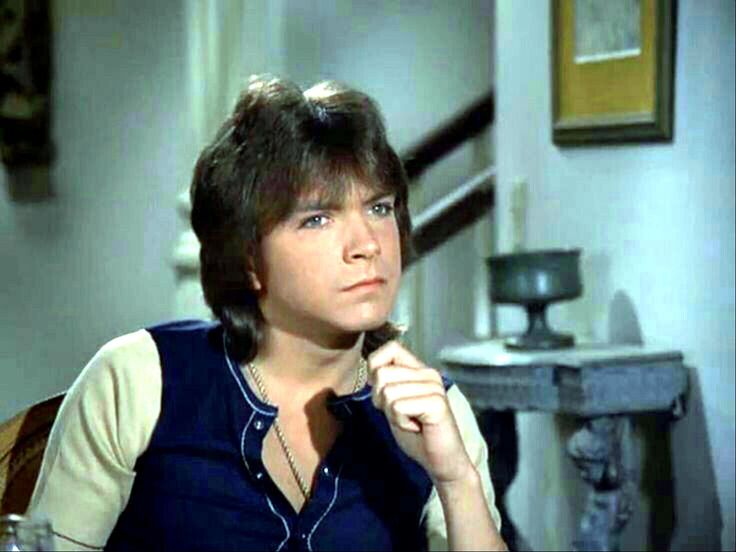
Before the glare of fame softened into memory, David Cassidy’s “(Oh No) No Way” let a flash of resistance cut through the shine of Rock Me Baby.
“(Oh No) No Way” appears on David Cassidy’s 1972 solo album Rock Me Baby, a record released at a moment when Cassidy was already carrying a remarkable double identity. To millions, he was the bright, familiar face and voice connected with The Partridge Family. On his solo albums, though, there was another kind of work being attempted: not a full rejection of the pop image that made him famous, but a gradual widening of it. Rock Me Baby, his second solo LP, followed Cherish in the same extraordinary year and tried to meet the demands of a devoted audience while also giving Cassidy material with a little more adult-pop tension in its seams.
That is why an album cut like “(Oh No) No Way” deserves attention. It is not usually the track that dominates discussions of the album. Listeners are more likely to approach Rock Me Baby through the title song, through Cassidy’s carefully shaped ballad performances, or through the broader story of his early-70s rise. But deep inside an album, away from the obvious doorway, a song can sometimes reveal how an artist’s public image was being held together. “(Oh No) No Way” has that quality. Even before a note is considered, the title itself carries a small act of refusal. It is blunt, quick, and conversational, the sound of someone pushing back rather than surrendering to the smoothness around him.
In 1972, Cassidy’s fame was anything but quiet. The screams, the magazine covers, the television schedule, and the constant machinery of teen stardom could easily make the music seem secondary in the public imagination. Yet his records from this period are more interesting when heard as negotiations. They had to be polished enough for the pop market, warm enough for listeners who loved the television persona, and convincing enough to suggest that Cassidy was not merely a face placed in front of a song. His voice, at its best, carried a boyish brightness with a trace of pressure underneath. That pressure is what gives a track like “(Oh No) No Way” its value.
The song belongs to the clean, concise language of early-70s pop-rock, where melodies were built for immediacy and arrangements often kept their emotions neatly framed. But neatness does not mean emptiness. Within that kind of production, a singer’s smallest choices matter: how firmly a phrase lands, how much edge sits behind a line, how much charm is allowed to harden into attitude. On “(Oh No) No Way”, the central feeling is not grand confession. It is resistance in miniature. Cassidy does not need to abandon the brightness people expected from him; he simply lets a sharper contour appear inside it.
That contrast is part of what makes Rock Me Baby such a useful document of Cassidy’s early solo career. The album is not just a collection of songs placed around a young celebrity. It reflects a pop system in motion, one trying to turn television affection into record-store loyalty while also giving its star room to sound less scripted. The album included material that pointed in several directions: romantic pop, familiar cover territory, and tracks shaped for the audience that already knew every photograph, every smile, every line of the public myth. In that environment, “(Oh No) No Way” becomes a small but telling interruption. It suggests motion. It suggests that the smooth surface was not the whole story.
Album cuts often survive differently from hits. A single is asked to represent an artist in public; it must step forward, announce itself, and carry the weight of memory. A deeper track can behave more privately. It can become the song someone discovers later, after the famous titles have already done their work. For longtime listeners, that is where a record begins to feel lived-in rather than merely remembered. “(Oh No) No Way” has that album-cut appeal: it does not demand the spotlight, but it changes the texture of the record around it. It adds a little friction to an album that might otherwise be remembered only for polish and youthful appeal.
Heard now, the track also benefits from distance. The rush around David Cassidy in 1972 can obscure how difficult it must have been to sing with any sense of self while standing inside such a carefully managed image. One does not need to invent hidden turmoil to hear the tension. It is already present in the historical setting: a young performer known everywhere, making records that had to satisfy fantasy while trying to leave behind something durable. “(Oh No) No Way” captures a sliver of that tension without overexplaining it. Its refusal is modest, but it matters because it interrupts the expected sweetness.
That is the quiet reward of returning to Rock Me Baby beyond the familiar names. The album opens a window onto a moment when pop stardom was bright, fast, and carefully packaged, yet still full of human details if one listens closely. “(Oh No) No Way” may not be the grand centerpiece of Cassidy’s catalog, but it helps complete the portrait. It lets the singer sound a little less like an image and a little more like a young man testing the edges of the frame. In that sense, the song remains valuable not because it asks to be rediscovered as a lost anthem, but because it quietly complicates the story everyone thought they already knew.
