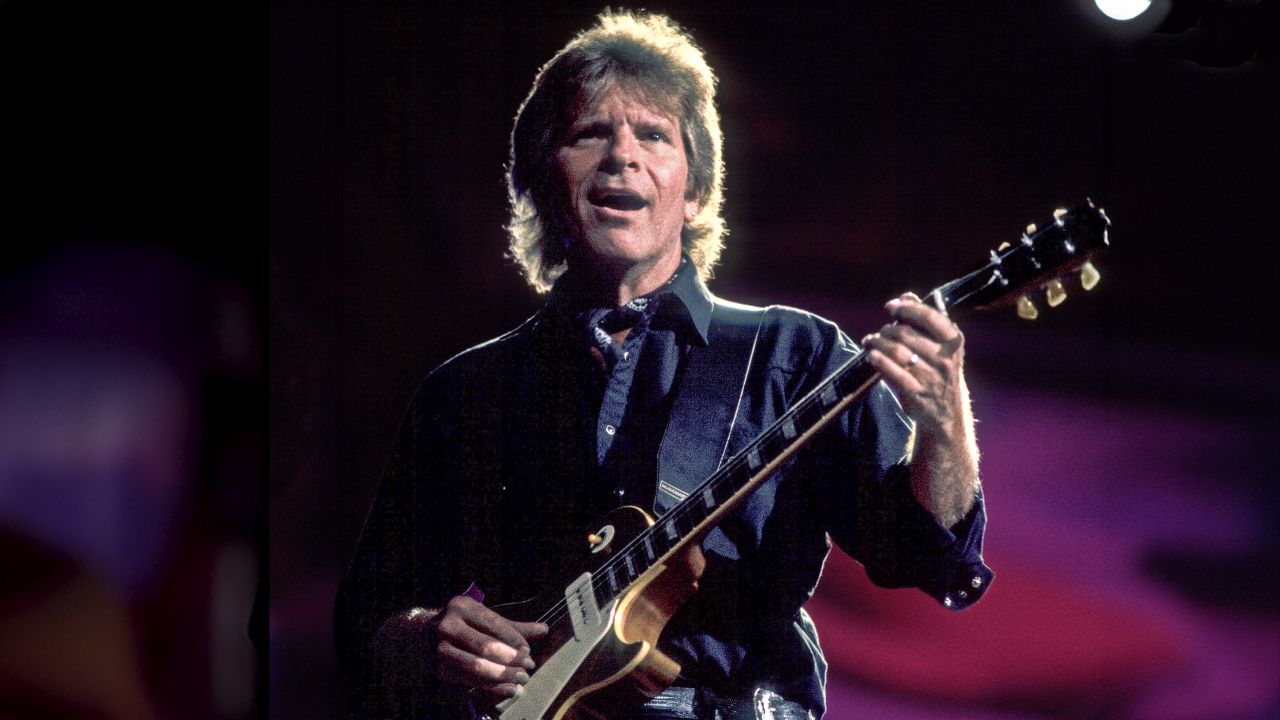
On Dream/Song, John Fogerty made a full-band sound feel like a private room, where craft, control, and independence all pressed against the same tape.
John Fogerty released his self-titled solo album, John Fogerty, in 1975, and Dream/Song belongs to one of the most revealing recording contexts of his post-Creedence Clearwater Revival years: Fogerty famously engineered the sessions and played the instruments himself. That fact is more than a trivia point. It changes the way the track can be heard. What might first seem like a compact roots-rock deep cut begins to feel like a document of self-reliance, made by an artist who understood the language of a band so deeply that he could rebuild it alone, one part at a time.
By 1975, Fogerty had already lived several musical lives. With Creedence Clearwater Revival, he had become one of American rock’s most recognizable voices: direct, nasal, urgent, and disciplined, able to make a three-minute record sound as if it had been carved from wood, swamp air, garage electricity, and AM radio static. After CCR’s breakup, his 1973 album The Blue Ridge Rangers had appeared under a group name even though Fogerty was effectively the group himself, performing the vocal and instrumental parts. The 1975 self-titled album carried his own name on the cover, and that shift mattered. It placed the solitary labor closer to the surface.
Dream/Song sits inside an album that also included songs such as Rockin’ All Over the World and Almost Saturday Night, titles that would travel far beyond the original LP in different ways. But Dream/Song has a quieter kind of importance. It draws attention not only to what Fogerty could write, but to how he could construct a record when there was no band dynamic to lean on, no roomful of players pushing and pulling in real time. The rhythm, the tone, the arrangement, and the sense of momentum had to be imagined internally first, then performed outwardly in layers.
That is the emotional tension at the center of this recording context. Fogerty’s music has often sounded communal, as if it were built for dance halls, car radios, roadside bars, and Saturday nights with the windows open. Yet here, the source is solitary. The listener hears something that resembles a band, but behind it stands one person making decision after decision: where the groove should sit, how the guitars should answer, how much space the vocal should take, when to tighten the arrangement and when to let it breathe. The result is not merely a display of skill. It is a portrait of an artist trying to hold together the sound world he had created, even when the circumstances around that sound had changed.
Fogerty’s great gift has always been compression. His best-known records rarely waste motion. They use plainspoken phrases, muscular chords, and rhythms that seem simple until one notices how precisely they land. On Dream/Song, that same instinct works in a more inward way. The title itself suggests something suspended between memory and construction, between a private vision and a finished track. The slash in Dream/Song almost looks like a seam, a mark between the imagined and the performed. Whether heard as a small album cut or as part of the broader 1975 statement, it carries the feeling of music made under close supervision by the person who had the most to lose if the sound did not hold.
There is also a fascinating contrast between freedom and confinement in a record like this. Playing everything yourself can be liberating: no arguments, no compromises, no need to translate an idea through another musician’s hands. But it can also be demanding in a different way. Every part reflects back on the maker. There is no hiding inside the blend. If the drum feel is stiff, if the guitar line crowds the vocal, if the mood does not cohere, the responsibility returns to one name. Fogerty had long been known as a commanding studio force, but Dream/Song makes that command audible in a more intimate form.
He was not simply proving that he could perform multiple roles. He was preserving a recognizable musical identity after one of rock’s most productive band chapters had closed. The 1975 album arrived before the later commercial comeback of Centerfield in 1985, and because of that it occupies a revealing middle space: after the explosion, before the re-emergence, when the work itself had to carry the argument. Dream/Song does not need to be treated as a grand announcement to be meaningful. Its value lies in the way it lets the listener stand close to the machinery of a song and sense the human pressure behind it.
Heard now, Dream/Song is not just a track from John Fogerty’s 1975 solo album. It is a reminder that independence in music is rarely abstract. Sometimes it sounds like a man in a studio building the illusion of company, trusting his hands, his ears, and his stubborn internal clock. The record moves, but beneath its movement is stillness: one artist alone with the sound he believed in, turning private control into something that could still reach the outside world.
