
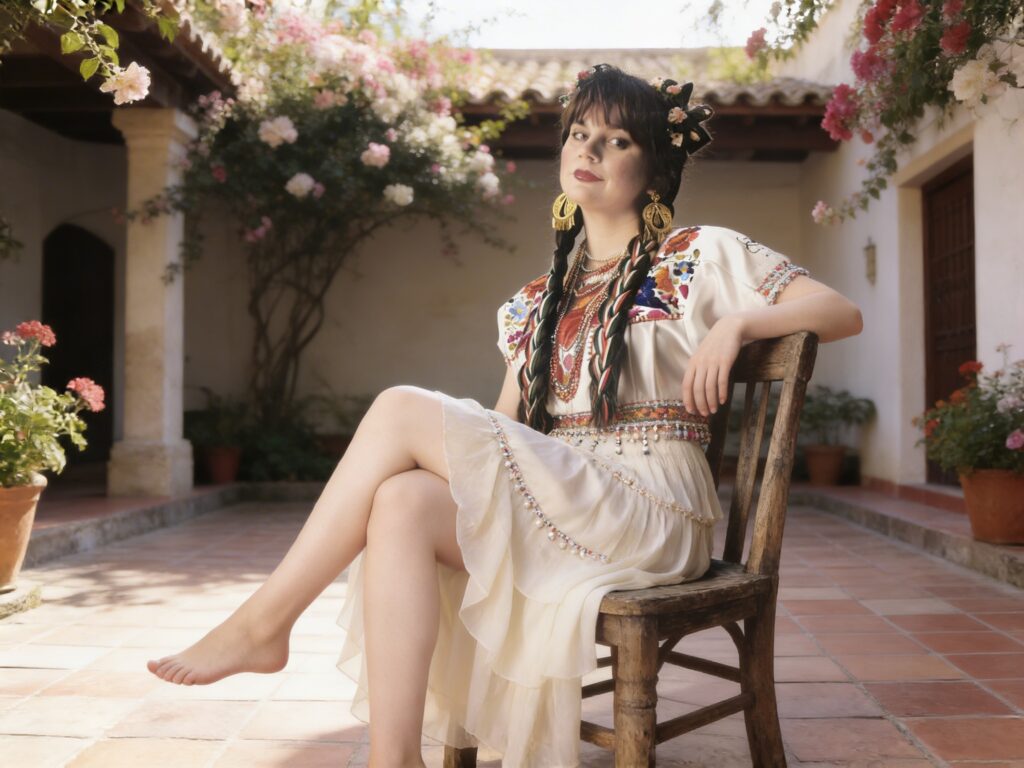
“La Cigarra (The Cicada)” in Linda Ronstadt’s voice becomes a song of proud sorrow—earthbound and aching, yet still singing against the heat, as if endurance itself were a form of grace.
One of the most important facts to place at the very beginning is that “La Cigarra (The Cicada)” was released by Linda Ronstadt on her landmark 1987 album Canciones de Mi Padre, her first full album of traditional Mexican mariachi music. The song itself was not issued as a major charting single, but it lives inside an album of enormous historical weight: Canciones de Mi Padre reached No. 42 on the Billboard 200, won Linda Ronstadt a Grammy for Best Mexican/Mexican-American Album, and went on to become the best-selling non-English-language album in U.S. history. In later years, the album’s stature was confirmed again when it entered the Grammy Hall of Fame and the Library of Congress National Recording Registry. So while “La Cigarra” did not have a separate chart story of its own, it belongs to one of the most significant and deeply personal records Ronstadt ever made.
Just as important is the song’s authorship. Catalog sources for Ronstadt’s recordings identify “La Cigarra” as written by Raymundo Pérez y Soto—often shortened in listings to Ray Pérez y Soto. On Ronstadt’s official and archival song listings, the track appears clearly on Canciones de Mi Padre, where it stands among songs drawn from the Mexican musical tradition that shaped her family life and childhood ear. This matters, because “La Cigarra” was not chosen as an exotic detour or a clever genre exercise. Ronstadt recorded it as part of a return to the music that had lived in her home long before fame, long before California rock, long before the great American stardom that made her one of the defining voices of the 1970s.
That family and cultural return is the real story behind the song. In discussing Canciones de Mi Padre, Ronstadt said she made the album because she loved these songs and because they were part of her inheritance. The Recording Academy described the album as her revisiting “the soundtrack of her childhood,” while the Library of Congress essay on the album emphasizes the deep connection between these songs and her family’s Sonoran Mexican roots. In that setting, “La Cigarra” becomes more than a performance. It becomes remembrance. It becomes recovery. Ronstadt was not borrowing this music from afar; she was going back toward it, almost as one returns to an old house and finds that its silence still knows one’s name.
And what does “La Cigarra” mean? The title points us in the right direction at once. The cicada is a creature known for song, for heat, for persistence, for that dry-season cry that seems to rise from the burning earth itself. In Mexican song tradition, the image often carries sadness, pride, and defiance all at once. The singer may be worn down by pain, poverty, abandonment, or fate, yet still refuses silence. That is the essence of “La Cigarra.” It is not merely a lament; it is a lament that sings back. The sorrow in it is real, but it is never weak. There is dignity in its suffering, and even a kind of rough nobility. The cicada may be small and fragile, but it fills the air with its voice. So too does the soul in this song.
That is why Linda Ronstadt was so right for it. She had one of the great voices of her era, but what made her truly exceptional was not power alone. It was emotional intelligence. She knew how to sing grief without flattening it into melodrama. On “La Cigarra,” she sounds neither ornamental nor distant. She sounds committed—almost reverent before the song’s old hurt. The mariachi setting deepens that effect. The arrangement does not merely accompany her; it surrounds her like memory itself, with all the ceremony, ache, and grandeur that traditional Mexican music can hold. And because Ronstadt approached this repertoire with humility rather than display, the song breathes with unusual authenticity.
There is also something profoundly moving in the timing. By 1987, Ronstadt had already conquered rock, country-rock, pop, standards, and opera. She had nothing left to prove in commercial terms. That made Canciones de Mi Padre—and songs like “La Cigarra”—feel even more meaningful. This was not ambition in the ordinary sense. It was devotion. A late return to origins. A public honoring of private inheritance. In a career full of stylistic triumphs, this music seems to come from an especially intimate chamber of the heart.
So “La Cigarra (The Cicada)” deserves to be heard as one of the emotional centerpieces of Linda Ronstadt’s Mexican songbook: a traditional piece by Raymundo Pérez y Soto, preserved within the great achievement of Canciones de Mi Padre, an album whose success and cultural importance far exceeded ordinary chart language. The song’s deepest meaning lies in its image of suffering that still sings. It understands that sorrow does not always go silent. Sometimes it grows a voice of its own—dry, proud, unyielding—and rises into the hot air like a memory that refuses to die.
