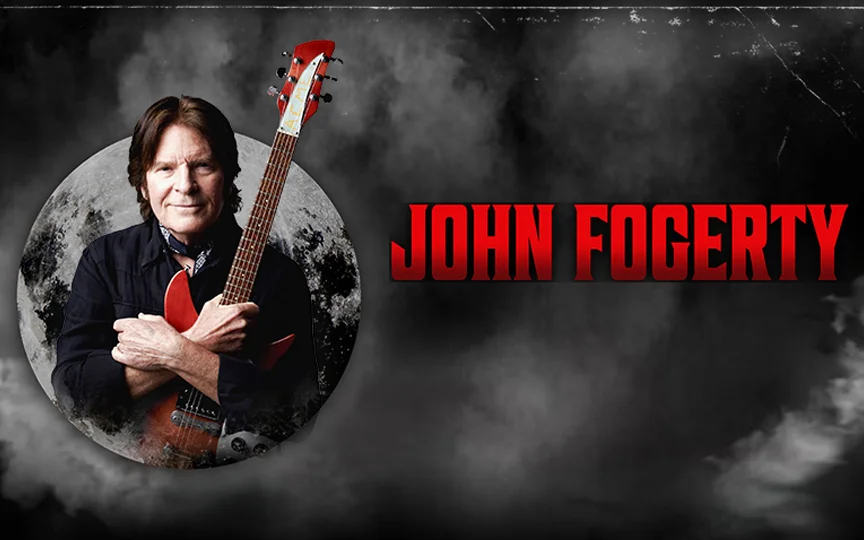
In the shadow of Eye of the Zombie, John Fogerty found a burst of forward motion with Knockin’ on Your Door, a rare promo-side reminder that grit and uplift could share the same groove.
John Fogerty released Eye of the Zombie in 1986, only a year after the remarkable return of Centerfield had brought his voice back to radio with the force of a familiar engine starting again. The song in focus here, Knockin’ on Your Door, came from that 1986 album and also appeared as a promotional 12-inch single, a rarer piece of Fogerty’s solo story that gives one of the record’s more upbeat tracks its own small spotlight. The recording also carries the presence of Alan Pasqua on keyboards, a detail that matters because the track belongs not only to Fogerty’s songwriting world, but to the sound of a particular studio moment in the mid-eighties.
That context is important. Eye of the Zombie was not simply another classic-rock comeback record. It arrived after Centerfield, an album that had reintroduced Fogerty as a one-man force of memory, rhythm, and compressed American storytelling. Where Centerfield often felt like a man reclaiming a baseball diamond, a guitar riff, and a piece of his own public identity, Eye of the Zombie moved into heavier air. Its title track, its production choices, and its uneasy social atmosphere placed Fogerty in a more angular, contemporary frame. The record leaned into the textures of the era: big drums, sharper keyboard colors, and arrangements that did not always look backward toward the swamp-rock economy of Creedence Clearwater Revival.
Inside that setting, Knockin’ on Your Door has a different kind of charge. It does not feel as weighty as the album’s title might suggest, and that is part of its appeal. The song’s forward push, its directness, and its brighter mood make it stand out as a cut that seems to want contact rather than distance. Fogerty had always understood the power of a simple phrase struck hard enough to become a scene. A door is one of rock and roll’s oldest images: someone outside, someone inside, a decision waiting in the space between. In Fogerty’s hands, that image does not need much decoration. The rhythm does the knocking. The vocal supplies the urgency.
The promotional 12-inch format adds another layer to the way the track can be heard. In the 1980s, a 12-inch single was not always a grand commercial event; sometimes it was a working object, pressed to put a song in the hands of radio programmers, DJs, reviewers, and industry people who might give it a little more room than an album track usually received. That makes this Knockin’ on Your Door pressing feel like a signal from a very specific corner of Fogerty’s catalog. It is not the obvious artifact from his solo career. It is not the hit everyone names first. It is the kind of record that turns up later in a collector’s crate and asks a quieter question: what else was happening in that chapter?
Part of the answer lies in the sound. Alan Pasqua’s keyboards help place the song in a landscape far removed from the stripped-down bar-band urgency that many listeners still associate with Fogerty’s most famous work. Pasqua, a skilled and versatile keyboardist, brings a kind of color that supports the track’s momentum without crowding its center. The keyboards do not erase Fogerty’s identity; instead, they show him negotiating with the language of the decade. The result is a record that still depends on drive, voice, and hook, but dresses those instincts in a studio palette that belongs firmly to 1986.
That tension is one reason Knockin’ on Your Door deserves a more careful listen. Fogerty’s voice has always carried an unusual combination of command and strain. Even when a song is upbeat, he rarely sounds casual. There is a flinty edge in his delivery, a sense that the singer is pushing through resistance rather than floating over the track. On this recording, that quality gives the song its human grip. The arrangement can move with brightness, the 12-inch single can suggest promotion and energy, but the vocal keeps the performance grounded in Fogerty’s familiar restlessness.
He was, by this period, no longer simply the former leader of Creedence Clearwater Revival. He was an artist trying to define how much of the past to carry, how much to resist, and how much to reshape inside modern production. The years around Eye of the Zombie were not as universally celebrated as the triumph of Centerfield, but that does not make them disposable. In many ways, they are revealing. They show Fogerty working under expectation, testing the edges of a new sound, and placing his old gifts inside arrangements that belonged to a changing radio world.
The rare promotional 12-inch of Knockin’ on Your Door captures that in miniature. It is upbeat, yes, but not lightweight. It carries the snap of an artist who could still make a groove feel like an invitation and a challenge at the same time. It also reminds us that careers are not made only of the songs that become permanent public monuments. Sometimes the smaller releases, the promotional pressings, the album cuts given a brief separate life, preserve the texture of an era more vividly than the obvious milestones.
Heard now, Knockin’ on Your Door feels like a bright knock from inside a complicated album: a track with motion in its bones, keyboards flashing at the edges, and Fogerty’s voice still cutting through with that unmistakable grain. It may not be the first song people reach for when they tell the story of John Fogerty, but it opens a door onto a fascinating room in that story, one where a classic American songwriter met the production mood of 1986 and found, for a few minutes, a way to keep moving.
