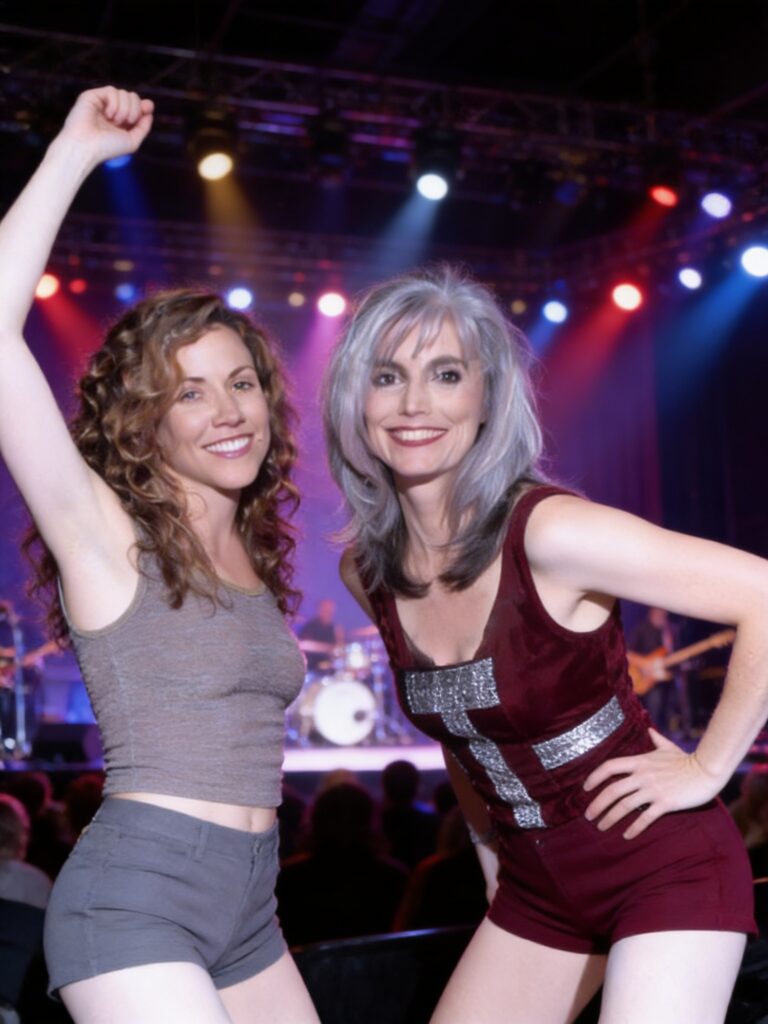
“Wheels of Love” in the hands of Emmylou Harris, Iris DeMent, and Mary Black becomes more than a song—it becomes a gathering of souls, where harmony itself seems to carry memory, longing, and the old, unbroken promise that music can still hold people together.
One of the most important facts to place right at the beginning is that this revered live performance of “Wheels of Love” comes from the original Transatlantic Sessions in 1995, recorded at Montgreenan House in Ayrshire, Scotland and later broadcast as part of the first series. In the official programme listing for that first run, “Wheels of Love” appears in Programme One, performed by Emmylou Harris, Iris DeMent, and Mary Black. The song itself, however, began earlier in Emmylou Harris’s own catalog: it first appeared on her 1990 album Brand New Dance, where it is listed as track one and credited to songwriter Marjy Plant. It also had some modest country-chart life as a single, reaching No. 71 on Billboard’s Hot Country Singles and No. 84 in Canada.
Those facts matter because they show how unusual and beautiful this 1995 performance really is. “Wheels of Love” was not one of Harris’s most famous commercial standards, not one of the titles endlessly recycled through radio memory. It belonged instead to the more reflective side of her work, the side that often lives longest in the hearts of listeners who stay with albums rather than singles. And then, in the setting of Transatlantic Sessions, the song found an even deeper life. Surrounded by the house band and placed among musicians rooted in American, Irish, and Scottish traditions, it stopped sounding like a mere album track and began to feel like a piece of shared musical inheritance.
What makes this live version so moving is not only the song itself, but the voices gathered around it. Emmylou Harris brings that unmistakable silver ache—clear, seasoned, almost unearthly in its calm. Iris DeMent brings a trembling truthfulness, the sound of a heart that has known plain sorrow and still sings without disguise. Mary Black brings warmth, grace, and that deeply human Irish lyricism that makes even a harmony line feel like a hand laid softly on the shoulder. Together, they do not compete. They complete. This is one of those performances where harmony is not decoration but meaning. The song’s emotional world widens because each voice seems to carry its own kind of weather into the room.
And the song itself deserves that kind of company. “Wheels of Love” is built on one of the oldest and most durable images in roots music: the wheel, the turning, the movement that carries us onward whether we are ready or not. In country, folk, and gospel traditions, wheels can mean destiny, time, longing, separation, return. Here, the phrase feels rich with all of those possibilities at once. Love is not still. It turns. It rolls through lives, through memory, through distance, through changes of heart and season. That is what gives the song its haunting pull. It does not treat love as a fixed monument. It treats love as motion—beautiful, inevitable, and touched with sadness because anything that moves can also move away.
In Emmylou Harris’s 1990 studio version on Brand New Dance, that idea is already present, but in the 1995 live performance, the song becomes fuller and more communal. The Transatlantic Sessions setting matters enormously here. This was never a glossy concert vehicle. It was conceived as a meeting place for traditions, players, and voices from both sides of the Atlantic, with the first series recorded in 1995 under the guidance of Aly Bain and Jay Ungar. In such a setting, a song like “Wheels of Love” breathes differently. It sounds less like individual testimony and more like something handed from one singer to another across years and borders.
That is why this performance lingers so powerfully. The title promises movement, but the singing gives it stillness too—the stillness of attention, of listening, of three women standing inside the same emotional truth without forcing it. There is no showy excess here. No grand theatrical push. The beauty comes from trust: trust in the song, trust in the harmony, trust in the old wisdom that three distinct voices can sometimes express a feeling more completely than one. And because the three voices are so different, the result is even more affecting. It sounds like life itself: separate histories meeting briefly in one shared circle of sound.
So “Wheels of Love” (Live 1995) deserves to be heard as one of those quietly extraordinary moments that reveal what live music can do when the right song meets the right singers. It reaches back to Marjy Plant’s composition, to Emmylou Harris’s 1990 recording on Brand New Dance, and then flowers fully in the 1995 Transatlantic Sessions performance with Iris DeMent and Mary Black.
What remains, though, is not the release history. It is the feeling of hearing three legendary voices turn a fine song into something timeless. The wheels keep turning, yes—but for a few minutes here, they seem to turn in pure light.
