
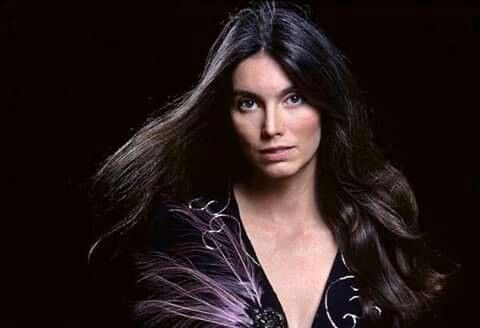
“Beneath Still Waters” is one of Emmylou Harris’s most elegant heartbreak records—a song where pain is kept so carefully beneath the surface that its quietness becomes even more devastating.
One of the most important facts to place right at the beginning is that “Beneath Still Waters” was written by Dallas Frazier and became Emmylou Harris’s fourth No. 1 hit on Billboard’s Hot Country Singles chart in 1980. It was the second single from her 1979 album Blue Kentucky Girl, an album that helped confirm how completely Harris could inhabit classic country feeling without sacrificing any of her own luminous style. The record also reached No. 1 in Canada’s RPM Country chart, and by then Harris had already become one of the defining voices of late-1970s country music. That is the key fact to remember before anything else: this was not merely a respected album cut that listeners later elevated in memory. It was a genuine chart-topping country hit.
The “classic live 1978” label that often circulates around vintage clips should be handled carefully, because the song’s big commercial life belongs to 1980, tied directly to Blue Kentucky Girl and its single release. The available source material I found clearly supports the chart and album history, but it does not firmly establish a specific famous 1978 live performance as the song’s defining original moment. So the performance may be vintage and “classic” in feeling, but the song’s true breakthrough belongs to the turn from 1979 into 1980, when it rose all the way to No. 1.
That history matters because “Beneath Still Waters” is exactly the kind of song that can be misunderstood if one hears only its polish. On the surface, it is calm, poised, almost serene. But the title tells the real story. The song is built on one of country music’s oldest and finest insights: the deepest pain is not always the loudest. Sometimes sorrow does not break the surface at all. Sometimes it lies hidden under manners, grace, and stillness, where it grows even heavier because it is unseen. That image—still waters hiding a dangerous depth—is the whole emotional architecture of the song. It speaks of betrayal, disappointment, and emotional ruin, but in a language of restraint rather than spectacle.
That restraint is exactly why Emmylou Harris was so right for it. Few singers in country music have ever understood better how to let heartbreak breathe without forcing it. In lesser hands, “Beneath Still Waters” could become melodramatic or overly polished. Harris does something finer. She sings it with a calm so complete that the hurt becomes almost ghostly. She never has to announce the pain. It is there in the phrasing, in the silvery ache of the voice, in the way every line seems to float while carrying weight underneath. She makes the song feel like a woman standing perfectly still while the heart inside her is quietly sinking.
Within Blue Kentucky Girl, the song takes on even more meaning. That album is one of the great Emmylou records, full of material that let her move between country tradition and her own reflective, almost otherworldly emotional tone. It also produced the hit “Save the Last Dance for Me,” but “Beneath Still Waters” may be the more purely country wound of the two. It has that old Nashville virtue of saying something brutal with elegance. No shouting. No excess. Just the truth, sung beautifully enough to make the truth hurt more.
There is also something quietly historic about its chart moment. When “Beneath Still Waters” reached the upper part of the country chart in April 1980, it was part of a remarkable week in which the top five country singles were all by female artists, the first time that had happened in Billboard’s history. That detail gives the song an added place in the larger story of women in country music at the dawn of the 1980s. Harris was not merely succeeding alone; she was part of a powerful female presence reshaping the top of the format.
So “Beneath Still Waters” deserves to be heard as one of Emmylou Harris’s essential heartbreak records: a Dallas Frazier song, a 1980 No. 1 country hit, and one of the emotional high points of Blue Kentucky Girl. But beyond all the facts lies the real reason it lasts. It understands that the most dangerous sorrow is often the sorrow nobody sees. And in Emmylou Harris’s voice, that hidden hurt becomes not only believable, but hauntingly beautiful.
