
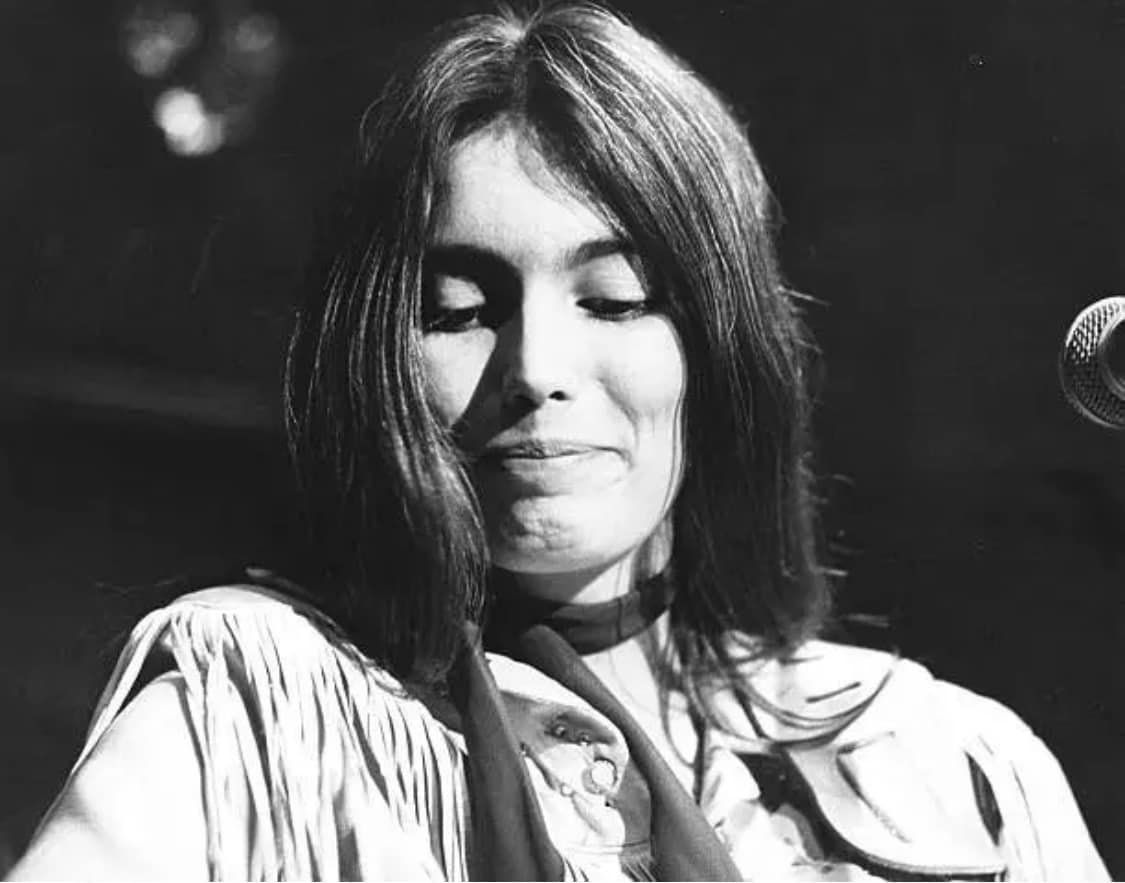
Beyond the Great Divide shows how Emmylou Harris could turn distance, silence, and longing into something almost sacred, singing not just about separation but about the ache of trying to cross it.
Some songs arrive with loud chart numbers, heavy radio play, and a clear place in popular memory. Beyond the Great Divide belongs to a different, often deeper category. In the story of Emmylou Harris, this is not usually treated as one of the big commercial singles that stormed country radio in the way songs like To Daddy or Beneath Still Waters did. It is better understood as one of those reflective performances that reveal why Harris mattered so much in the first place: not simply because she could sing beautifully, but because she could make emotional distance feel visible, like a landscape opening under a fading sky.
That distinction matters. A song does not need a high Billboard peak to endure. In fact, some of the most lasting recordings in the Harris catalog are the ones listeners discover slowly, then carry with them for years. Beyond the Great Divide has that kind of life. It feels less like a radio event than a private reckoning. The title alone suggests geography on a grand scale, but in Harris’s hands the divide becomes emotional as much as physical. It is the space between two people, between the past and the present, between what was promised and what life finally gave.
This is where Emmylou Harris was always singular. From the 1970s onward, she built a body of work that stood at the meeting point of country, folk, and Americana, yet she never sang as if genre were the point. What mattered was truth of feeling. On a song like Beyond the Great Divide, she does not force sorrow. She lets it gather. The phrasing is patient, the emotional shading careful, and the performance trusts the listener to hear what is trembling beneath the words. That restraint is one of the great powers of her music. She never had to oversell a heartbreak song, because she understood that the quietest lines often cut the deepest.
The story behind this song is less about spectacle than sensibility. Harris had a rare gift for choosing material that sounded old, wise, and lived-in even when it was new to the listener. She gravitated toward songs that carried weather in them, songs shaped by roads, rivers, departures, and hard-earned tenderness. Beyond the Great Divide fits naturally inside that artistic world. Its imagery suggests a vast outer space, but the real drama happens inside the heart. The divide in the title can be read as mileage, memory, regret, or even faith itself. Harris sings it in a way that allows all of those meanings to coexist.
That layered meaning is one reason the song lingers. On the surface, it sounds like a meditation on separation. Beneath that, it becomes something more searching: a question about whether love, memory, or devotion can survive the distances life creates. Harris never turns the song into melodrama. Instead, she gives it air. You can hear the horizon in the performance. You can almost feel dusk settling in around it. Few singers have ever been better at creating that sense of emotional landscape, where a single line can feel as wide as a valley and as intimate as a whisper.
There is also something deeply American in the song’s mood. The phrase great divide carries echoes of mountains, frontier distances, old roads, and the lonely beauty of the West. Harris had always been drawn to music that understood place, and this performance carries that instinct beautifully. Yet the brilliance of Beyond the Great Divide is that it never stays merely scenic. The landscape becomes inner weather. The open country becomes solitude. The journey becomes a test of what the heart can still hold after loss, after waiting, after time has done its work.
If the song never became one of her headline chart triumphs, that only sharpens its legacy. It reminds us that Emmylou Harris was never just a hitmaker. She was an interpreter of feeling, one of those rare artists who could make a song sound inherited rather than simply recorded. Many singers can deliver melody. Harris could deliver memory. That is why a piece like Beyond the Great Divide stays with people. It does not shout for attention. It earns it quietly.
And perhaps that is the true meaning of the song. Not just longing, and not just distance, but endurance. The hope that something human can survive the space between where we are and where we ache to be. Harris sings that hope with the kind of grace that defined her finest work. The result is a song that feels timeless precisely because it does not chase the moment. It listens to it. It waits inside it. And long after louder records have faded, Beyond the Great Divide still stands there on the horizon, calm and sorrowful, asking how far love can travel and still remain love.
