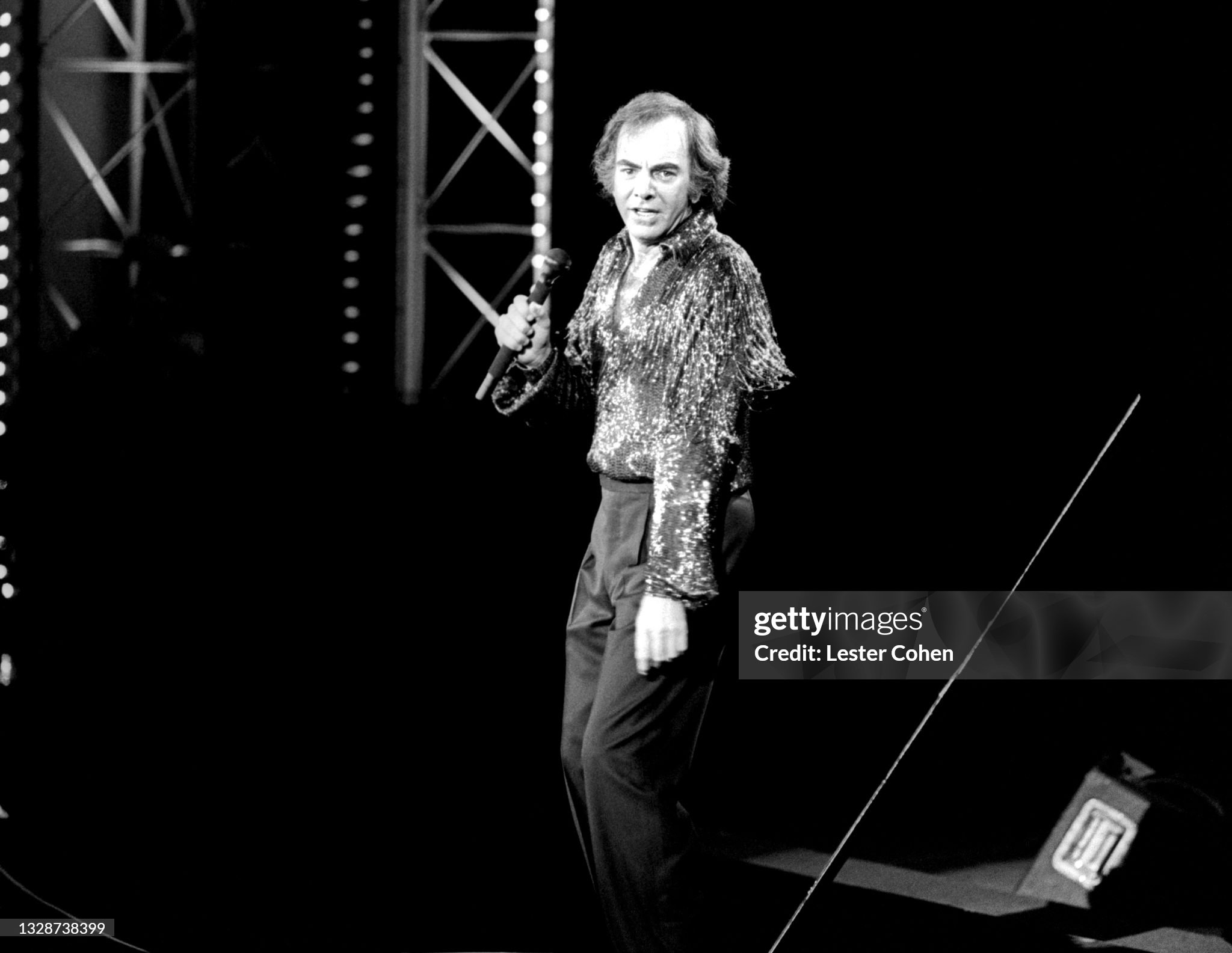
On a record pointed toward tomorrow, Neil Diamond tucked in a song that seemed to stop, look back, and measure a life by memory rather than momentum.
In 1986, Neil Diamond released Headed for the Future, a Columbia album that carried its era right in the title. Popular music was changing quickly: keyboards were cleaner, drums were sharper, studio polish had become part of the language of mainstream pop, and veteran singer-songwriters were finding new ways to place familiar voices inside the bright architecture of the decade. Within that setting, The Story of My Life stands out as an album track that does something quietly revealing. Instead of simply joining the album’s forward motion, it turns the idea of the future into a question about what a person carries with him.
That contrast is what gives the song its particular weight. Headed for the Future sounds, at first glance, like a declaration: a man looking ahead, refusing to be trapped by yesterday, stepping into the production language of the mid-1980s with confidence. But The Story of My Life suggests that no future is ever cleanly separated from the road behind it. The title alone feels almost autobiographical, even before a note is heard. In Diamond’s hands, that kind of phrase does not need to announce grand confession. His best performances often work through plainspoken intensity, the sense that something large is being held just beneath a direct line.
By 1986, Diamond was not a newcomer trying to prove himself to radio. He had already moved through the Brill Building years, the explosive late-1960s and early-1970s run of self-defining songs, the arena-sized concert identity, and the crossover success connected to The Jazz Singer at the start of the decade. His voice was part of American pop memory by then: deep, grainy, dramatic when the moment called for it, but also capable of a conversational closeness that could make a large arrangement feel suddenly personal. On The Story of My Life, that familiar quality matters. The song is not merely about events; it is about the emotional residue of a life lived in public and in private.
As an album track, it does not have to behave like a single built for instant arrival. It can breathe inside the record. That makes it especially interesting in the context of Headed for the Future. The album reflects a period when many established artists were negotiating the sound of the moment without surrendering the identity that had brought listeners to them in the first place. The surrounding production world favors a sleek 1980s finish: polished textures, careful studio surfaces, a sense of controlled scale. Yet Diamond’s presence cuts through that finish because his singing has always carried the feeling of a narrator standing close to the listener, not above them.
The Story of My Life works because it lets the title become both simple and heavy. Everyone has a story of a life; few can reduce it to one easy meaning. In Diamond’s recording, the phrase feels less like a summary than a room full of unfinished echoes. There is the public story, the one made from albums, tours, applause, radio hits, and marquee lights. Then there is the private story, the one hinted at by tone: choices made, love remembered, roads taken because there was no other way to keep moving. The song’s emotional strength lies in that space between certainty and reflection.
What makes this 1986 setting so effective is the tension between surface and center. The decade often rewarded brightness, speed, and electronic sheen, but Diamond had built much of his power on emotional directness. When those two qualities meet, the result is not a contradiction so much as a portrait of an artist adapting without disappearing. The production may belong to its time, but the impulse behind the performance belongs to a much older tradition: the singer as witness, the song as a place where a life can be gathered for a few minutes and looked at honestly.
For listeners returning to Headed for the Future today, The Story of My Life can feel like one of those tracks that quietly changes the shape of an album. It reminds us that a record about moving forward can still be full of backward glances. It also shows how Diamond’s catalog contains not only the songs everyone remembers first, but also deeper cuts that reveal the emotional logic of a particular career moment. In 1986, he was not trying to sound like the young man who had written his earliest hits. He was singing from somewhere farther down the road, where the future no longer meant escape from the past, but an agreement to carry it with more understanding.
That is why The Story of My Life still deserves attention. It is not simply a title tucked into an album sequence. It is a small reflective hinge inside a forward-looking record, a place where Diamond’s 1980s sound meets the long memory of his songwriting persona. The track leaves the listener with a feeling that is difficult to reduce: not regret exactly, not triumph, not nostalgia alone. More like recognition. A life is not one chapter, one decade, one success, or one reinvention. It is all of it moving together, and for a few minutes in 1986, Neil Diamond let that truth sit plainly in the middle of the music.
