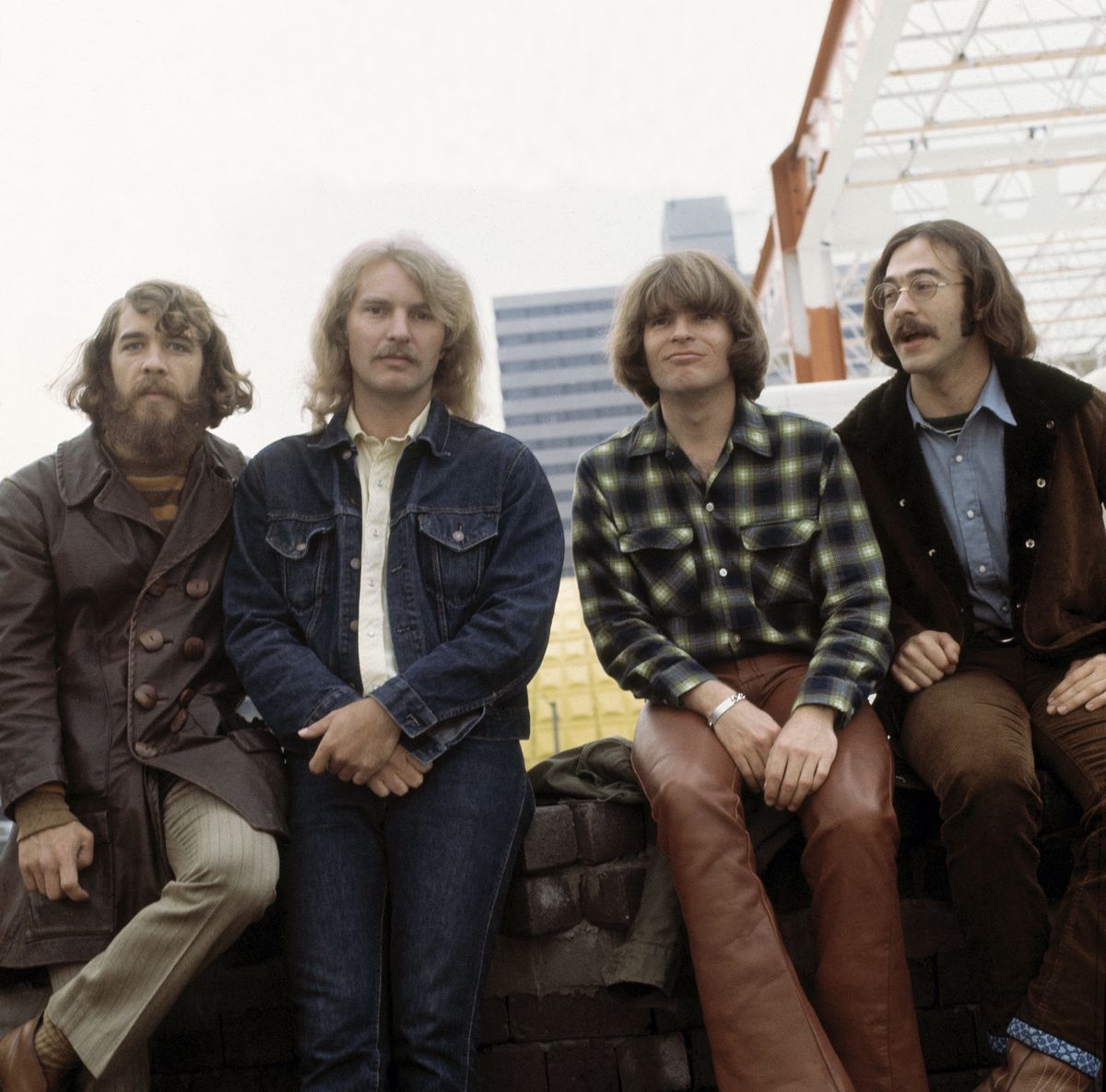
Run Through the Jungle sounded like Vietnam to many listeners, but John Fogerty wrote it as a darker warning about the flood of guns in America.
There are songs that arrive with a meaning so obvious that nobody argues with it. Then there are songs like “Run Through the Jungle” by Creedence Clearwater Revival, a record that seemed, on first listen, to explain itself. It came out in 1970, at the height of the Vietnam era, wrapped in fog, menace, and unease. The title alone nudged people in one direction. The sound pushed them the rest of the way. For years, many listeners assumed it was a Vietnam song.
John Fogerty would later make clear that it was not.
That may be the most fascinating thing about “Run Through the Jungle”: one of the most haunting songs of its time was not written about a faraway battlefield, but about America itself. More specifically, Fogerty has said it was his warning about guns in this country, about the sheer number of them, and about the dangerous atmosphere that number created. Once you know that, the song changes. It does not lose its mystery. If anything, it becomes more unsettling, because the fear in the record is no longer distant. It is close to home.
Released in April 1970 as the B-side of the hit single “Up Around the Bend”, “Run Through the Jungle” rode on a record that reached No. 4 on the Billboard Hot 100. A few months later, it appeared on Cosmo’s Factory, the monumental CCR album that went to No. 1 on the Billboard 200. By then, Creedence Clearwater Revival had become one of the defining American bands of the era, with a run of songs so strong that it almost seemed unreal in real time. But even within that astonishing catalog, “Run Through the Jungle” stands apart. It does not swagger like “Travelin’ Band”. It does not surge with the release of “Up Around the Bend”. It creeps. It stalks. It warns.
The arrangement is a major part of why the misunderstanding lasted. Fogerty’s guitar has that swamp-born tremor, a vibration that feels half-natural and half-mechanical, while the rhythm section moves with a steady, relentless pulse. Doug Clifford’s drums and Stu Cook’s bass do not rush the song; they trap it in place. Over that, Fogerty sings like a man trying to describe danger before it reaches the doorstep. The harmonica, too, adds a ghostly edge. Everything about the performance suggests tension, pursuit, and a threat that cannot be fully seen.
That is precisely why people heard war in it. In 1970, America was saturated with images, headlines, and anxieties tied to Vietnam. A song called “Run Through the Jungle” practically invited a political reading connected to Southeast Asia. But Fogerty’s own explanation points somewhere else. He has said the song was inspired by the alarming number of guns circulating in America at the time. The “jungle” was not a literal place overseas. It was a metaphor for a society where weapons had become frighteningly common, where violence felt near, diffuse, and difficult to control.
That distinction matters, because it reveals something powerful about Fogerty as a songwriter. He was often grouped with the turbulence of his era, and rightly so, but he rarely wrote in lazy slogans. His songs were rooted in American weather, roads, labor, memory, unease, escape, and contradiction. He knew how to write records that sounded immediate without being simplistic. “Run Through the Jungle” is a perfect example. It uses the language of fear without pinning itself to one poster, one speech, or one newsreel. It leaves room for the listener to feel the dread before fully naming it.
And perhaps that is why the song has endured so strongly. A topical song can fade when its headline fades. But a song about the texture of fear, about the feeling of living in a place where danger may be hidden in plain sight, can travel through decades with disturbing ease. When Fogerty later clarified that “Run Through the Jungle” was about guns in America, many listeners were surprised. Yet once that meaning is placed back into the song, the lyrics and mood begin to align in a new way. The track no longer feels misread; it feels deeper than the first reading allowed.
There is also something profoundly American about that misunderstanding. Creedence Clearwater Revival, after all, built their identity from Southern textures despite coming from California, and they made records that felt like old river myths colliding with modern disillusionment. In that world, the “jungle” could be many things: confusion, lawlessness, fear, national anxiety, or moral overgrowth. Fogerty understood how to take a phrase that sounded vivid and familiar, then fill it with meanings that lingered long after the needle lifted.
On Cosmo’s Factory, a record full of energy, confidence, and musical range, “Run Through the Jungle” remains one of the album’s darkest shadows. It is not merely memorable because it is moody. It matters because it captured a truth that has never fully gone away. That is part of the reason the song still lands with such force. It was written in 1970, but its warning does not belong to 1970 alone.
Many songs are remembered for what they sounded like at the time. The great ones keep speaking after the time has passed. “Run Through the Jungle” does exactly that. What once seemed like a song about one war now feels like a troubling reflection of another American struggle entirely. And maybe that is why the record still raises the hair on the back of the neck: it was never only about a place in the distance. It was about the country listening to it.
