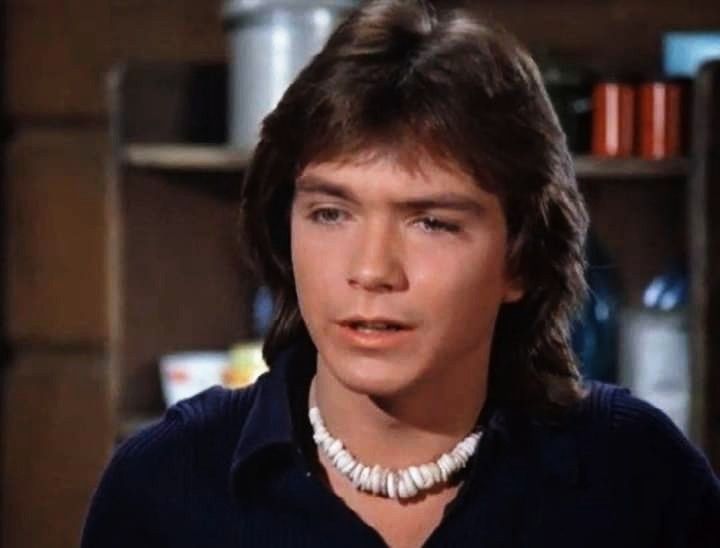
Fifty-five years after Sound Magazine, The Partridge Family’s Walking in the Rain still feels startlingly mature, and much of that power comes from David Cassidy refusing to oversell the ache at its center.
There are songs that become famous because they are huge, and then there are songs that stay with us because they are careful. Walking in the Rain, tucked inside The Partridge Family’s 1971 album Sound Magazine, belongs to the second group. At the time, Sound Magazine was another commercial success for the television-pop phenomenon, reaching the Billboard album chart’s Top 10 in the United States, while the single I Woke Up in Love This Morning climbed to No. 13 on the Billboard Hot 100. Yet 55 years later, it is not only the bright, radio-ready hits that linger. This cover of Walking in the Rain now feels like one of the album’s deepest emotional surprises.
That may sound unusual when we remember how The Partridge Family were packaged in their day: colorful television comedy, polished pop, a family-band fantasy built for mass affection. But records often outlive the images built around them. And when they do, little details become everything. On Walking in the Rain, what lasts is not spectacle. It is restraint.
The song itself came with history. First made famous by The Ronettes in 1964, and written by Barry Mann, Cynthia Weil, and Phil Spector, Walking in the Rain already carried a very particular emotional weather: longing, distance, the ache of seeing someone and not quite reaching them. The original was dramatic, atmospheric, and wrapped in the full force of early-1960s pop grandeur. The Partridge Family version does not try to overpower that memory. Instead, it shifts the center of the song inward.
That is where David Cassidy matters so much. He could sing with force when the material asked for it. He had charisma, clarity, and the kind of youthful intensity that made him one of the defining voices of his era. But on Walking in the Rain, he does something finer than showing range. He measures the feeling. He stays inside it. He phrases the lines as if loneliness is not something to perform for the back row, but something you carry privately, almost carefully, because saying too much might break the mood completely.
This is why the performance feels so adult, even now. Not adult in a flashy or provocative sense, but adult in the old pop tradition: emotionally controlled, observant, bruised, and believable. So much youthful heartbreak on record is sung as if devastation must arrive in a wave. Cassidy understands a different truth here. Some sadness comes softly. Some disappointment does not shout. Some of the most painful feelings arrive in a voice that is trying very hard to remain composed.
And that is exactly why he never oversinging the loneliness becomes the key to the whole track. If he had pushed harder, the record might have turned merely pretty or merely dramatic. Because he holds back, it becomes intimate. The distance inside the song remains intact. You hear the space around the words. You hear a young singer already learning that understatement can wound more deeply than display.
That quality also gives Sound Magazine a richer place in the Partridge Family story than it is sometimes granted. The album is often remembered in the shadow of the group’s biggest television-era hits, but it contains moments where the machine-made brightness of the project opens into something more reflective. Like much of the group’s recorded work, it was built with first-rate studio craft, but craft alone does not create emotional afterlife. Songs endure because a voice finds the right emotional distance. On this track, Cassidy does precisely that.
It also helps explain why listeners who return to the album decades later sometimes hear something they missed the first time. In 1971, many people heard The Partridge Family through the noise of fame: the TV series, the fan magazines, the cultural rush of instant popularity. In that setting, subtlety could be easy to overlook. Now, with all that external excitement long faded into memory, the quieter records have room to speak more clearly. Walking in the Rain is one of those records. Removed from the frenzy, it sounds less like an album cut from a teen-pop institution and more like a small, beautifully controlled meditation on absence.
There is also something moving about where David Cassidy stood at that point in his career. He was still very young, still carrying the impossible burden of being both a television character and a real singer trying to make lasting records. Performances like this remind us that the deeper musician was already there. He did not need to tear the song apart to make us believe him. He only needed to understand where the hurt lived.
Fifty-five years on, that may be the real revelation of Walking in the Rain on Sound Magazine. It is not just a fine cover, and not just an overlooked album moment. It is a record where image falls away and feeling remains. In a catalog remembered for sunshine, harmonies, and bright hooks, this song still stands in the rain a little longer. And because David Cassidy never tries to overwhelm the listener, the loneliness reaches us all the more completely. Sometimes the most lasting performances are the ones that trust silence, trust breath, and trust the listener to hear the heart without being told where it is.
