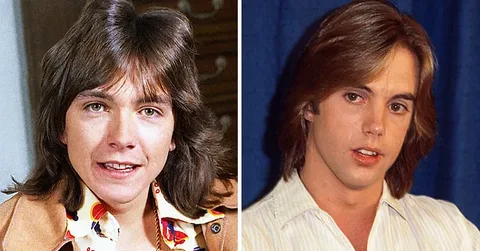
Treat Me Like You Used To is one of those later David Cassidy recordings that asks for a deeper kind of listening: not to the myth of the teen star, but to the adult artist still standing behind the image.
When David Cassidy released Didn’t You Used to Be… in 1992, the title alone carried a sting. It sounded like a challenge, a joke, and a wound all at once. By then, much of the public memory around him had been frozen in the early 1970s, in the bright blur of The Partridge Family, magazine covers, screaming arenas, and a fame so large it almost erased the person beneath it. That is what makes Treat Me Like You Used To so interesting. Heard inside the context of that 1992 album, it plays like more than a romantic song. It feels like part of a larger argument about recognition, maturity, and the cost of being remembered too narrowly.
The album itself arrived after years in which Cassidy had worked across television, stage, and live performance while trying, repeatedly, to move beyond the label of former teen idol. Didn’t You Used to Be… did not pretend the past had not happened. Its very title leaned straight into it. But songs like Treat Me Like You Used To reveal something more subtle than nostalgia. They suggest an artist trying to reclaim emotional space from an image that had followed him for decades. On paper, the title sounds like a plea to return to some earlier state of love. In Cassidy’s hands, it carries another layer. It can also sound like a request to be approached without cynicism, without stereotype, without the tired assumption that everything meaningful about him had already happened.
Musically, the track belongs to its moment. The production sits in the polished adult-pop landscape of the early 1990s, with a smooth surface and a measured sense of control rather than youthful rush. That matters. Cassidy is not trying to recreate the sparkle of his first wave of stardom, and he is not performing some self-conscious parody of it either. He sings as a grown man whose voice has changed with time. The brightness that once made him such an easy vessel for pop fantasy is tempered here by grain, restraint, and a more conversational emotional weight. The effect is not flashy, but it is revealing. Age, in this performance, is not a problem to hide. It becomes the thing that gives the lyric its credibility.
That is why the song works so well as a career-reassessment piece. So much of Cassidy’s reputation has long been shaped by the intensity of his first fame, which was enormous but often flattening. He was frequently discussed as a cultural phenomenon before he was discussed as an interpreter of songs. The image was easy to remember; the later work required a different kind of patience. Treat Me Like You Used To rewards that patience. It does not beg for a second chance with theatrical gestures. It simply lets Cassidy sound like someone who has lived long enough to understand how memory can both comfort and distort.
There is also something quietly clever in how the song sits beside the album title. Didn’t You Used to Be… is a phrase built on public misrecognition, the awkward question asked of celebrities who have outlived the version of themselves people prefer to remember. Treat Me Like You Used To turns that broad cultural tension into something intimate. Suddenly the question is no longer about fame. It is about closeness, habit, tenderness, and the strange gap between who we were and how we are seen now. In that sense, the song becomes one of the clearest windows into the album’s emotional architecture. The personal and the public keep echoing each other.
What makes this especially compelling is that Cassidy never sounds as if he is asking to be turned back into his younger self. The performance carries too much weariness, too much self-awareness, for that. Instead, he seems to be measuring the distance between past and present, between first impressions and fuller knowledge. That is a more interesting drama than simple comeback mythology. Comebacks are often sold as triumph or collapse, victory or disappointment. But many artists live in a far more human middle ground, where the real story is not about reclaiming the spotlight but about being heard clearly again. Treat Me Like You Used To belongs to that category.
It is also a reminder that the early-1990s chapter of Cassidy’s catalog deserves better than a footnote. Popular memory tends to sort musicians into fixed eras: the breakthrough, the peak, the decline, the rediscovery. Real careers are messier than that. A song like this complicates the old script. It shows Cassidy working within the sound of his time while carrying the full burden of his history, neither disowning it nor allowing it to define the whole performance. That balance is difficult, and it is part of why the recording still has value now. The song does not ask for sympathy. It asks for attention.
Listen to it today, and the title starts to feel almost philosophical. What does it mean to be treated as one once was? Is it a wish for innocence, for warmth, for belief, for the version of love that existed before disappointment arrived? Or is it, in Cassidy’s case, a way of testing whether the world can ever meet a familiar face without reducing it to old headlines and old fantasies? That unresolved tension is exactly what gives the recording its afterglow. In Treat Me Like You Used To, David Cassidy is not trapped inside his past. He is standing just outside it, singing with enough grace and steadiness to make you realize how much of the story was left unfinished.
