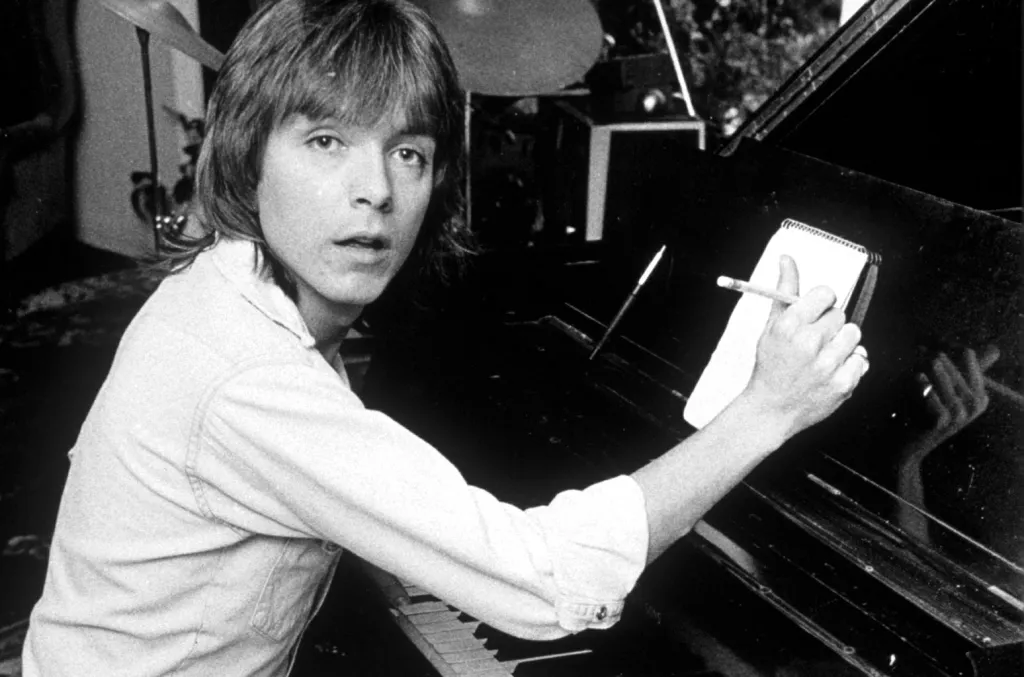
On “The Letter,” David Cassidy’s 1985 Romance era turns the memory of a teen idol into the sound of an artist trying to meet a new decade on its own terms.
Released in 1985 as part of the European-only album Romance, David Cassidy’s “The Letter” belongs to one of the more revealing chapters in his post-Partridge Family life. By the middle of the 1980s, Cassidy was no longer simply the bright face that had once stared out from bedroom walls, television screens, lunchboxes, and fan magazines. He was a grown performer carrying the weight of a very specific kind of fame: the kind that arrives early, burns loudly, and then leaves the artist with the difficult task of being heard again without being frozen in memory.
That is what makes “The Letter” feel so interesting inside the Romance album. The record was not a broad American relaunch built around old teen-idol recognition. It was a European pop release, shaped by the clean, glossy language of the 1980s: keyboards, carefully framed vocals, smooth adult-pop textures, and a sense of romantic drama that belonged to radio of that moment rather than to Cassidy’s early-1970s past. The setting matters. In Europe, where pop audiences often embraced reinvention with fewer boundaries between rock, dance, synth-pop, and adult contemporary, Cassidy could step into a different kind of light.
Romance is often remembered in connection with “The Last Kiss”, the album’s most visible 1980s calling card, which featured George Michael on backing vocals and helped bring Cassidy back into the UK pop conversation. But “The Letter” offers a quieter doorway into the same reinvention. It does not need to announce itself as a comeback manifesto. Instead, it reveals the more delicate challenge of the project: how does an artist whose voice had once been attached to teenage fantasy sing as an adult without sounding as if he is fighting his own history?
In that sense, “The Letter” becomes more than just an album track. The title itself suggests distance, delay, and words that could not be spoken directly. A letter is intimate, but it is also removed from the immediate heat of a conversation. It carries feeling across space. It allows someone to say what might be too difficult to say face to face. Within Cassidy’s 1985 context, that idea gains an extra layer. The song sits in a period when he was, in effect, sending a message to listeners who thought they already knew him.
The power of this era is not that Cassidy abandoned his past. He could not, and the best parts of his later work do not pretend otherwise. What “The Letter” suggests is something subtler: a performer learning to place that past at a distance, to let it exist without letting it control every note. His voice no longer has to carry the effortless shine of a television phenomenon. It can sound more measured, more shaded, more aware of the distance between youthful image and adult experience. The 1980s production does not erase that tension; it frames it.
That frame is important because the mid-1980s were not especially gentle to artists trying to return after being branded by an earlier era. Pop had become intensely visual and fast-moving. New stars arrived with sleek videos, fashionable surfaces, and studio sounds built for a modern radio landscape. Cassidy entered that world with a name everybody recognized, but recognition can be a double-edged gift. It opens the door, then asks the artist to prove he belongs in the room for reasons beyond memory.
“The Letter” carries that pressure in a restrained way. It does not ask to be heard as a spectacle. It asks to be heard as a piece of adult pop shaped by a man who had already known the dangers of being loved too loudly and too narrowly. There is a sense of careful control in the way the Romance era presents him: not the loose defiance of a rock-star reinvention, not a retreat into oldies comfort, but a polished attempt to speak the language of the present. For Cassidy, that present was the 1980s, and it required a different kind of confidence.
Listening to “The Letter” now, the most moving thing may be the gap between what the public expected from David Cassidy and what the song quietly asks for. It asks for patience. It asks for the listener to notice the adult craft underneath the famous name. It asks us to understand that reinvention is not always loud, dramatic, or victorious in the obvious sense. Sometimes it is a singer stepping into a new arrangement, allowing the old image to remain in the background, and trusting that the voice can still carry meaning without the machinery that first made it famous.
That is why “The Letter” deserves a careful place in the story of Romance. It captures Cassidy at a crossroads that was not only commercial, but emotional. He was not simply chasing trends; he was trying to locate himself inside a decade that sounded different from the one that had made him a star. The result is a recording that feels like a message folded into clean 1980s pop fabric: controlled, vulnerable, and quietly aware that being remembered is not the same thing as being understood.
In the end, David Cassidy’s “The Letter” is valuable because it lets us hear reinvention not as a slogan, but as a human negotiation. It is the sound of an artist standing between the boy the world would not forget and the man still looking for room to sing in the present tense.
