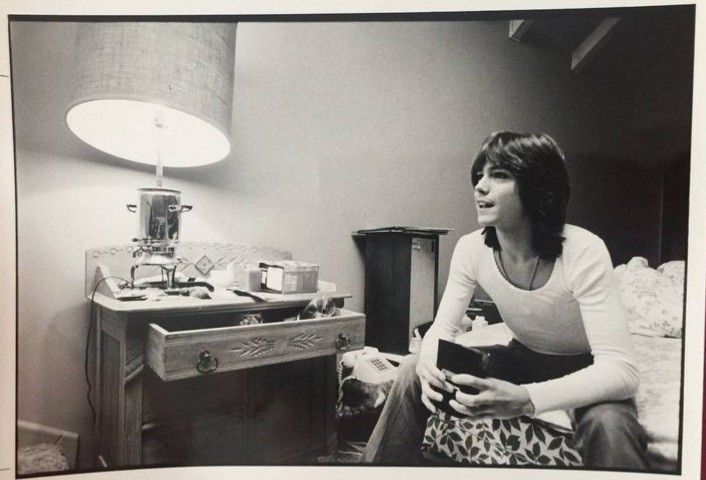
At the end of Cassidy Live!, David Cassidy sounded less like a manufactured dream and more like a young performer trying to outshout the frame built around him.
The six-minute Rock Medley that closes David Cassidy‘s 1974 live album Cassidy Live! is not just a fast ending tacked onto a concert record. It is the album’s final argument. After a set shaped by the pressures and expectations surrounding one of the most recognizable young entertainers of the early seventies, Cassidy ends not with a gentle bow, but with speed, sweat, and the old language of rock and roll pushed through the noise of an arena crowd.
Released in 1974, Cassidy Live! arrived at a complicated moment in Cassidy’s public life. The Partridge Family, the television series that had made him famous as Keith Partridge, was reaching the end of its run that same year. His solo career had already taken on a life of its own, especially in Britain, where his records and concerts drew a level of devotion that could be both thrilling and suffocating. To many people, Cassidy was still a poster on a bedroom wall before he was heard as a musician. That tension sits underneath the live album, and it gives the closing Rock Medley a sharper edge than a simple nostalgia workout.
What makes the medley strike so hard is the way it refuses the soft outline that fame had drawn around him. A performer marketed as beautiful, approachable, and romantic could easily have closed a record with warmth and reassurance. Instead, Cassidy drives toward something more physical. The medley reaches back toward the roots of rock performance: the snapped rhythm, the shouted momentum, the quick turns, the sense that the band is not decorating the singer but pushing him forward. It is built for movement rather than polish, for impact rather than delicacy.
That matters because live albums from the teen-idol era often carry a strange double burden. They document music, but they also document reaction. The screams can become so famous that they threaten to swallow the performance itself. On Cassidy Live!, the crowd is part of the atmosphere, a constant reminder of the scale of his fame. But during Rock Medley, Cassidy sounds as if he is trying to cut through that weather. The performance does not ask the audience to calm down. It tries to meet the volume with force.
A medley can sometimes feel like a shortcut, a string of familiar fragments designed to keep a crowd happy. Here, because of where it sits on the album, it takes on a different meaning. As the closing track, it becomes a release valve. The six-minute length gives the finale room to gather pressure. Instead of presenting Cassidy only as a singer of carefully arranged pop moments, it places him inside a rougher, older tradition of stagecraft, where stamina and timing matter as much as sweetness of tone. The performance is not refined in the studio-pop sense, and that is part of its appeal. It wants to be felt in the body.
Heard now, the track also carries the weight of hindsight. The year 1974 was a turning point for Cassidy, not only because of the end of The Partridge Family, but because the scale of his concert fame had become increasingly difficult to manage. The frenzy surrounding his live appearances was real, and after the tragic crowd incident at London’s White City Stadium in 1974, Cassidy would step back from the kind of touring life that had placed him at the center of such intense public emotion. The Rock Medley should not be reduced to that tragedy, but it is hard not to hear the performance as part of a season when the stage itself had become both liberation and pressure chamber.
That is why the finale still feels revealing. It does not erase Cassidy’s pop identity, and it does not pretend he was someone other than the artist his audience loved. Instead, it complicates the picture. Beneath the television smile and the magazine-cover image was a singer who understood that rock and roll was not only a sound but an act of assertion. In those closing minutes, he seems to be saying that he could carry more than adoration. He could carry heat, pace, and risk.
The beauty of Rock Medley is that it does not ask for a grand reassessment with speeches or explanations. It simply plays. It closes Cassidy Live! with a rush of old-school energy, leaving behind the impression of a young star trying to turn spectacle back into music. For anyone who has only remembered David Cassidy as a face from the early seventies, this finale opens another door. It shows him in motion, fighting for space inside his own fame, and ending the album not as an image but as a performer still pushing for the last burst of sound.
