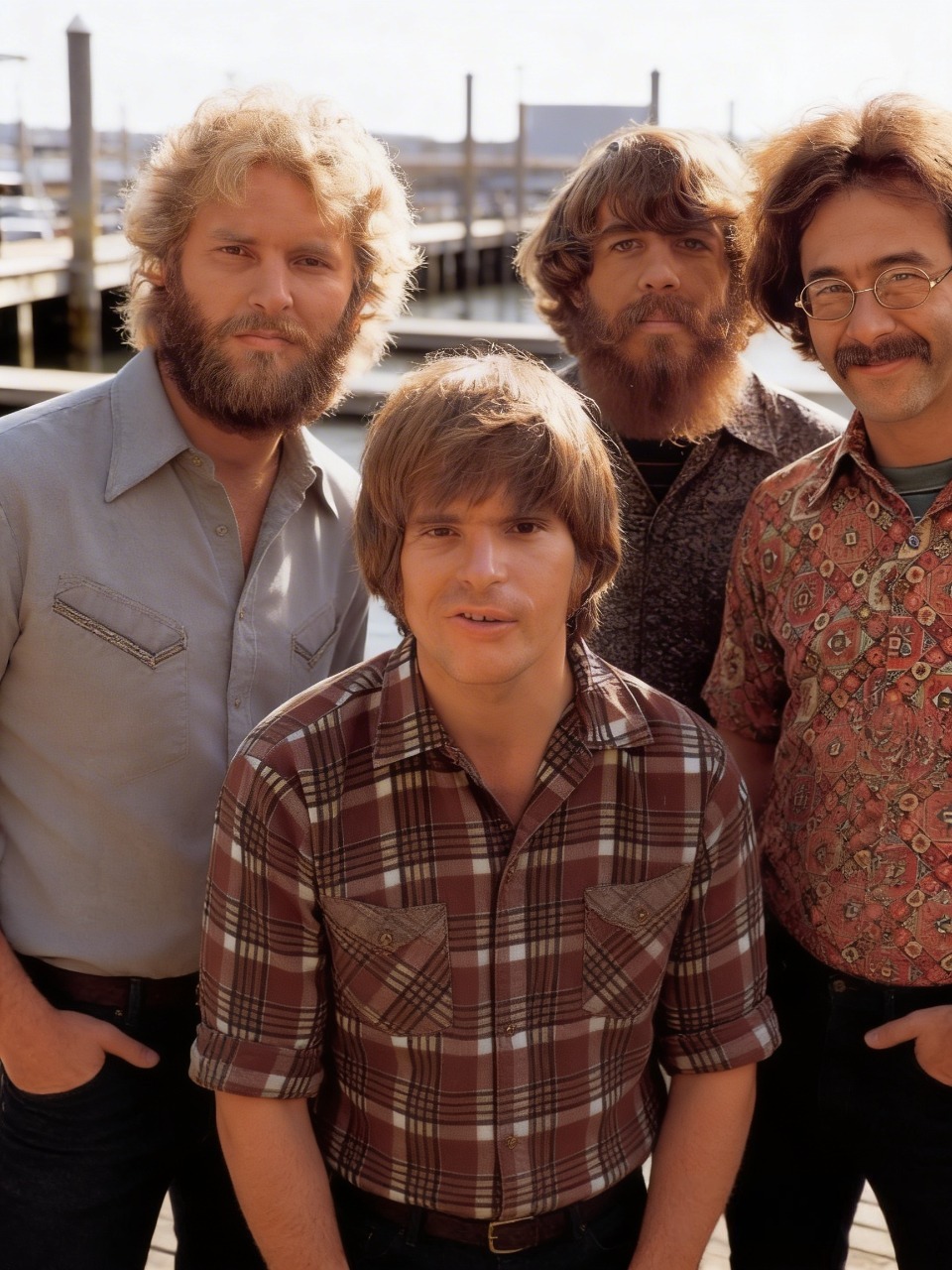
A short Creedence Clearwater Revival deep cut asks a plain American question: who carries the country while others look away?
Creedence Clearwater Revival released “Don’t Look Now (It Ain’t You or Me)” on the 1969 album Willy and the Poor Boys, placing one of John Fogerty’s most direct social observations beside songs that were already turning the band’s swampy rock and roll into a language of American unease. It was not the album’s loudest protest. It did not arrive with the blunt force of “Fortunate Son” or the street-corner brightness of “Down on the Corner.” Instead, it moved with the deceptive ease of a folk-rock tune, asking its questions in a voice so plain that the accusation could almost pass for conversation.
The song’s power comes from that plainness. Fogerty frames the lyric around labor: coal from the mine, salt from the earth, food from the field, shelter built by hand. The repeated answer, “Don’t look now, it ain’t you or me,” is not merely a joke at someone else’s expense. It is a mirror held at an uncomfortable angle. The line suggests a society that depends on workers while keeping them at a distance, a nation proud of production but less willing to see the people who make production possible. In under three minutes, the song turns everyday necessities into a civic roll call.
Musically, “Don’t Look Now (It Ain’t You or Me)” does not shout. That restraint is part of its bite. The arrangement sits close to American roots music, with a steady rhythm, clipped phrasing, and a melody that feels as if it could have been carried across a porch, a union hall, or a small-town barroom. CCR were often described through the imagery of bayous and back roads, though the band came from California’s Bay Area. What mattered was not geography alone but feel: they created a compressed sound of working landscapes, where guitar, bass, drums, and voice seemed to leave very little wasted space.
Fogerty’s vocal is central to the song’s authority. He does not perform the lyric as a distant narrator with delicate irony. He sings it with a dry, almost matter-of-fact edge, as if the answer has been obvious all along and only now is being said aloud. The phrasing gives the questions room to land, but it does not linger over them. That economy keeps the song from becoming a lecture. It sounds less like a manifesto than a work song turned inside out: instead of celebrating labor from the outside, it asks who has the privilege of being absent from it.
On Willy and the Poor Boys, that question fits into a larger portrait. The album was released in a remarkably productive year for the band, following Bayou Country and Green River, and it blended original songs with pieces connected to older American folk and blues traditions, including “Cotton Fields” and “The Midnight Special.” The record’s title and cover imagery leaned toward a makeshift, street-band idea of music: players gathering where people pass by, making sound out of ordinary public life. Against that setting, “Don’t Look Now” feels like the album quietly asking what ordinary life costs.
The late 1960s gave rock music many languages of protest: psychedelic expansion, electric fury, poetic abstraction, documentary realism. Creedence Clearwater Revival found a different kind of force by narrowing the frame. The band’s songs often used simple structures, but simplicity did not mean thinness. In this track, the repeated title phrase becomes a moral mechanism. Each verse returns to the same unsettling division between those who need the work done and those who do it. The song does not name a single villain. That is one reason it remains sharp. It points toward a whole arrangement of comfort, labor, and avoidance.
There is also a subtle tension in the pronoun “you or me.” Fogerty does not let the listener stand safely outside the song. The phrase can sound like a shrug, a warning, or an indictment depending on how closely one listens. It implicates the comfortable listener, but it also recognizes how easy it is to belong to a system without fully seeing one’s place in it. The song’s American truth is not only that hard work exists. It is that a country can build its identity around work while allowing many workers to remain anonymous.
As a deep cut, “Don’t Look Now (It Ain’t You or Me)” benefits from being encountered away from the heaviest glare of classic-rock memory. Without the burden of anthem status, it can be heard in its original scale: compact, unsentimental, and exact. Its protest is not theatrical. It is almost domestic. The song moves through basic human needs — fuel, food, materials, care — and asks who will provide them. The more ordinary the list becomes, the more serious the question feels.
That is why the recording still carries weight. It understands that social criticism does not always need grand language. Sometimes it needs a rhythm sturdy enough to walk on, a voice that refuses ornament, and a refrain simple enough to follow a person into the day’s work. Creedence Clearwater Revival made many songs that sounded like America in motion. With “Don’t Look Now (It Ain’t You or Me)”, they caught another sound: America looking over its shoulder, realizing that the hands holding it up may not be the hands receiving the credit.
