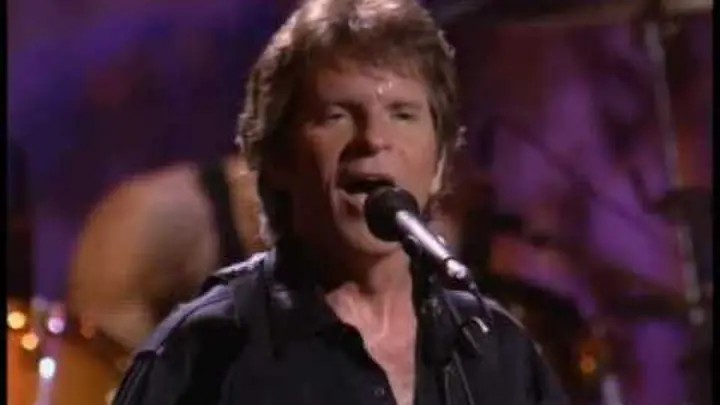
Before John Fogerty stepped forward alone, he built a bright country band out of himself.
In 1973, Blue Ridge Mountain Blues opened The Blue Ridge Rangers, the first solo album by John Fogerty after Creedence Clearwater Revival disbanded the previous year. It was not presented as a standard singer-songwriter debut. The album appeared under the name The Blue Ridge Rangers, and the crucial fact was almost plain enough to seem like a riddle: there were no Rangers beyond Fogerty. He sang the songs and played the instruments himself, using old country and gospel material to make a full-band record alone.
The choice gave the opening track unusual weight. A listener waiting for a direct public statement after Creedence did not receive one. Instead, Fogerty began with a country standard from an older songbook, often credited to Cliff Hess, a tune of mountain memory and homesick return. In that setting, the title did double work. Blue Ridge Mountain Blues named the song, but it also seemed to sketch the imaginary territory where The Blue Ridge Rangers could exist.
Fogerty’s version is energetic without becoming flashy. The rhythm sits forward, the guitars are picked with compact purpose, and the vocal moves in clean, clipped phrases that keep the old lyric from sinking into wistfulness. The song carries homesickness, but this recording keeps traveling. That contrast is the heart of it: a tune about looking back is made to feel like an act of moving ahead. The performance does not deny the ache in the material; it gives the ache wheels.
The multi-instrumental nature of the recording matters because it can be heard as discipline, not novelty. Fogerty does not crowd the track to prove how many roles he can occupy. The parts are arranged to make the illusion of a working country band believable: a sturdy pulse, bright string figures, short instrumental answers, and a lead voice placed where the ensemble naturally gathers. The energy comes from coordination. Each layer seems to know its job, and that gives the track its brisk confidence.
This was a striking way to begin a solo life. Creedence Clearwater Revival had been built around Fogerty’s voice, writing, guitar, and sense of American vernacular music, yet a band’s identity is never the work of one fact alone. Under the Blue Ridge Rangers name, he avoided turning the album into a direct extension of Creedence. The swamp-rock force was replaced by a cleaner country profile, and original songs were replaced by covers. The album looked backward through repertoire, but its method was pointedly new for him.
Blue Ridge Mountain Blues also reveals how deeply Fogerty understood older popular forms as living materials. He does not approach the song as fragile museum glass. He tightens it, brightens it, and sings it with the sturdy directness that had always made his voice sound older than the calendar around it. The mountain setting in the lyric remains distant, but the performance is present-tense. Rather than reproducing a bygone sound exactly, he lets the song pass through his own rhythmic instincts.
The restraint of the project is easy to miss because the playing is so alive. There is no grand introduction announcing a reinvention, no autobiographical lyric asking to be decoded, no display of wounded grandeur. The statement is practical: choose a song, arrange every part, perform it cleanly, and let the recording stand. In the early 1970s, when rock artists often framed solo debuts as revelations of self, Fogerty’s first move was to disappear into a name that sounded like a group from somewhere else.
That disappearance was not empty modesty. It created distance from the expectations attached to John Fogerty the frontman, while still allowing his musical fingerprint to appear everywhere. The snap of the arrangement, the plainspoken vocal attack, and the love of American roots music all point back to him. Yet because the song is a cover, and because the band is fictional, Blue Ridge Mountain Blues becomes less about confession than craft. It is a portrait made through selection and execution.
As an opener, it does something quietly brave. It begins after a famous band not by escalating the noise, but by rebuilding the room. Fogerty places himself at every instrument, but the result does not feel isolated; it feels communal, as if careful overdubbing could summon the fellowship implied by the band name. The solo transition is there in the facts, yet the music refuses to sound lonely. It is one musician drawing a circle wide enough to stand inside.
Decades later, the recording still offers a clear lesson in artistic movement. A new chapter does not always begin with an announcement. Sometimes it begins with an old song, a borrowed name, and the patience to play each part until a path appears. John Fogerty did not open The Blue Ridge Rangers by explaining where he had been. He opened it by setting Blue Ridge Mountain Blues in motion, and the motion was the message.
