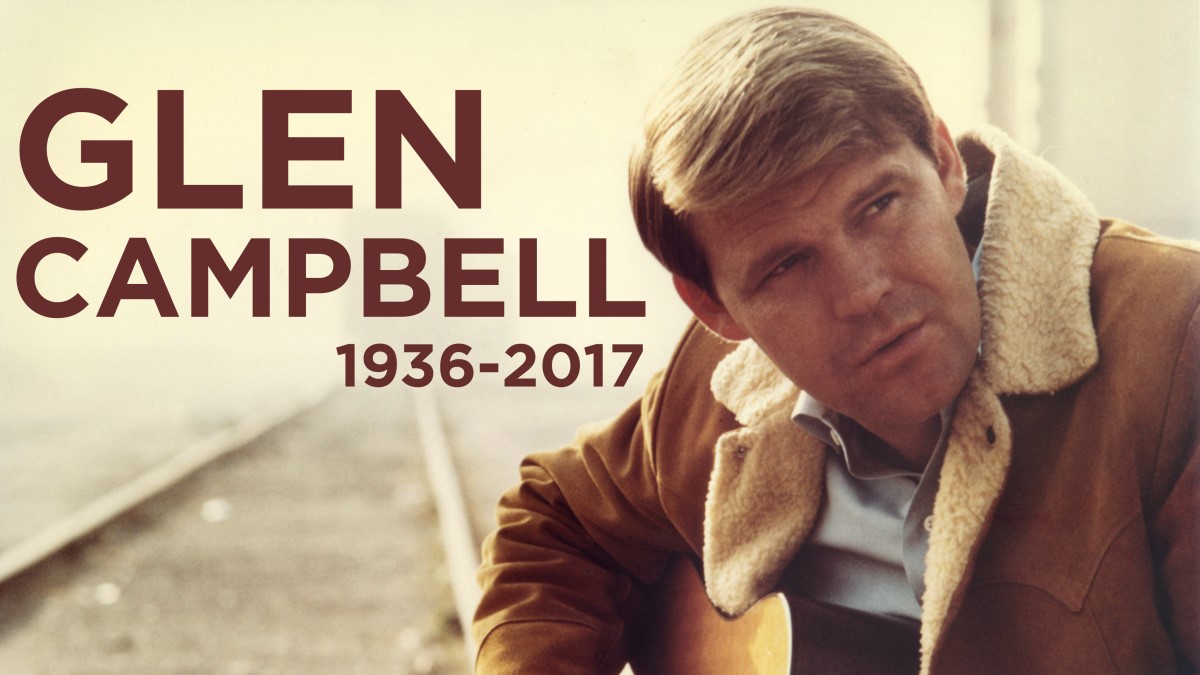
A man maintaining the line becomes the song’s quietest instrument: steady, exposed, and far from home.
In 1968, Glen Campbell recorded Wichita Lineman, a Jimmy Webb song that turned a county utility worker into one of pop music’s most affecting narrators. Issued as the title track of Campbell’s Capitol album that year, it followed the success of another Webb composition, By the Time I Get to Phoenix, but it did not repeat that earlier song’s shape. Instead of a man leaving a relationship behind, this voice is suspended in the middle of work, weather, and yearning. He is driving a road, listening through a wire, and measuring private ache against public duty.
Webb’s idea came from the kind of image many people would pass without turning into art: a lone line worker seen against the open spaces of the American plains. Though the title names Wichita, the emotional geography is larger than one city. The song belongs to long roads, service routes, utility poles, and the strange intimacy of distance. Its genius is that it finds romance not in a candlelit room, but in infrastructure: a man’s job becomes the channel through which longing travels.
The arrangement, guided by producer Al De Lory, gives that image a horizon. Wichita Lineman moves with a country-pop pulse, but it is softened by orchestral color and a sense of space. The rhythm never hurries. The strings rise as if the landscape itself is widening, while the instrumental passages suggest signals moving across invisible miles. Nothing in the recording feels crowded. Every sound seems to leave room for the next thought, the next pole, the next stretch of road.
Campbell’s vocal performance is the center of that restraint. He had the clean diction and melodic ease of a pop singer, but also the grounded warmth of someone connected to country music’s plainspoken storytelling. Here, he does not dramatize the lyric as a grand confession. He sings it almost as a report from the field, and that is what makes it so moving. The feeling does not arrive through theatrical force; it arrives through steadiness. This is male storytelling by subtraction, where emotion gathers power because the singer refuses to decorate it.
Webb’s lyric also resists over-explanation. We do not get a full history of the relationship, a scene between lovers, or a clear promise that anything will be repaired. We hear the worker’s solitude, the signal in the line, and a need that has outgrown simple desire. The brief phrase “I need you more than want you” has often stayed with listeners because it sounds both direct and unsettled. It is not polished courtship language. It feels like a sentence discovered after too much time alone with one’s own thoughts.
That balance between plainness and mystery placed the song perfectly inside Campbell’s late-1960s rise. He was becoming one of the rare artists who could move between country, pop, television, and sophisticated studio production without losing the accessibility of his voice. Wichita Lineman did not ask him to choose between those worlds. It let him inhabit all of them at once: the rural road, the polished orchestra, the working man’s vocabulary, the modern ache of being connected and unreachable at the same time.
The song’s beauty lies partly in how little it resolves. The lineman remains at work. The wire remains open. The person he longs for remains distant, perhaps present only as a voice, a memory, or a hope carried through the lines. That open ending is not a weakness in the storytelling; it is the point. Many songs describe longing as a crisis that must be solved. Wichita Lineman understands longing as something people sometimes carry while continuing to do what the day requires.
More than half a century later, the recording still feels unusually modern in its loneliness. It recognizes that connection can be technical without being complete, that a human voice can travel far and still not reach where it needs to go. Campbell’s performance gives dignity to that contradiction. He does not break under the distance, and he does not conquer it. He keeps the line open. In that quiet act, Wichita Lineman becomes a song about endurance without speeches, devotion without display, and the fragile courage of staying connected.
