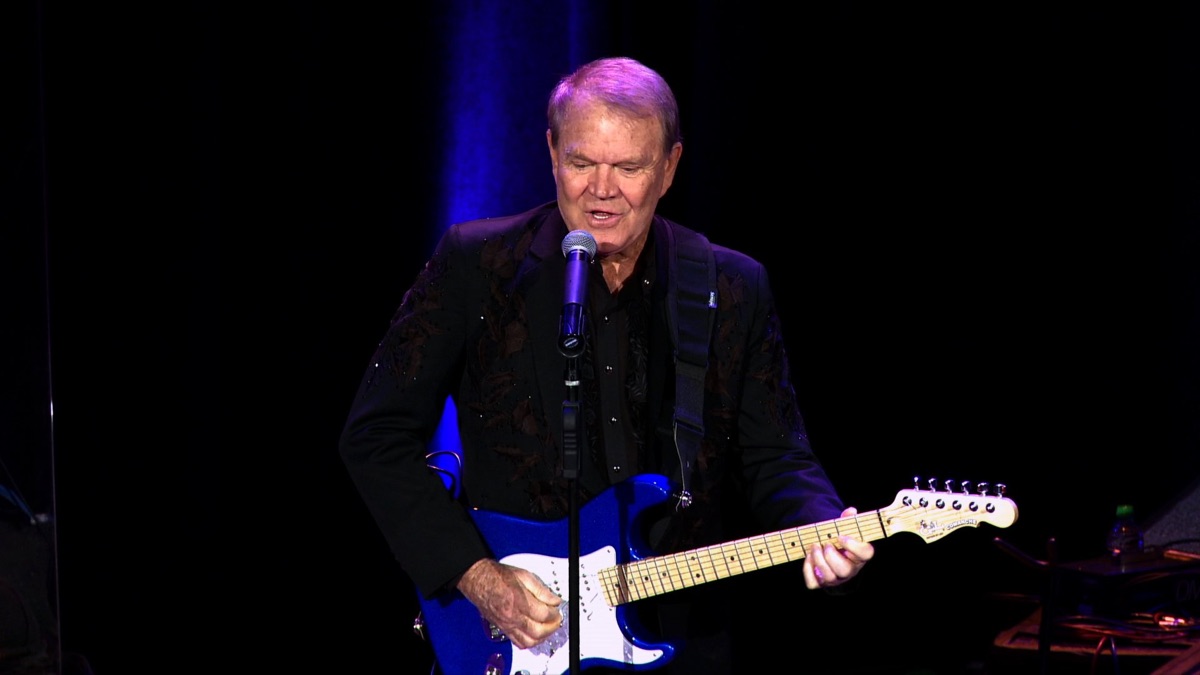
In 1975, Glen Campbell made ambition sound polished, wounded, and strangely noble.
“Rhinestone Cowboy”, released by Glen Campbell in 1975, became one of the defining country-pop crossover records of its decade. Written by Larry Weiss, the song had already existed before Campbell made it his own, but his version gave it a different kind of reach: warm enough for country radio, bright enough for pop, and dignified enough to carry the private ache beneath its glittering title. It topped major American pop and country charts and traveled far beyond Nashville, helping fix Campbell’s image in the public imagination as a performer who could stand comfortably between worlds.
That position mattered. Campbell was not a country singer trying on pop sophistication as a costume; he had long been fluent in both languages. Before his solo stardom, he worked as a first-rate studio guitarist, contributing to the Los Angeles session world with the discipline of a musician who understood how records were built from the inside. By the time “Rhinestone Cowboy” arrived, he already carried the ease of television fame, the precision of a studio professional, and the open-toned singing associated with country storytelling. The record succeeded because it did not force those elements apart. It let them share the same light.
The opening does not rush toward triumph. It moves with the confidence of a carefully arranged pop record, but Campbell’s voice keeps the song human-sized. He sings the first lines not as a boast, but as a report from someone who has spent time in the long corridors of trying. The “rhinestone cowboy” image could easily have tipped into novelty: bright clothes, show-business sparkle, a little self-mockery. Campbell’s interpretation steadies it. He allows the rhinestones to shine, but he also lets the listener sense the hard pavement underneath.
Musically, the recording is a study in country-pop balance. The melody has the clean upward motion of a pop anthem, while the lyric keeps its roots in the traveling performer’s vocabulary: roads, offers, compromises, and the promise of being known. The arrangement surrounds Campbell with smooth orchestration and a rhythm section that moves forward without sounding aggressive. It is glossy, certainly, but not hollow. The polish becomes part of the meaning. The song is about surviving long enough to become visible, and the record itself gleams like the success the narrator is still reaching for.
What gives Campbell’s performance its emotional authority is restraint. He does not oversell the loneliness in the verses, and he does not shout the chorus into victory. Instead, he lets the chorus rise as if confidence is something earned measure by measure. When he reaches the image of riding out like a rhinestone cowboy, the line carries both theatricality and fatigue. The phrase suggests applause, but also endurance; spectacle, but also labor. Campbell’s voice makes room for both, which is why the recording feels larger than a simple success anthem.
The song also arrived at a moment when country music was becoming increasingly porous. In the mid-1970s, many listeners who did not identify as country fans were nevertheless drawn to records that softened the boundaries between Nashville, Los Angeles, adult contemporary pop, and easy-listening radio. “Rhinestone Cowboy” fit that landscape perfectly, but it did not merely follow a trend. It gave the crossover sound a memorable emotional shape. The record’s sophistication was not in complexity for its own sake; it was in how naturally it made different audiences hear themselves in the same story.
Campbell’s background helped make that possible. He could sing with country clarity without abandoning pop elegance, and he could inhabit a lyric about show business without turning it into self-congratulation. The song’s narrator dreams of cards and letters from people he does not even know, yet the performance avoids vanity. It understands recognition as something more fragile: proof that the years of motion, rejection, and persistence have not been invisible. That is why the record could speak to entertainers, workers, strivers, and anyone who has had to keep presenting themselves with brightness while carrying uncertainty inside.
There is a subtle sadness in the fact that “Rhinestone Cowboy” is so often remembered for its hook, when its verses are where much of its character lives. The chorus is open and communal; the verses are more solitary. Campbell bridges the two spaces with unusual grace. He lets the listener feel the distance between wanting to be seen and actually being understood. In that distance, the song becomes more interesting than its title first suggests. It is not just about fame. It is about the careful performance of hope.
As a 1975 international crossover hit, “Rhinestone Cowboy” helped define Campbell’s mature public identity. It was neither rustic throwback nor pure pop escape. It was a clean, beautifully sung record about the cost of keeping faith with a dream in public view. Its brightness has lasted because it never fully hides the strain behind it. Campbell made the song shine, but he did not erase its dust.
That is the quiet power of the recording: it understands that polish and honesty do not have to be enemies. Sometimes the most elegant country-pop records are not the ones that smooth life over, but the ones that find a graceful surface strong enough to hold disappointment, ambition, and belief at once. In “Rhinestone Cowboy”, Glen Campbell turned a sparkling image into a human one, and the light still comes from that tension.
