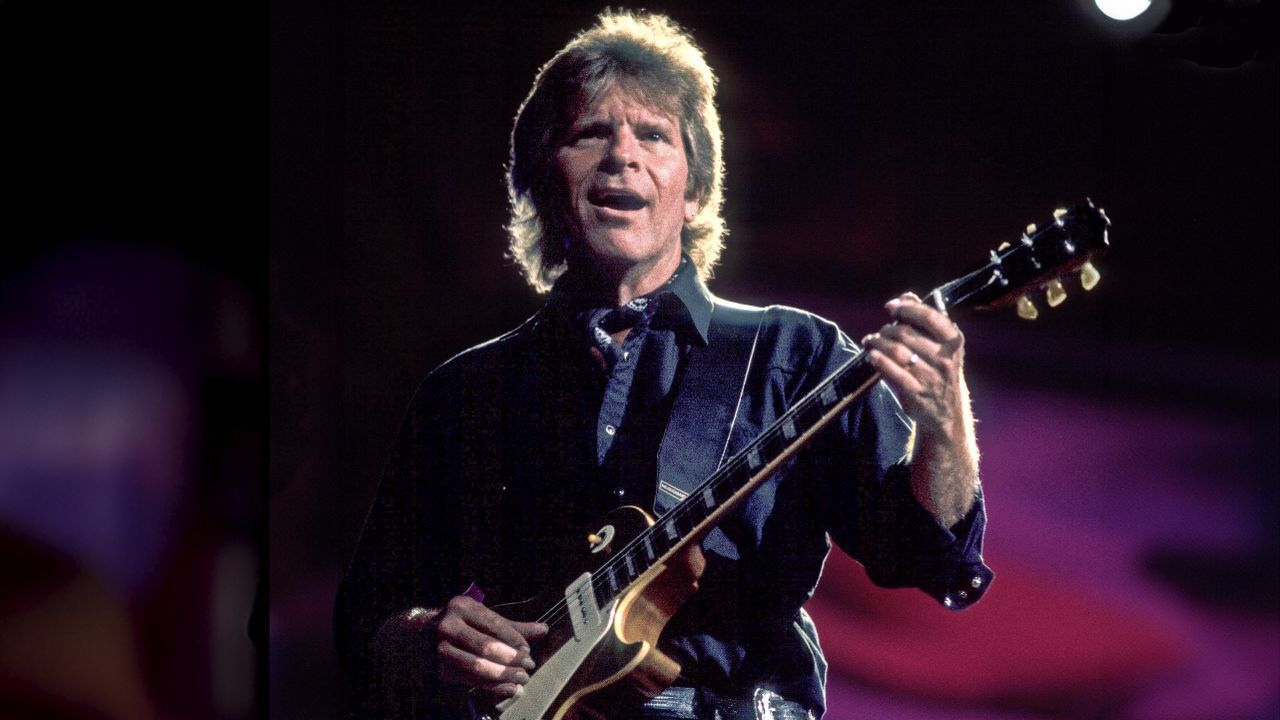
In 1975, John Fogerty turned solitude into motion, building “Almost Saturday Night” like a small celebration he could carry himself.
“Almost Saturday Night” was released in 1975 on John Fogerty’s self-titled solo album, a record that placed him in an unusually exposed position: the former Creedence Clearwater Revival frontman was not only writing and singing the songs, but playing the instruments himself. On this track, that self-contained approach included the bright, bell-like touch of a glockenspiel, a detail that fits the song’s spirit perfectly. It is not a grand ornament. It is a flicker of anticipation, the sound of a weekend appearing just over the horizon.
The title alone carries a modest kind of American poetry. Not Saturday night, but almost. The song lives in the charged hour before release, when the workweek has not quite fallen away but the mind has already escaped it. Fogerty had always been gifted at compressing place, motion, and desire into simple rock and roll shapes. Here, he does it without the heavier swamp atmosphere often associated with his earlier work. “Almost Saturday Night” is lighter on its feet, more open to daylight, and built around the plain pleasure of looking forward.
That lightness matters because of where it arrives in his story. By 1975, Fogerty was no longer operating inside the band identity that had made his voice one of the most recognizable in rock. His solo career required a different kind of authority. The self-titled John Fogerty album did not need to prove that he could sound like a group; it revealed how much of that group’s musical urgency had always come from his internal sense of rhythm, compression, and melodic directness. Playing all the parts himself was not just a studio method. It gave the record a handmade clarity, as if each sound had been placed there by the same pulse.
On “Almost Saturday Night,” the arrangement moves with economical confidence. The guitars do not crowd the song; they push it forward. The rhythm feels road-tested rather than polished into smoothness. Fogerty’s vocal sits at the center with that familiar grain, but he does not lean into menace or complaint. Instead, he sings like someone already halfway out the door, carried by the knowledge that joy can begin before the actual moment arrives. The melody does not strain for triumph. It rides a clean, upward feeling, making anticipation sound almost as satisfying as arrival.
The glockenspiel is especially telling because it could have become a novelty in a rough-edged rock and roll setting. Instead, it works as a small flash of color. Its chiming tone suggests neon, dashboard lights, a fairground in the distance, or simply the quickened brightness of expectation. Fogerty’s best writing often understands that ordinary scenes become powerful when the rhythm underneath them is exact. In this song, the glockenspiel does not soften the rock foundation; it sharpens the sense of waiting for something good.
There is a discipline in the song’s happiness. “Almost Saturday Night” is often described as feel-good rock and roll, and that description is fair, but its charm is not careless. Fogerty’s craft is in how little he needs to establish the scene. The song does not over-explain the weekend, the people, or the destination. It trusts the listener to know the feeling: the turn in the week when possibility begins to loosen the shoulders. That restraint keeps the track from becoming a slogan. It feels lived-in because it is built from a recognizable human rhythm.
The solo context deepens that rhythm. After the enormous success and pressure of Creedence Clearwater Revival, Fogerty’s early solo work can be heard as an artist testing what remained when the machinery around him was stripped back. “Almost Saturday Night” does not announce reinvention with theatrical drama. It simply works. Its optimism is practical, assembled part by part, drumbeat by drumbeat, guitar line by guitar line. There is something quietly moving about that: a musician known for commanding a band’s sound choosing to rebuild a sense of momentum with his own hands.
The song’s brightness also avoids pretending that joy must be large to be real. Its emotional scale is compact: a night coming on, a spirit lifting, the promise of music and movement just ahead. That is why the recording still feels fresh in the context of Fogerty’s solo legacy. It captures a transition without making a monument of it. The performance does not ask to be admired for its difficulty; it invites the listener into its forward motion. The craft is there, but it serves the feeling.
In the end, “Almost Saturday Night” stands as one of those recordings where simplicity is not a limitation but a form of conviction. Fogerty’s voice, his instruments, and that glockenspiel glint all point in the same direction: toward a moment not yet fully arrived, but already changing the air. For an artist stepping further into his own name, the song offers a modest but durable image of renewal. Sometimes starting over does not sound like a confession or a grand declaration. Sometimes it sounds like the road opening, the week loosening its grip, and Saturday night coming close enough to sing about.
