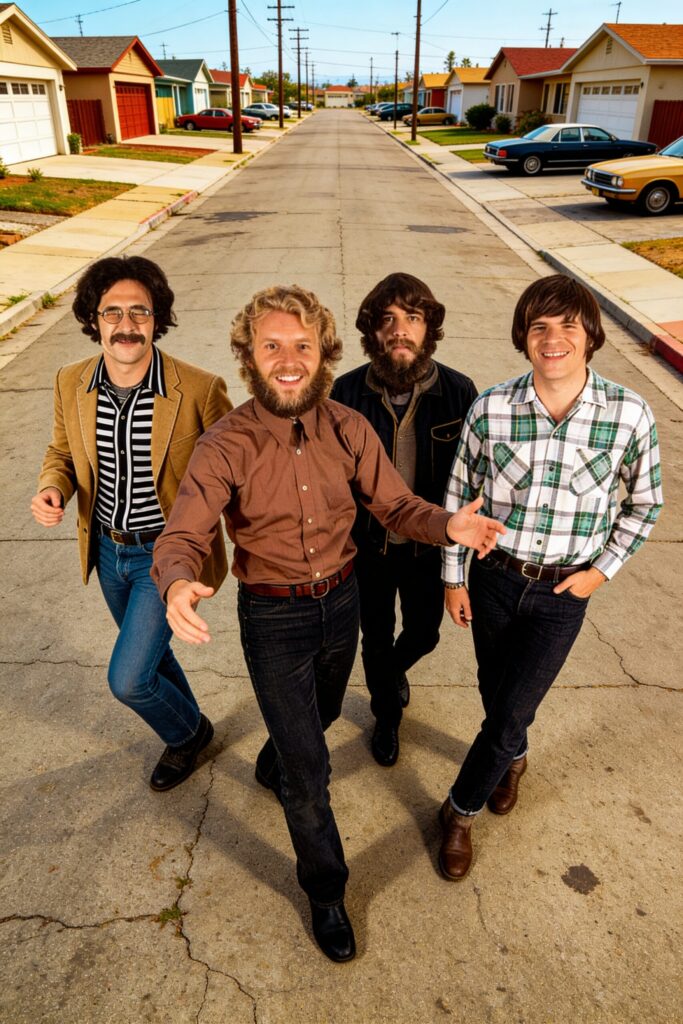

Rude Awakening #2 is the sound of John Fogerty refusing to let Creedence Clearwater Revival leave Pendulum on a note of comfort, turning the album’s final stretch into a shadowy studio experiment.
Released in December 1970, Rude Awakening #2 was never built for the singles chart, and it did not chart on its own. But the album that carried it, Pendulum, still reached No. 5 on Billboard’s Top LPs chart in the United States, while its most famous single, Have You Ever Seen the Rain backed with Hey Tonight, climbed to No. 8 on the Billboard Hot 100 in early 1971. That matters, because this odd, unsettled closing piece did not come from a band in decline commercially. It came from a band still selling in huge numbers, still filling the radio, and still led by a songwriter who had already mastered directness so completely that he could now afford to test the edges of it.
That is what makes Rude Awakening #2 so fascinating in the long history of Creedence Clearwater Revival. Public memory tends to hold the group in a very specific frame: short songs, hard grooves, plain language, a river-road feel, and no patience for indulgence. John Fogerty was the great compressor of late-1960s American rock, taking blues, country, rhythm and blues, and rockabilly instincts and cutting them down to size with almost ruthless efficiency. Yet on the closing track of Pendulum, he allowed a different instinct to surface. Instead of the clean line and the immediate chorus, he leaned into texture, atmosphere, tension, and studio construction. It is not psychedelic in the full flower-power, ballroom-jam sense, but it absolutely brushes into studio psychedelia through layering, unease, and the refusal to resolve in the usual way.
Pendulum itself was already pointing in that direction. It was an all-original album written by John Fogerty, and it widened the band’s palette with more keyboards, richer arrangements, and a broader sense of color than many listeners associated with earlier CCR records. The production was more sculpted. The sound was less like four men catching fire in a room and more like one highly driven musical architect shaping the room itself. That shift gave the album some of its beauty, but it also reflected the growing imbalance inside the group. Tom Fogerty was still there, but this would be the last Creedence Clearwater Revival album made before he left the band. By the time Rude Awakening #2 closes the record, the music seems to know that something has changed, even if it never says so out loud.
What one hears in Rude Awakening #2 is not a conventional narrative song. It is closer to a mood piece, a sonic corridor, a controlled disorientation. Over more than six minutes, the track moves through rough textures, pulsing rhythm, blurred edges, and a creeping, late-night atmosphere that feels worlds away from the radio certainty of Bad Moon Rising or Green River. The title itself sounds half like a joke and half like a warning, and the music honors both possibilities. There is swagger in it, but also strain. There is invention in it, but also something claustrophobic. It feels like a band inside the studio rather than on the highway, and that distinction is central. John Fogerty was not simply documenting a performance here. He was using the studio as an instrument, shaping space and mood as carefully as melody.
That studio-minded turn is the real story behind the track. For all the mythology around Creedence Clearwater Revival as a back-to-basics American rock band, Fogerty was never a simple primitive. He was disciplined, exacting, and often intensely controlling in the studio. He knew how records should hit the ear. On Rude Awakening #2, that instinct leads him somewhere stranger than usual. The piece suggests that he was testing how far CCR could move away from the swamp-rock identity that had made them famous without losing its force altogether. He does not abandon rhythm. He does not dissolve into formlessness. But he does let the listener feel instability, which was rare in the group’s catalog and all the more powerful because of that restraint.
As for meaning, this is one of those recordings whose significance is felt more than explained. There is no lyric sheet to decode in the usual way, no single emotional thesis plainly stated. Instead, the meaning arrives through atmosphere. The track sounds like unrest. It sounds like pressure in the walls. It sounds like the moment after triumph, when success no longer protects anyone from fatigue, control, frustration, or curiosity. Heard in the context of late 1970, it can seem like an accidental self-portrait of a band at the edge of transition. Pendulum gave listeners elegant songs such as Have You Ever Seen the Rain and Molina, but it chose to end not with reassurance, only with this murky, unresolved experiment. That was a bold decision, and a revealing one.
In retrospect, Rude Awakening #2 also asks an irresistible question: where might Creedence Clearwater Revival have gone if the internal balance had held together? Could the band have become even more adventurous in the studio? Could John Fogerty have pushed further into layered, mood-driven work while keeping the group’s famously lean attack? History never gave that version of CCR much time. Tom Fogerty left after Pendulum, and the next chapter would be different in spirit and much more fragile.
That is why this closing track remains so valuable. It may never be the first song named when people celebrate Creedence Clearwater Revival, and it was never supposed to be. But for listeners willing to sit with it, Rude Awakening #2 reveals a deeper truth about the band and about John Fogerty himself. Beneath the reputation for economy and toughness was an artist who could also think in shadows, tension, and strange colors. The closer to Pendulum does not merely end an album. It leaves a door open to a path the band only briefly entered, and that unfinished feeling is part of what gives the track its lasting pull.
