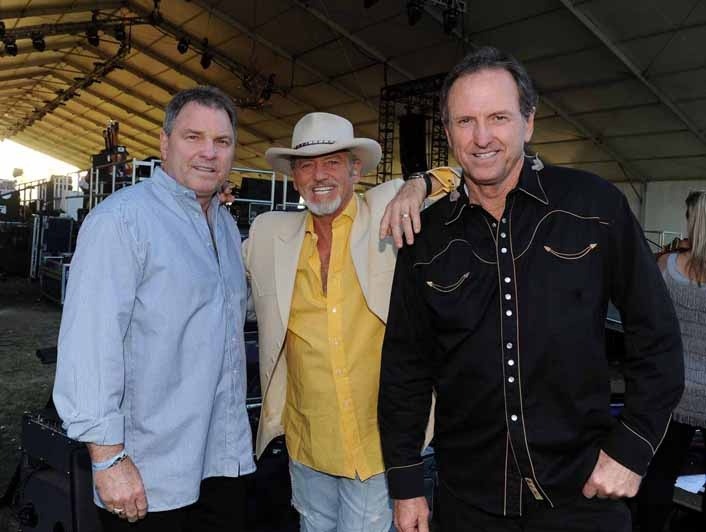
In 1979, three family voices turned the California dream into a bright warning that rose higher with every harmony.
Larry Gatlin & The Gatlin Brothers Band released All the Gold in California in 1979, with Larry Gatlin as its writer and lead voice and his brothers Steve Gatlin and Rudy Gatlin completing the unmistakable family blend. Issued during the Straight Ahead album era, the song became a No. 1 country hit and remains one of the clearest examples of what made the Gatlins distinctive: not simply a lead singer supported by background voices, but a family sound moving as one body.
The song arrived at a moment when country music was opening its doors to smoother production, broader radio textures, and a kind of Nashville polish that could travel beyond the honky-tonk and the front porch. All the Gold in California belongs to that late-1970s landscape, but it does not feel weightless. Its surface gleams, yet its message is wary. The famous image at its center is not of open hills or endless opportunity, but of wealth locked away in Beverly Hills under somebody else’s name. California becomes less a destination than a test of what people are willing to believe about success.
That caution might have sounded sharp or cynical in another singer’s hands. The Gatlins make it more complicated. Larry’s lead vocal carries the song’s narrative with a plainspoken firmness, never pushing too hard to prove the point. Around him, Steve and Rudy rise into harmonies that give the record its lift. Their voices do not decorate the story; they enlarge it. The three-part blend turns one man’s observation into something closer to shared testimony, as if the warning has been considered, repeated, and confirmed around a family table before being sung out loud.
Family harmony has a different kind of gravity from a carefully assembled studio stack. It is not automatically better, but it is often more revealing. Siblings can lock into vowels, phrasing, and instinctive movement in ways that are difficult to manufacture. On All the Gold in California, that closeness matters because the chorus needs height without losing its sense of judgment. The harmonies soar, but they do not escape the ground. They make the song feel expansive while keeping it morally centered.
The arrangement supports that balance. It has the controlled brightness of country-pop from its era, with a steady pulse and enough polish to let the voices gleam. Nothing feels crowded. The record gives the brothers room to climb into the chorus, and when they do, the sound is both smooth and stern. The upward motion of the harmony seems to mimic the lure of the dream itself: the promise of rising, arriving, becoming someone. Yet the lyric keeps reminding the listener that not every shining place is open to everyone who heads toward it.
That tension is the song’s deepest strength. All the Gold in California is not an anti-California song in any simple sense. It is a country song about distance between image and possession, between what a place appears to offer and what it actually gives. In 1979, when migration, ambition, and entertainment culture all fed the mythology of the West, the song found a concise way to puncture the fantasy without sounding bitter. Its wit is dry, its melody is memorable, and its warning is delivered with enough beauty that the listener can understand the temptation even while hearing the cost.
For Larry Gatlin & The Gatlin Brothers Band, the record also clarified the public power of their identity. Larry Gatlin was already respected as a songwriter and singer, but this recording placed the brothers’ vocal relationship at the center of the story. The family blend was not incidental to the hit; it was the emotional engine. The song’s success helped fix in listeners’ minds the idea that the Gatlins’ greatest signature was the way individual voices could keep their character while still surrendering to a common sound.
That is why the record still carries more than period charm. Many songs about ambition either celebrate the climb or mourn the failure. All the Gold in California does something subtler. It stands at the edge of the dream and asks who really owns what everyone is chasing. Then the harmonies rise, not to soften the question, but to make it ring. The beauty of the singing does not cancel the warning; it gives the warning dignity.
In that sense, the song’s lasting power comes from restraint as much as brilliance. The brothers do not oversell the drama. They trust the line, the melody, and the discipline of singing together. Their harmony suggests that truth can be carried more strongly when no one voice tries to own it alone. The gold may be out of reach in the story, but the sound of three brothers finding one shape in the air remains its own kind of wealth.
