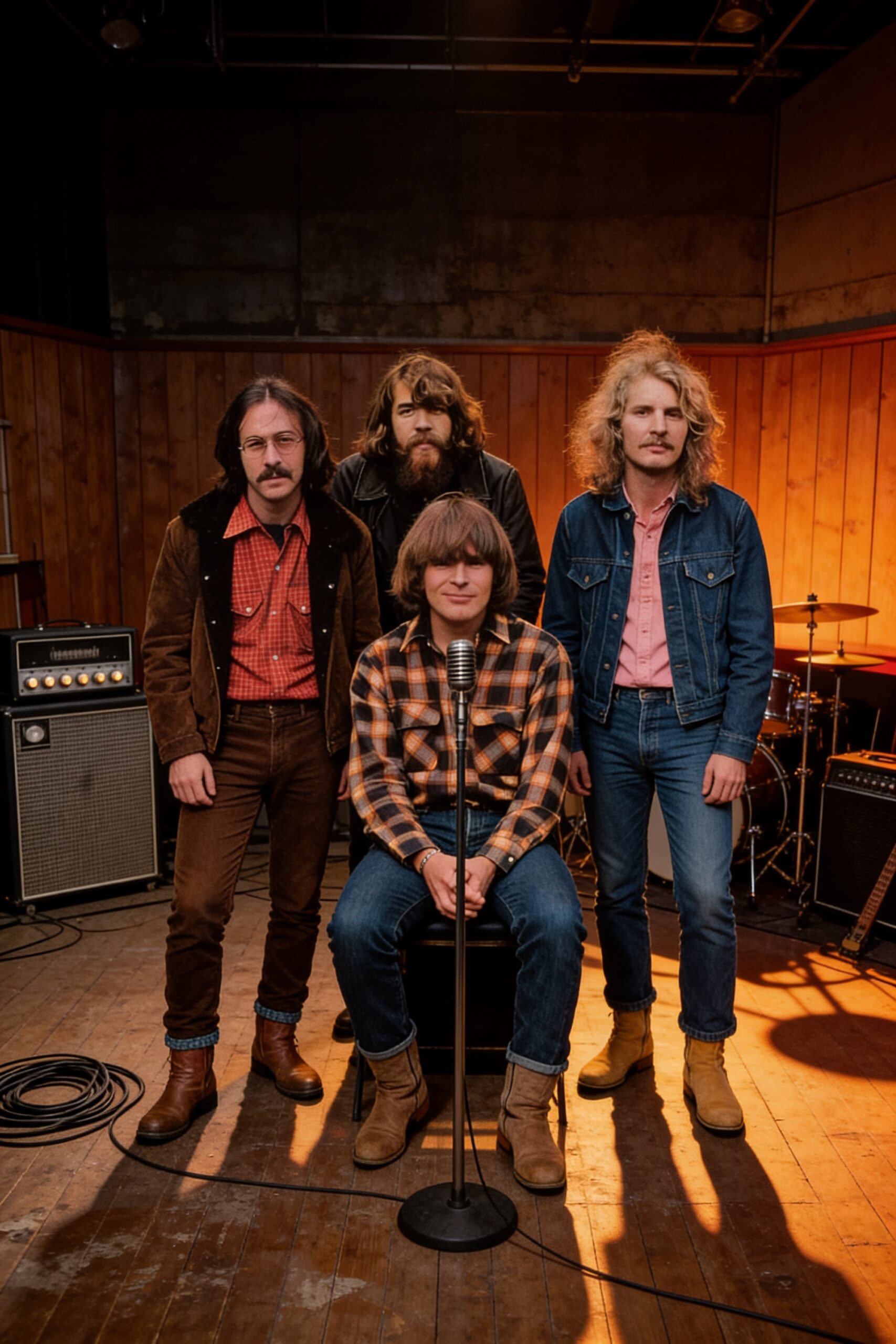
Before Creedence Clearwater Revival became shorthand for swampy American grit, The Working Man sketched the laboring voice that would guide John Fogerty’s songs.
Released on Creedence Clearwater Revival’s self-titled debut album in 1968, The Working Man is one of those early cuts that can sound modest at first and revealing on a second pass. The album arrived on Fantasy Records after the group had left behind its earlier identity as The Golliwogs, and before the extraordinary run of records that would soon make CCR one of the most recognizable American rock bands of its era. On a debut LP that also carried their long, hypnotic reading of Susie Q and a fierce version of I Put a Spell on You, this John Fogerty composition offered something different: not merely a groove or a blues inheritance, but the outline of a narrator.
What makes the song matter is not that it arrived fully formed as a grand statement. It did not need to. CCR were still sharpening their identity, still carrying the marks of bar-band toughness, British Invasion discipline, American blues records, and the hard education of playing for real audiences before fame had softened anything. But in The Working Man, Fogerty began to place his imagination close to people whose lives are measured by labor, fatigue, money, obligation, and pride. The song does not need a large stage to make its point. It moves with a sturdy, compressed force, the kind of rhythm that feels built rather than decorated.
That was one of Fogerty’s crucial gifts. He could make roots music feel less like costume and more like testimony. Creedence Clearwater Revival came from El Cerrito, California, not from the Louisiana bayou their sound would later seem to summon so vividly. Yet Fogerty’s writing found a language of American weather, work, roads, rivers, class pressure, and plainspoken unease. On later songs, that language would become sharper and more public: Fortunate Son would turn class resentment into a two-minute charge; Lodi would give the struggling musician a town he could not escape; Who’ll Stop the Rain would let a weary question hang over a whole generation. The Working Man stands earlier in the line, less famous but quietly foundational.
The debut album itself sits at an interesting crossroads. In 1968, rock music was full of studio expansion, psychedelic color, long improvisations, and grand gestures. CCR did not ignore the moment, but they cut against much of its ornament. Their sound was lean, direct, and physical. The rhythm section of Stu Cook and Doug Clifford had a plain muscularity that gave Fogerty’s guitar and voice room to strike hard. Tom Fogerty’s rhythm guitar helped keep the band grounded, pushing the songs forward without drawing attention away from the collective engine. In The Working Man, that engine matters. The arrangement feels as if it understands repetition not as limitation, but as pressure: the repeated day, the repeated shift, the repeated demand to keep going.
Fogerty’s vocal approach was already taking shape. He did not sing the part from a distance. He leaned into it with a rasp that suggested urgency without theatrical pleading. The voice carried a kind of stubborn compression, as though the man inside the song had more to say than the song would allow him to explain. That restraint would become part of CCR’s emotional power. Fogerty often wrote in plain language, but his best performances made plainness feel charged. He could suggest a whole life with a clipped phrase, a tightened guitar figure, or the way his voice seemed to push through a wall of heat and responsibility.
There is also a subtle tension in hearing The Working Man as part of the band’s first album. CCR were not yet the radio giants they would soon become. They were a group entering the national conversation, still proving who they were and what kind of American story they intended to tell. The blue-collar perspective that later listeners would associate so strongly with Fogerty was not a marketing pose added after success. Its early form was already present here, in the choice to center a working figure rather than a psychedelic vision, a romantic fantasy, or a fashionable pose. The song’s title itself points toward a world of wages, effort, and endurance.
That does not mean The Working Man should be treated as a hidden manifesto. Its strength is smaller and more musical than that. It belongs to the roots of the CCR vocabulary: tough guitars, clipped motion, blues and R&B shadows, and a singer learning how to speak for characters who sounded both specific and widely familiar. The band would refine that language rapidly. By the time Bayou Country, Green River, and Willy and the Poor Boys arrived in 1969, the Fogerty world would feel unmistakable. But beginnings matter because they show the first shape of instinct before it becomes reputation.
Heard now, The Working Man has the appeal of a foundation beam. It is not the best-known song on the 1968 debut, and it is not the track most likely to appear first in a casual discussion of Creedence Clearwater Revival. Yet it helps explain why the band’s music never felt merely nostalgic, even when it drew from older American forms. Fogerty was not only borrowing the sound of earlier music; he was building a place for ordinary pressure inside rock and roll. The sweat in the groove, the tightness of the vocal, the absence of polish for polish’s sake — all of it points toward the work songs he had not yet written.
In that sense, The Working Man remains valuable because it lets us hear the moment before the myth hardens. Before CCR became associated with foggy rivers, bad moons, fortunate sons, and weary rain, there was already a man in the song trying to keep his footing. Fogerty would spend much of his greatest period returning to that figure in different disguises: the laborer, the outsider, the soldier, the drifter, the citizen watching power move above his head. Here, on the 1968 debut, the voice is still young, but its compass is already set toward the people who carry the weight and keep moving anyway.
