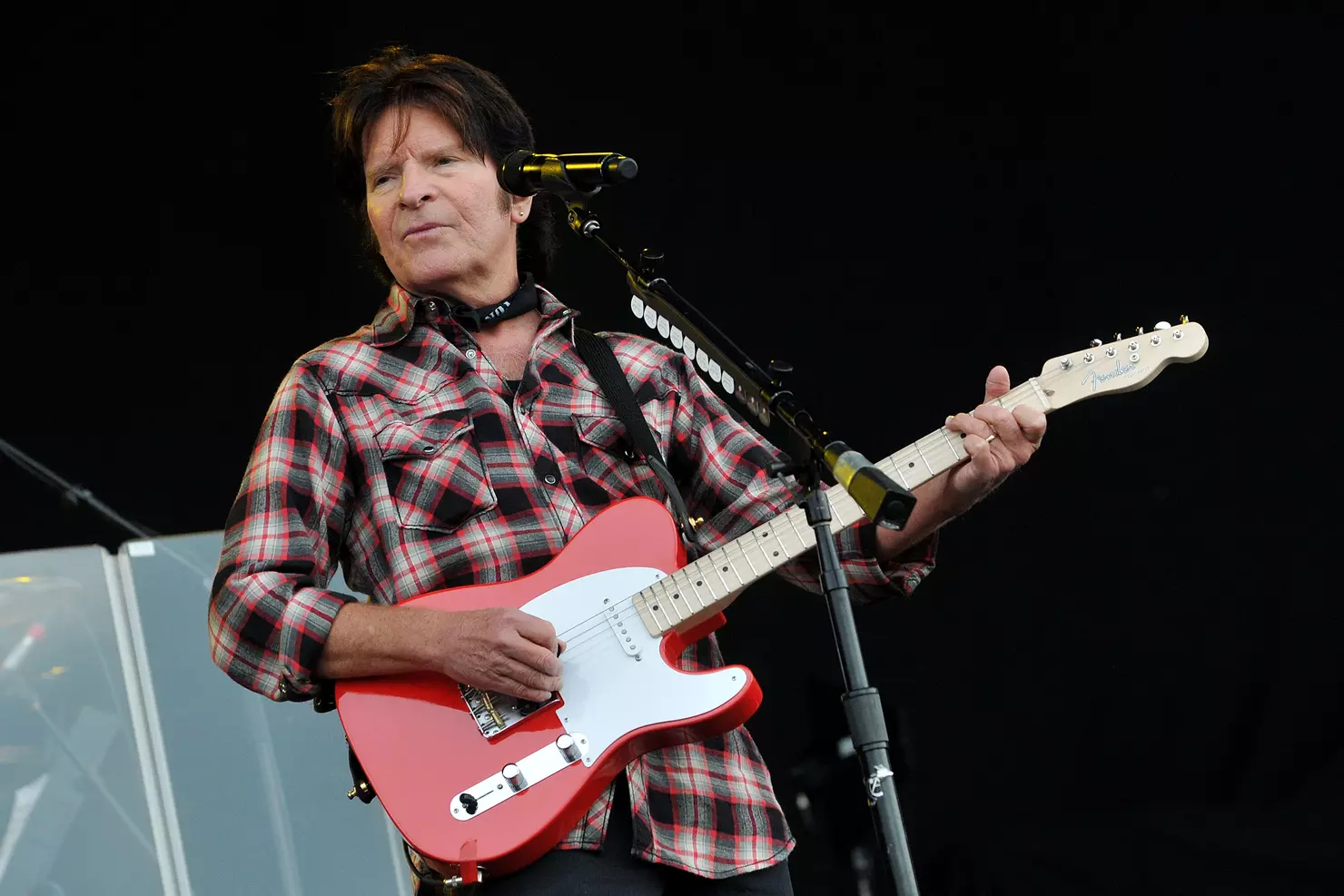
Between the shadow of Creedence Clearwater Revival and the road ahead, John Fogerty made Travelin’ High sound like motion itself.
Travelin’ High sits on John Fogerty, the self-titled solo album Fogerty released in 1975, and its place there matters. This was not a Creedence Clearwater Revival record with the name changed on the jacket. It was a self-produced statement from a songwriter, singer, guitarist, and bandleader trying to stand alone after one of American rock’s most concentrated hit-making runs. Heard as a deep cut rather than as a headline song, Travelin’ High reveals something that the more familiar titles can sometimes obscure: Fogerty’s instinct for movement, economy, and pressure was still alive, but now it had to answer to a different kind of silence.
The album named simply John Fogerty arrived after The Blue Ridge Rangers, the 1973 project in which Fogerty had stepped away from the CCR name and filtered roots music through his own hands. By 1975, putting his own name on the cover carried weight. He was no longer the voice at the center of a band myth; he was the man responsible for every expectation that came with that voice. The record includes better-known titles such as Rockin’ All Over the World and Almost Saturday Night, songs that would travel widely in other ways. But Travelin’ High has a different kind of value. It does not ask to be the grand announcement. It works like a spark in the engine.
Fogerty had always understood the power of forward motion. In the CCR years, he could make a song feel as if it were coming down a highway, across a river, through rain, smoke, or radio static. His best writing often used motion not only as scenery but as emotional grammar. Someone was leaving, running, returning, searching, surviving, or refusing to be pinned down. Travelin’ High belongs to that lineage, but on the 1975 solo album the feeling is more solitary. The momentum is still there, yet the frame has changed. The band identity is gone, and the sound now carries the sharper outline of one man deciding how hard to push.
As a self-produced track, Travelin’ High benefits from Fogerty’s plain-spoken sense of arrangement. The song does not need decorative excess to make its point. Its force comes from drive, rhythmic confidence, and the kind of vocal attack that made Fogerty instantly recognizable without needing theatrical display. There is a compactness to the recording that feels true to him: nothing lingers too long, nothing is polished into softness, and the energy keeps leaning forward. That directness is part of why the song still feels worth pulling out from the deeper shelves of his catalog.
Deep cuts often tell us what an album was doing between its obvious moments. Singles and famous songs can become public property, repeated until their original setting almost disappears. A song like Travelin’ High asks for a different kind of listening. It invites attention to the album’s inner weather: the restless confidence, the refusal to collapse under comparison, the way Fogerty continued to draw from rock and roll, country, rhythm and blues, and road-song mythology without sounding as if he were merely cataloging his influences. The track is not a monument. It is a pulse.
That pulse matters because the mid-1970s were not an easy place for Fogerty’s public identity. CCR’s run had been so compressed and so powerful that anything afterward was likely to be measured against a memory that had already hardened into legend. For many artists, that kind of past becomes a trap. Every new recording risks sounding too similar or not similar enough. Travelin’ High does not solve that problem by making a grand argument. Instead, it simply moves. It trusts the beat, the riff, the voice, and the old American promise that another road might still open if the engine keeps turning.
There is something quietly revealing about that. The song’s title suggests lift and motion, but the deeper feeling is not carefree escape. It is the sound of an artist keeping himself in motion because standing still would mean being swallowed by what came before. Fogerty’s voice, even at its most forceful, often carries a grain of pressure inside it. On Travelin’ High, that pressure becomes part of the pleasure. The record pushes ahead, and the listener can hear both the freedom and the weight behind that push.
Today, the song stands as more than a footnote on a 1975 solo album. It is a reminder that the smaller tracks in a major artist’s catalog can sometimes show the working machinery more clearly than the celebrated ones. John Fogerty did not need Travelin’ High to explain his whole career. What it does is narrower and, in its own way, more intimate: it catches him after the storm of Creedence, still reaching for speed, still trusting the road, still sounding as if the next mile might be the one that makes everything feel possible again.
