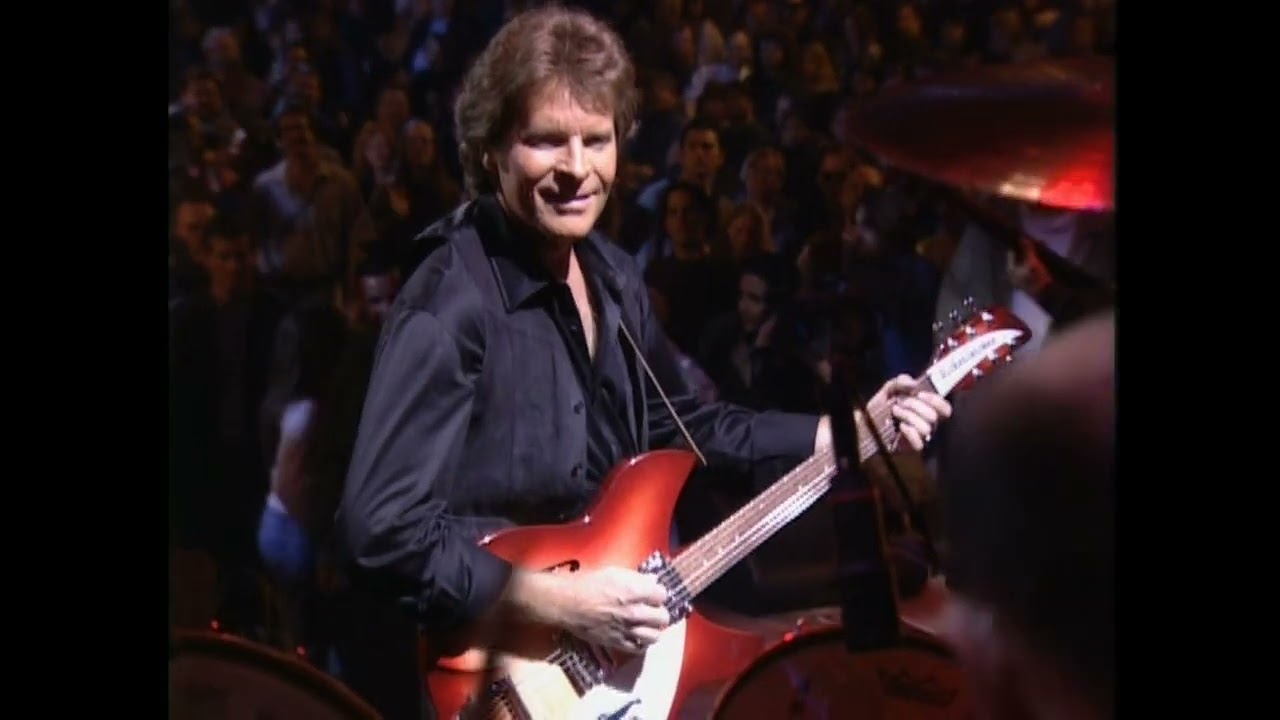
In John Fogerty’s hands, Haunted House stops being just a spooky rock-and-roll joke and becomes a hard-charging reminder of where his music learned to move.
John Fogerty recorded his version of Haunted House for the 2009 album The Blue Ridge Rangers Rides Again, a roots-minded sequel in spirit to the solo covers project he had first introduced in 1973. The song was already part of American rock-and-roll memory long before Fogerty touched it: written by Robert Geddins, recorded earlier by Johnny Fuller, and made famous to a wider audience by Jumpin’ Gene Simmons with his 1964 hit version. By the time Fogerty arrived at it, Haunted House carried the charm of a novelty record, the snap of rockabilly, and the stubborn humor of a narrator who refuses to be frightened out of his own home.
That last part is what makes Fogerty such a natural fit. He has always been drawn to songs where ordinary people face strange weather, bad luck, hard roads, or shadows at the edge of town and answer them with rhythm. With Creedence Clearwater Revival, he gave American radio a whole geography of riverbanks, back porches, roadside trouble, and swampy unease, even when the band was working out of California. On The Blue Ridge Rangers Rides Again, he was not trying to recreate Creedence, but the album allowed him to revisit the older musical soil beneath his own sound: country, gospel, early rock and roll, rhythm and blues, and the lean drive of rockabilly.
His 2009 cover of Haunted House understands that the song’s humor only works if the band plays it straight and hard. If it becomes too cartoonish, the joke floats away. If it becomes too polished, the danger disappears. Fogerty finds the middle ground by leaning into the groove. The performance feels lively, compact, and physical, the kind of track that seems to kick open a door rather than quietly enter a room. The vocal has that familiar Fogerty bite: clipped, bright, slightly wild at the edges, with enough grin in it to honor the song’s playful spirit and enough muscle to keep it from turning into costume music.
What is striking is how little the song needs to be explained. The premise is simple, almost like a campfire tale told with a backbeat: a man moves into a house, discovers it may be occupied by ghosts, and decides he is not leaving. But inside that comic setup is a very American kind of defiance. The house may shake, the walls may talk, the spirits may make themselves known, yet the singer stands his ground. Fogerty has built much of his career on that kind of stance. His best performances often sound like someone bracing himself against pressure, whether the pressure is social, political, romantic, or simply atmospheric.
That is why Haunted House sits so comfortably on The Blue Ridge Rangers Rides Again. The album is a covers record, but not in the sense of a museum tour. Fogerty was not dusting off old songs to prove he knew them. He was showing how the old songs still lived inside his hands. The Blue Ridge Rangers name itself points back to his early solo era, when he made a one-man album of country and roots material after the end of Creedence. Returning to that name decades later gave the 2009 project a feeling of circular motion: not nostalgia for its own sake, but a musician looking again at the records, voices, and rhythms that had taught him what American music could do.
The connection to Jumpin’ Gene Simmons matters because Simmons’ 1964 version gave Haunted House its lasting public identity. It had the bounce and theatrical wink of early rock and roll, a period when radio could make room for songs that were funny, eerie, danceable, and strangely resilient all at once. Fogerty’s version does not erase that history. Instead, it pushes the song through his own roots-rock engine. The result sounds less like a Halloween prop and more like a Saturday-night stomp, a reminder that rockabilly was never merely quaint. At its best, it was tense, fast, and alive with personality.
There is also pleasure in hearing Fogerty take on a song that is not weighed down by solemnity. Much of his catalog carries the force of protest, longing, or mythic atmosphere, but Haunted House lets him play. Even so, he plays with discipline. The energy is sharp rather than messy, the performance animated without becoming silly. That balance is part of Fogerty’s gift as an interpreter: he can respect the original shape of a song while making the rhythm feel freshly urgent.
Heard now, the track feels like a small but revealing corner of his later work. It is not trying to announce a grand reinvention. It does something more modest and, in its own way, more satisfying. It places John Fogerty in conversation with the rockabilly past, with Jumpin’ Gene Simmons, with the earlier roots of Haunted House, and with the restless American beat that always ran beneath his own writing. A song about refusing to be run out of a strange old house becomes, through Fogerty, a song about musical persistence: the old rooms still creak, the floorboards still jump, and the singer is still very much at home.
