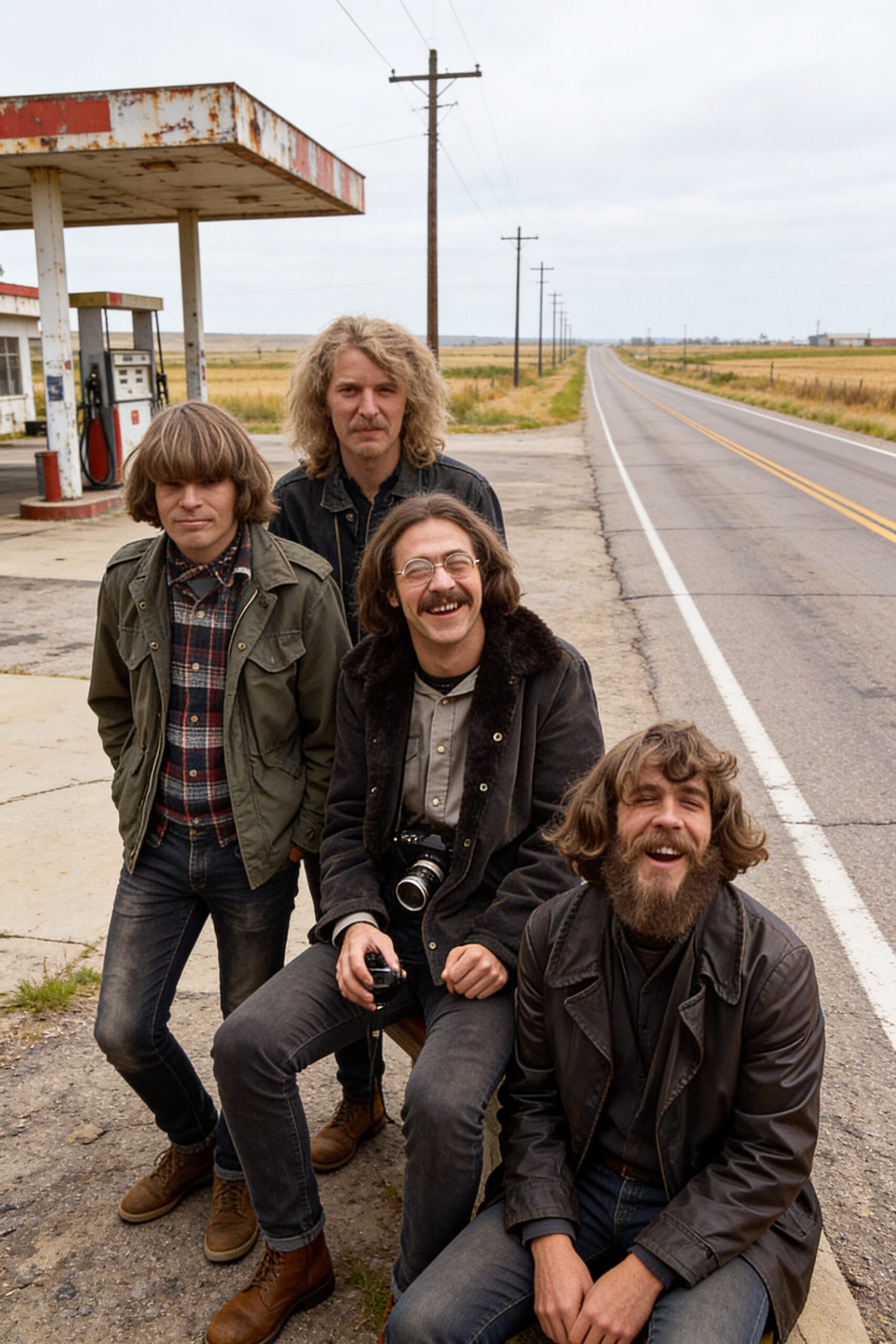
Before the swamp-rock image hardened around Creedence Clearwater Revival, this fierce 1968 Wilson Pickett cover showed John Fogerty reaching straight into the heat of R&B.
Creedence Clearwater Revival placed their cover of “Ninety-Nine and a Half (Won’t Do)” on their self-titled debut album in 1968, released on Fantasy Records at the moment the band was still defining what its name would mean. The song itself had come from the world of Wilson Pickett, whose Atlantic soul recording was written by Pickett, Steve Cropper, and Eddie Floyd. In Creedence’s hands, it became something more than a respectful nod to a favorite record. It became an early confession of influence, a clue to the way John Fogerty was building his voice from the sounds of rhythm and blues, soul shouting, gospel urgency, and lean guitar-band force.
By the time many listeners came to know Creedence through “Proud Mary”, “Green River”, “Bad Moon Rising”, or “Fortunate Son”, the band already seemed to arrive with its own weather: river fog, roadside tension, Southern place names, and a gritty American mythology that sounded far older than four musicians from El Cerrito, California. But the debut album catches them before that mythology was fully fixed. Alongside their long take on “Suzie Q” and their brooding version of “I Put a Spell on You”, “Ninety-Nine and a Half (Won’t Do)” shows a band still close enough to its sources that you can hear the gears turning, the appetite, the ambition, the need to prove that borrowed fire could become personal sound.
Wilson Pickett set a brutal standard for anyone daring to approach this song. The phrase itself, rooted in the language of spiritual insistence and carried into soul music with physical urgency, leaves no room for softness. Ninety-nine and a half is not enough. Almost is failure. Partial devotion will not carry the day. Pickett’s version had the authority of a singer who could turn a demand into a sermon and a groove into a test of stamina. Fogerty did not try to become Pickett, and that is part of what makes Creedence’s cover interesting. He attacks the song from another angle: less polished soul revue, more garage-floor pressure; less horn-driven grandeur, more guitar, snare, and clenched vocal muscle.
What comes through is a younger John Fogerty discovering how much force his voice could hold. The rasp was already there, but not yet settled into the familiar shape it would take on Creedence’s best-known records. On “Ninety-Nine and a Half (Won’t Do)”, he sounds as if he is pushing himself toward the edge of the note, trying to make the vocal crack open without losing control. That strain matters. It is not decorative grit. It is a working sound, the sound of a singer learning that conviction can be more persuasive than prettiness. Fogerty’s later writing would often be praised for its directness, but here the directness is vocal before it is lyrical. He is not telling a story so much as proving a pulse.
The arrangement also reveals something essential about early Creedence. Tom Fogerty, Stu Cook, and Doug Clifford give the song a hard, compact frame, stripping away some of the broader soul-band atmosphere and letting the groove become narrow, tense, and driven. That economy would become one of the group’s great strengths. Creedence could sound enormous without sounding crowded. Even in this early cover, they were learning how to make space feel like pressure: a guitar figure, a drum pattern, a bass line moving with purpose, and John’s voice cutting through the center like a warning.
The 1968 debut is often heard as a beginning, but it is also a map of listening. Creedence did not emerge from nowhere with a fully invented swamp. They absorbed Black American R&B, blues, rock and roll, country feeling, and the rough electricity of bar-band performance, then reshaped those ingredients into something stark and recognizable. Their version of Wilson Pickett’s “Ninety-Nine and a Half (Won’t Do)” is important because it refuses to hide that process. It lets us hear the band before the image became larger than the rooms they played in, before the songs began to feel like folk tales, before Fogerty’s voice became one of the most identifiable instruments in American rock.
There is also a kind of artistic principle tucked inside the choice of song. “Ninety-nine and a half won’t do” could almost describe Creedence’s own standard once they hit their stride: no excess, no half-commitment, no ornament placed where a harder truth would work better. In 1968, they were not yet the band that would release a remarkable run of albums in just a few years, but the hunger was already audible. This cover catches them at the moment when influence was still visible on the surface, when the young band’s roots had not yet disappeared into its identity.
That is why this recording still has a charge beyond simple nostalgia. It is not merely Creedence covering Wilson Pickett. It is John Fogerty measuring himself against the language of soul music and finding a way to answer in his own rough dialect. The performance does not replace the original and never needed to. Its value lies in the distance between the two versions: Pickett’s command, Fogerty’s pursuit; Southern soul authority, California rock urgency; the source and the transformation. Somewhere in that gap, the sound of Creedence Clearwater Revival begins to gather itself.
