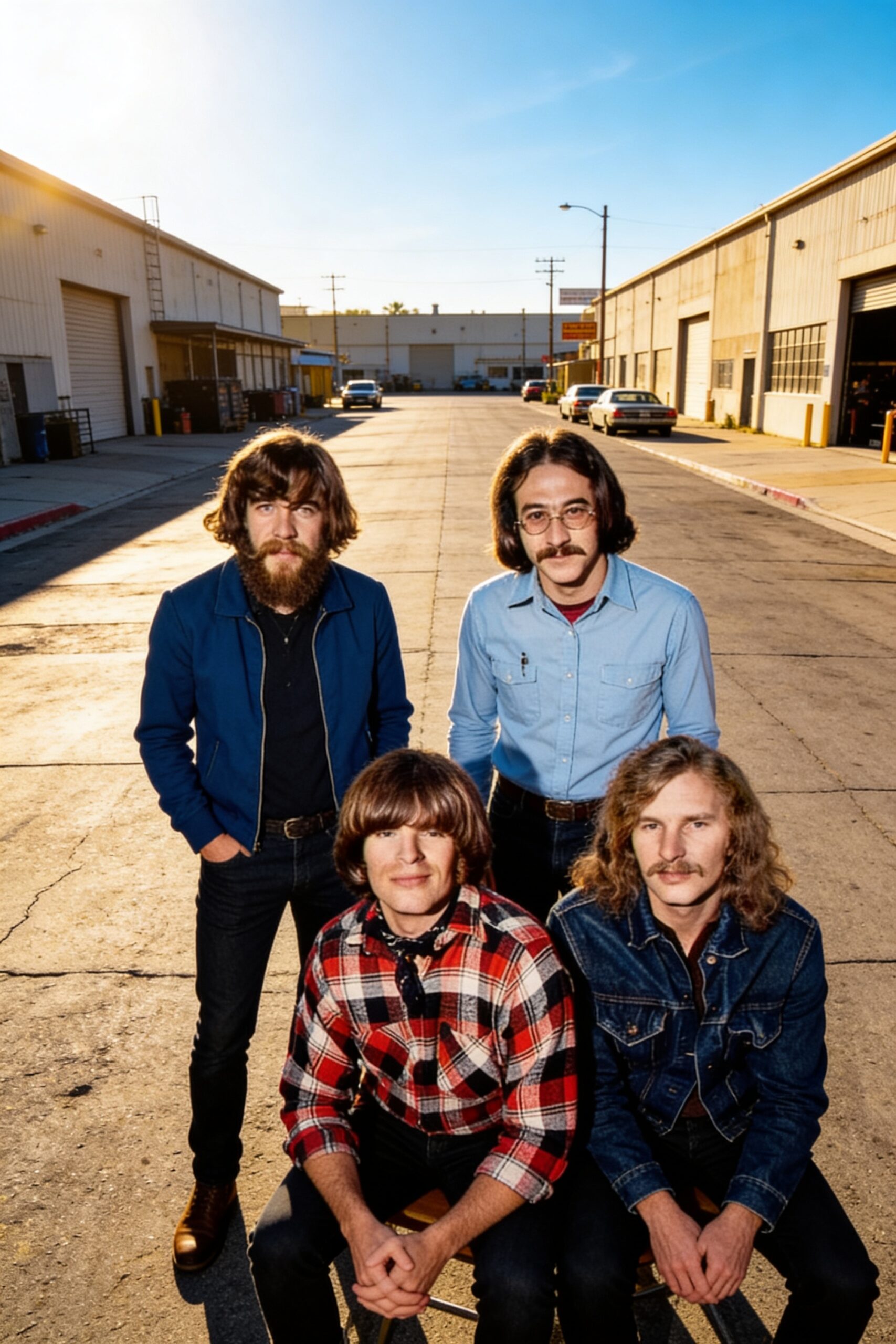
On Cosmo’s Factory, Creedence Clearwater Revival turned Arthur Crudup‘s My Baby Left Me into something lean, urgent, and revealing: a compact salute to the hard floor, hot echo, and forward pull of the early Sun Records sound.
When Cosmo’s Factory arrived on Fantasy Records in July 1970, Creedence Clearwater Revival were already one of the defining American bands of their moment. The album carried major originals, radio staples, and the sense of a group working at full command. Yet tucked inside that record is a cover that tells a different kind of truth about the band. Their version of My Baby Left Me, written by Arthur Crudup, is not there as ornament and not there as filler. It feels like a deliberate studio turn back toward the rough, economical excitement that helped shape early rock and roll. In the middle of a huge year for the band, the song acts almost like a private map of where some of their instincts came from.
Crudup first recorded My Baby Left Me at the start of the 1950s, and his writing sat close to the roots from which rock and roll would soon rise. He was one of the great bridge figures in American music, a blues man whose songs later traveled into the repertoire of younger performers and wider popular culture. That history matters here. Even though Crudup’s own recording did not come from Sun Records, the material belongs to the same Southern crossroads where blues, country, boogie, and radio rhythm were colliding. By the time CCR cut the song, listeners could also hear the broader Memphis afterimage around Crudup’s catalog, because his music had already fed directly into the sound world that Sam Phillips helped turn into a new language.
What Creedence do on Cosmo’s Factory is especially telling because they do not treat the song as a museum piece. They strip it down. The arrangement is fast on its feet, guitar-led, and built around a clipped rhythmic pressure that never slackens. John Fogerty sings with bite rather than display, pushing the words forward as if the complaint inside the lyric matters less than the momentum it generates. That is where the tribute becomes audible. The band are not imitating one specific 1950s single, and they are not trying to disguise themselves as another act. Instead, they chase the principle behind the early Sun records: keep it direct, keep it physical, and make the groove feel like it might run out of the room before the tape can catch it.
There is a real difference between influence and reenactment, and My Baby Left Me lands on the right side of that line. The record does not arrive dressed in nostalgia. It arrives working. The guitars snap, the rhythm section keeps the floor hard beneath everything, and the whole performance is over before it has time to explain itself. That brevity is part of the point. Early Memphis rock and roll often lived on compression, on the thrilling sense that a song could say what it needed to say with very little ceremony. CCR understood that economy deeply. On this cut, their California discipline meets a Southern source code, and the result feels less like revival than recognition.
The placement of the track on Cosmo’s Factory makes it even more revealing. This is the same album that holds Travelin’ Band, Who’ll Stop the Rain, Run Through the Jungle, and the long, brooding take on I Heard It Through the Grapevine. Those songs show different sides of the group: compact rocker, moral unease, social fog, extended groove. Against that backdrop, My Baby Left Me becomes a small but clear statement about lineage. It reminds us that Creedence Clearwater Revival were never only making records about swamps, rivers, and restless motion. They were also listening backward, toward jukebox blues, country-boogie attack, and the fast, unpolished confidence of 1950s singles.
Fogerty‘s production instincts are central to why the track works. He had a rare gift for making records sound concise without making them feel thin. Here, that instinct serves the song beautifully. Nothing is overloaded. The band gives the tune room to kick. Stu Cook and Doug Clifford keep the engine steady, while the guitars avoid ornament in favor of impact. There is just enough edge in the sound to suggest old amplifiers and hard studio walls, but not so much self-conscious stylizing that the performance turns into an exercise. The nod to Sun Records comes through less as costume than as energy: a taut, unpolished readiness, the sense that the red light went on and everyone knew exactly how little was needed.
That is why the cover still matters. It opens a side door into CCR‘s musical character. Beneath the hits, beneath the swamp-rock label, there was a band with a sharp ear for the older American grammar of rhythm and release. Arthur Crudup‘s song gave them a perfect frame for that understanding. The lyric is simple, the form is flexible, and the emotional content is strong enough to survive a change of era. Creedence do not modernize it so much as return it to a live electrical current. In their hands, the blues complaint becomes a quick, hard-moving piece of rock and roll craft.
In the end, Creedence Clearwater Revival‘s My Baby Left Me on Cosmo’s Factory is memorable not because it tries to out-announce history, but because it trusts stripped-down history to speak for itself. For a few brisk minutes, the album steps out of 1970 and into a smaller, hotter room where the floor is wood, the band is close together, and the song has to earn its place on feel alone. That is what makes the track such a persuasive tribute to the early Sun Records spirit. It does not bow from a distance. It plugs in, counts off, and gets straight to the point.
