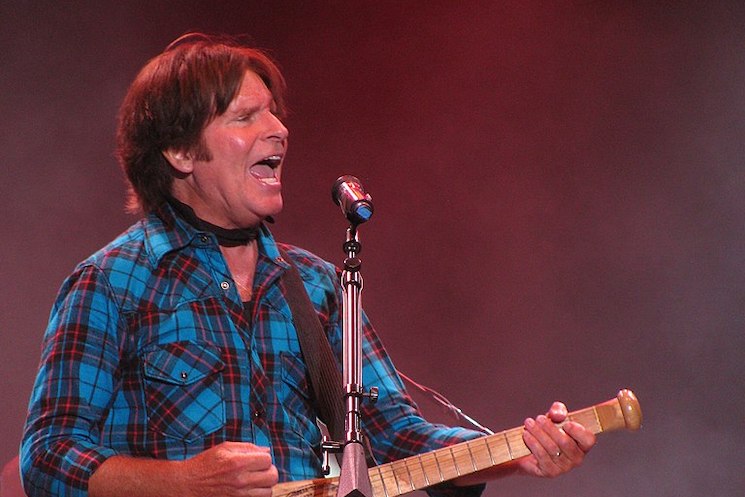
A rare 1986 B-side, John Fogerty’s version of “My Toot Toot” with Rockin’ Sidney is more than a curiosity; it is a brief, bright meeting between swamp-rock instinct and the living pulse of zydeco.
In 1986, John Fogerty released a cover of “My Toot Toot” as a vinyl B-side, and the detail that makes it immediately more interesting is the presence of Rockin’ Sidney, the zydeco artist most closely associated with the song itself. That release context matters. This was not a major album centerpiece pushed to radio until it became part of the standard story. It lived on the flip side of a single, in that half-hidden territory where artists often reveal a different set of instincts: looser, more playful, sometimes more honest. For many listeners, it remained a discographical footnote from Fogerty’s mid-1980s solo years. Yet the record says something unusually clear about where his musical imagination had always been pointing.
“My Toot Toot” had already made its mark before Fogerty touched it. Written and recorded by Rockin’ Sidney, born Sidney Simien, the song emerged in the mid-1980s as one of zydeco’s most visible crossover moments. Its title gave it a mischievous, almost novelty-like surface, but the reason it traveled was deeper than that. The groove was infectious, the rhythm carried local history in its bones, and the performance turned regional dance music into something the wider American audience could not easily ignore. Sidney’s recording helped bring zydeco into a broader national conversation, and it even earned him a Grammy. So when Fogerty chose the song in 1986, he was not simply borrowing a catchy tune. He was stepping toward a living tradition with a very specific regional identity.
That makes the collaboration especially revealing. For years, Fogerty had built some of rock’s most vivid Southern atmospheres while being, famously, a Californian. In Creedence Clearwater Revival, he sang of bayous, rivers, back roads, and swamp heat with such conviction that geography seemed to dissolve in the music. Songs like “Born on the Bayou” made listeners feel mud, humidity, and distance even when they knew those images were being imagined from far away. His gift was never documentary realism. It was emotional realism. He understood how American roots music could make a place feel spiritually true. But “My Toot Toot”, especially with Rockin’ Sidney present, brought him closer to one of the real Louisiana sounds that had hovered around his work for years.
What gives the B-side its charm is that Fogerty does not treat the song like a joke, even though its title invites a grin. He does not try to polish away its bounce or force it into a rigid rock frame. Instead, the performance feels like a respectful meeting point. His rough-edged voice, so closely tied to American road music, meets the rhythmic lift and communal spirit that made the song work in the first place. With Sidney involved, the record keeps its zydeco identity rather than becoming a generic roots-rock cover. That distinction matters. The performance feels less like appropriation than conversation, less like costume than contact.
The timing also adds another layer. Fogerty’s 1986 period was not a simple extension of the commercial triumph he had enjoyed with Centerfield in 1985. The next chapter, the era surrounding Eye of the Zombie, would come to occupy a more uncertain and contested place in his catalog. That is part of why a B-side like “My Toot Toot” stands out. It is not burdened by the expectation that often weighs on a comeback narrative or a follow-up album. It sounds like a side road taken because the music itself felt good, because the connection was worth making, because a song from Louisiana dance culture could briefly share space with one of rock’s most recognizable voices. Sometimes the off-center release tells you more about an artist than the headline material does.
There is also something fitting about Fogerty gravitating toward a song like this. His best work has always depended on motion: wheels turning, trains rolling, rivers moving, drums pushing forward. Zydeco is movement music too, but it comes from a different social ground, one built around dance floors, community rooms, regional memory, and the stubborn survival of local sound. On paper, a Fogerty cover of “My Toot Toot” could have looked like a novelty detour. In practice, it sounds more like recognition. He was hearing in Sidney’s record a kind of propulsion he had always loved, then answering it in his own language while allowing the original voice to stay in the room.
That is why the rarity of the track matters, but not in the shallow collector’s sense alone. Yes, its status as a 1986 vinyl B-side makes it easy to miss, and that scarcity gives it a certain aura. But the deeper fascination lies in what it reveals once you do hear it. It reminds us that the borders inside American music are far more porous than marketing categories suggest. Swamp rock, zydeco, country, and rhythm and blues are not sealed compartments. They share roads, borrow accents, and meet one another in places that history sometimes forgets to file neatly. This little record captures one of those meetings.
In the end, John Fogerty’s “My Toot Toot” with Rockin’ Sidney matters because it sharpens the larger picture of who he was as an artist. It does not need the weight of a major hit to justify itself. It only needs a few minutes to show how close his long-running bayou imagination could come to an actual Louisiana voice, and how alive that contact could feel. A rare B-side can seem small when you look at it on a discography. But when this one starts moving, it no longer feels small at all. It feels like a hidden crossroads in American roots music, playful on the surface, deeply telling underneath.
