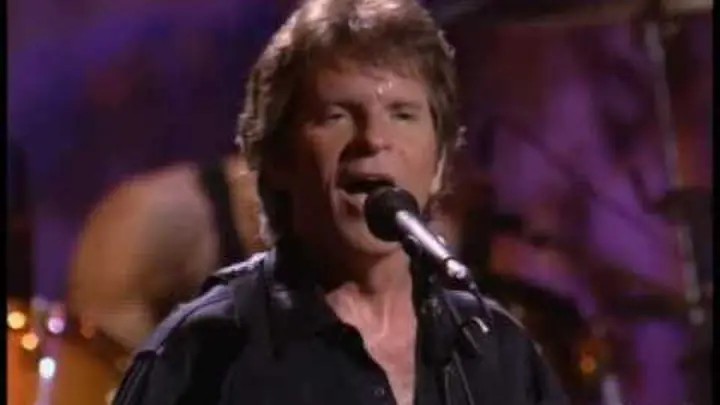
In John Fogerty’s quiet Rhubarb Pie, a childhood shortcut becomes a small map of memory, humor, and the gentler side of a hard-driving American voice.
Rhubarb Pie appears on John Fogerty’s 2004 solo album Déjà Vu All Over Again, a record released seven years after Blue Moon Swamp and long after his name had already been sealed into American rock history through Creedence Clearwater Revival and a restless solo career. The album is often approached through its title track, with its pointed echo of history repeating itself, but tucked inside the record is this acoustic song inspired by Fogerty’s childhood memories of sneaking through a neighborhood hedge. That small detail matters. It gives the track its scale, its scent, and its peculiar charm: not a grand confession, not a political statement, but a memory preserved like something cooling on a kitchen counter.
For a songwriter so closely associated with riverboats, bad moons, working-class thunder, and the sharp crack of a band in full motion, Rhubarb Pie can feel almost disarming. Fogerty’s public legacy is filled with songs that sound larger than the room they were recorded in. He could make a swamp seem mythic, a guitar riff seem like an engine, and a chorus seem as if it had existed before anyone wrote it down. Here, though, he steps into a humbler frame. The acoustic setting draws the listener closer to the grain of his voice and to the odd sweetness of the memory itself. A boy slips through a hedge; a household world sits nearby; rhubarb becomes more than a plant or dessert. It becomes a portal.
The beauty of the song is that it does not need to inflate the memory to justify it. In Fogerty’s hands, the childhood scene remains ordinary enough to be believable. That is where its strength lies. So much American songwriting depends on movement: highways, rivers, trains, open roads, and all the weather of escape. Rhubarb Pie turns instead toward a neighborhood boundary, the kind of green division children notice because it marks both permission and temptation. A hedge is not a dramatic symbol when an adult looks at it, but to a child it can be a wall, a doorway, a dare, and a secret route all at once.
On Déjà Vu All Over Again, that intimacy gives the album a valuable change of temperature. The record belongs to a mature phase of Fogerty’s solo work, when he was no longer fighting simply to prove that the voice behind so many classic songs still belonged to him. By 2004, his place in rock culture was not in doubt, but his solo albums still carried a particular tension: how does a songwriter with such a recognizable past keep writing without becoming trapped by it? Rhubarb Pie answers in a modest but revealing way. It does not chase the force of Creedence. It does not try to recreate the urgency of his best-known radio staples. It lets memory speak in a smaller register.
The acoustic arrangement is essential to that feeling. Without heavy production insisting on importance, the song can breathe like a recollection being told across a table. Fogerty’s vocal character remains unmistakable, but the rough edges serve a different purpose here. They are not only grit or defiance; they become texture, the sound of an older man reaching back toward a boyhood image without polishing it into sentiment. The result is warm without being sugary, playful without becoming trivial. It suggests that memory often survives not because an event was monumental, but because it carried a flavor, a smell, a slight thrill of rule-breaking, or the sensation of being small in a world full of fences and shortcuts.
That is part of what makes Rhubarb Pie meaningful within Fogerty’s broader solo legacy. His career after Creedence was shaped by distance, return, ownership, and renewal. Listeners often focus on the larger public battles and the unmistakable sound of his guitar-driven writing, but a song like this reminds us that legacy is also made from quieter acts of self-recognition. The artist who once seemed to channel entire regions of American imagination also had private corners of memory to revisit. The man who wrote with the compression of a radio classic could still pause over a hedge, a garden, a kitchen dessert, and a childhood path.
There is a tenderness in the way Rhubarb Pie refuses to overexplain itself. It invites the listener to remember their own small trespasses: the neighbor’s yard crossed in secret, the shortcut taken when no one was looking, the taste of something associated with home before home became a complicated word. Fogerty’s gift here is not just nostalgia. It is proportion. He understands that some memories should remain the size they were when they first formed, because enlarging them would destroy their truth.
Heard in that light, Rhubarb Pie is more than a pleasant acoustic track from Déjà Vu All Over Again. It is a reminder that the long arc of a rock-and-roll life does not only bend toward noise, fame, conflict, and triumph. Sometimes it bends back through a hedge, into a neighborhood, toward a taste remembered from childhood. And sometimes the smallest doorway in a songwriter’s past lets us hear the whole voice more clearly.
