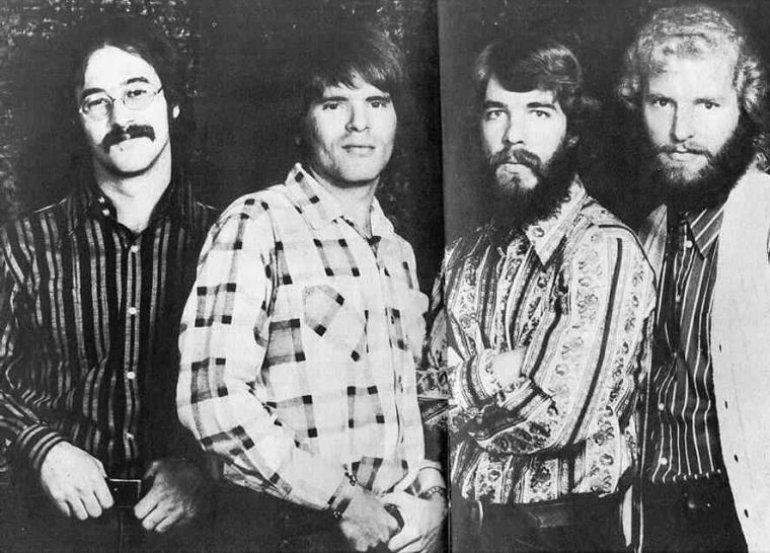
Long before Creedence Clearwater Revival became the sound of American urgency and riverbank myth, “Gloomy” caught John Fogerty in an earlier, more shadowed moment of becoming.
When Creedence Clearwater Revival released their self-titled debut album in 1968, the record arrived before the run of career-defining hits that would soon make the band feel almost inevitable. That first album still carried traces of transition: the group had only recently shed the long, awkward history of their earlier identity as The Golliwogs, and the new name suggested rebirth before the wider public had fully caught up. Inside that debut, among commanding interpretations of “Susie Q” and “I Put a Spell on You,” one track quietly matters for a different reason. “Gloomy” was an early John Fogerty original, and in its mood, structure, and pressure, you can hear a songwriter beginning to define the world only he could build.
That is what makes “Gloomy” so revealing. It is not the polished statement of a band already certain of its legend. It is the sound of direction hardening. The song belongs to a moment when Fogerty was still sorting through the residue of garage rock, rhythm and blues devotion, and the darker edges of late-1960s studio atmosphere. Yet even in that formative state, the instincts that would soon shape Creedence are already there: compression instead of excess, tension instead of drift, and a voice that sounds less interested in ornament than in pressure. Where many bands of the era were stretching outward, CCR often pulled inward, making their records feel tighter, more immediate, and somehow more physical.
“Gloomy” lives in that compressed space. The title itself promises a mood rather than a narrative spectacle, and the track follows through with a sense of unease that never has to announce itself loudly. This is one of the reasons early Fogerty is so compelling. He did not need grand declarations to create atmosphere. Even before he reached the sharper songwriting identity heard on later records, he understood how a song could feel thick with weather. The emotional tone of “Gloomy” is not theatrical sadness; it is closer to confinement, to the dim feeling of a room with no breeze in it, to a restlessness that has not yet found its full language.
Musically, the track sits in that fascinating borderland between the band’s past and future. There are echoes of the era’s psychedelic coloring, but Creedence Clearwater Revival never sounded fully at home in the ornamental side of psychedelia. Even early on, they were leaner than that. Their strength came from rhythm, attack, and a kind of muscular directness. “Gloomy” still carries some of the murkier studio texture that marked the late 1960s, but it also points toward the stripped-down force that would soon define albums like Bayou Country and Green River. Listening now, you can hear Fogerty testing how much darkness can be held inside a short, driving rock performance without losing shape.
That matters because “Gloomy” reminds us that John Fogerty did not simply arrive as the fully formed writer of later classics. He built that authority step by step. The debut album catches him before the full swamp-rock mythology settled around the band, before the headlines, before the familiar run of songs that would become part of the American bloodstream. In “Gloomy,” he is already reaching for something unmistakably his, but he is doing it in public, on record, before the style had become canon. There is something moving in that. Great artists are often remembered for the moment they crystallize, but the earlier moments, when the edges are still visible, can tell us more.
It also helps explain why the 1968 debut remains more than a preface. It is a document of assembly. Creedence Clearwater Revival were not a band chasing fashionable excess from the center of the San Francisco scene; they stood a little apart from it, more interested in discipline than sprawl. “Gloomy” reflects that separation. It is moody, yes, but not indulgent. It does not wander in search of revelation. It keeps moving, and that forward motion would become one of the group’s deepest strengths. Even at their most atmospheric, CCR rarely lost the feeling of wheels on the road.
For listeners returning to the debut album after years of knowing the bigger songs, “Gloomy” can feel like a small but meaningful doorway. It does not announce itself as a cornerstone. It does something more intimate than that. It lets you hear John Fogerty before the myth was complete, while the language of his songwriting was still tightening into focus. You hear a young writer leaning toward the sounds that would later define him: tension, economy, grit, and the ability to make emotional weather feel physical.
That is why the song lingers. Not because it towers over the catalog, but because it reveals the catalog in embryo. In “Gloomy,” the future Creedence Clearwater Revival is not fully formed, but it is absolutely present. The shadows are still thick, the identity still settling, and maybe that is precisely what gives the track its fascination. It is the sound of a band not yet standing on its own mountaintop, but already walking toward it with unmistakable purpose.
