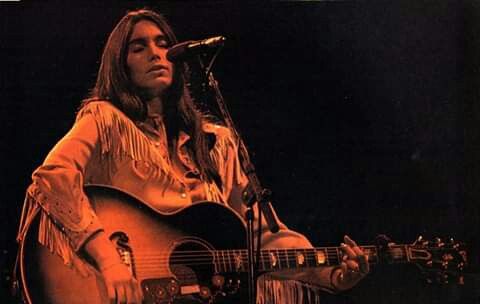
“Making Believe” still starts arguments because Emmylou Harris did not merely revive an old country standard—she lifted it into a different light, so pure and piercing that many listeners began asking the dangerous question every great cover invites: did she sing it best of all?
Few songs in classic country carry the kind of history that clings to “Making Believe.” Written by Jimmy Work, it first became a hit in 1955, when Work’s own version reached No. 5 on Billboard’s country jukebox chart. Then came Kitty Wells, whose version climbed to No. 2 and stayed there for an extraordinary 15 weeks, blocked from the top only by Webb Pierce’s long-dominant “In the Jailhouse Now.” In other words, before Emmylou Harris ever touched it, “Making Believe” was already old-school country scripture: a wounded, plainspoken song about pretending love still lives where it plainly does not. That is exactly why her version still provokes debate. She was not covering a forgotten curio. She was stepping into sacred territory.
When Emmylou Harris recorded “Making Believe” for Luxury Liner, released in January 1977, she was working from strength, not nostalgia. The album became her second straight No. 1 country album, and the single rose to No. 8 on the U.S. country chart. The recording itself was first cut on August 9, 1976, which places it right in the period when Harris was refining the sound that made her one of country music’s most revered interpreters: rooted in tradition, yet lifted by a kind of eerie grace that belonged unmistakably to her. She was not trying to out-honk-tonk Kitty Wells, nor to modernize the song beyond recognition. She was doing something subtler—keeping the heartbreak intact while changing the emotional weather around it.
That is where the debate begins in earnest. If one believes the ultimate version of a country song should sound closest to the jukebox, the barroom, the crying steel guitar, and the hard floor of 1950s pain, then Kitty Wells will remain the queen of “Making Believe.” Even the Country Music Hall of Fame describes her classic records as emotional dramas carried by her plaintive voice and crying steel, and “Making Believe” sits firmly in that lineage. Hers is the version of the song that seems to have lived through the hurt in real time. It has the authority of first great arrival—the sound of a record finding the American heart before anyone else knew just how deep it would go.
But Emmylou Harris changed the terms of the song’s survival. She did not sing “Making Believe” like a woman trapped inside the moment of loss. She sang it with distance, poise, and devastating clarity—as though time had passed, but the wound had not healed quite enough to stop glowing. That is one of Harris’s rarest gifts as a vocalist. She could sound both earthly and spectral, as if she were standing in the old country tradition and just slightly above it at the same time. On “Making Believe,” that quality turns sorrow into something almost luminous. The performance is not less painful than Wells’s. In some ways it is more painful, because it is so composed. The ache does not spill. It hangs in the air.
And that is why people still ask whether this was the ultimate cover. Not because Harris erased the song’s past, but because she proved how much more the song could hold. By the time she recorded it, “Making Believe” had already been covered many times, and it would continue to be covered afterward by artists including Merle Haggard, Loretta Lynn and Conway Twitty, and many others. Yet Harris’s version became one of the few later recordings strong enough to enter the argument rather than merely pay tribute. Even the song’s broader cover history shows how unusual that is: many artists revisit standards, but very few deliver a version that forces listeners to reconsider the hierarchy.
There is also a larger old-school country argument underneath this one. What should a great country cover do? Should it preserve the song’s original social setting and vocal manner, as though honoring a relic? Or should it reveal some hidden layer in the writing that earlier versions only hinted at? Emmylou Harris belongs to that second tradition. Throughout her career, she treated country songs not as museum pieces but as living texts. On Luxury Liner, that instinct is everywhere, and “Making Believe” benefits from it enormously. The result is a performance that sounds reverent without sounding dutiful—traditional, yes, but never embalmed.
My own judgment is that the debate survives because both sides have a real case. Kitty Wells made “Making Believe” canonical. Without her, there may be no debate at all. But Emmylou Harris made it eternal in a different way. She took a country standard already rich with hurt and sang it with such purity, such self-command, and such haunted beauty that the song seemed to leave the jukebox and enter the realm of legend. That does not automatically make it the “ultimate” cover. It does make it one of the very few covers worthy of that question. And in old-school country, that may be the highest compliment of all.
